 Seattle Siding
 Ballard's Exterior Climate Is Tougher Than It Looks
Ballard sits close to Puget Sound and the Ship Canal, which means homes here deal with a combination of weather stresses that inland Seattle neighborhoods don't feel as sharply. There's salt-laced marine air blowing in off the water, long stretches of driving rain through fall and winter, and the kind of persistent damp shade on north- and west-facing walls that keeps moss and algae growing for most of the year. None of this is dramatic weather in the way a hailstorm or a hard freeze is dramatic. It's slower and steadier, and that's exactly what makes it hard on siding — the damage shows up gradually, as paint failure, soft trim, or a wall that never quite dries out between rain events.
Add in Ballard's housing stock — a mix of older craftsman bungalows, mid-century houses, and a growing number of infill builds and ADUs on tight lots — and you get a wide range of exterior conditions on the same block. Some houses have decades of old paint layers and original wood trim; others are newer builds where the siding choice was made on a budget line item rather than a 30-year weather forecast. We work with both, but the climate conversation is the same regardless of the house's age: whatever goes on the walls has to handle sustained moisture and salt air without becoming a maintenance project every couple of years.
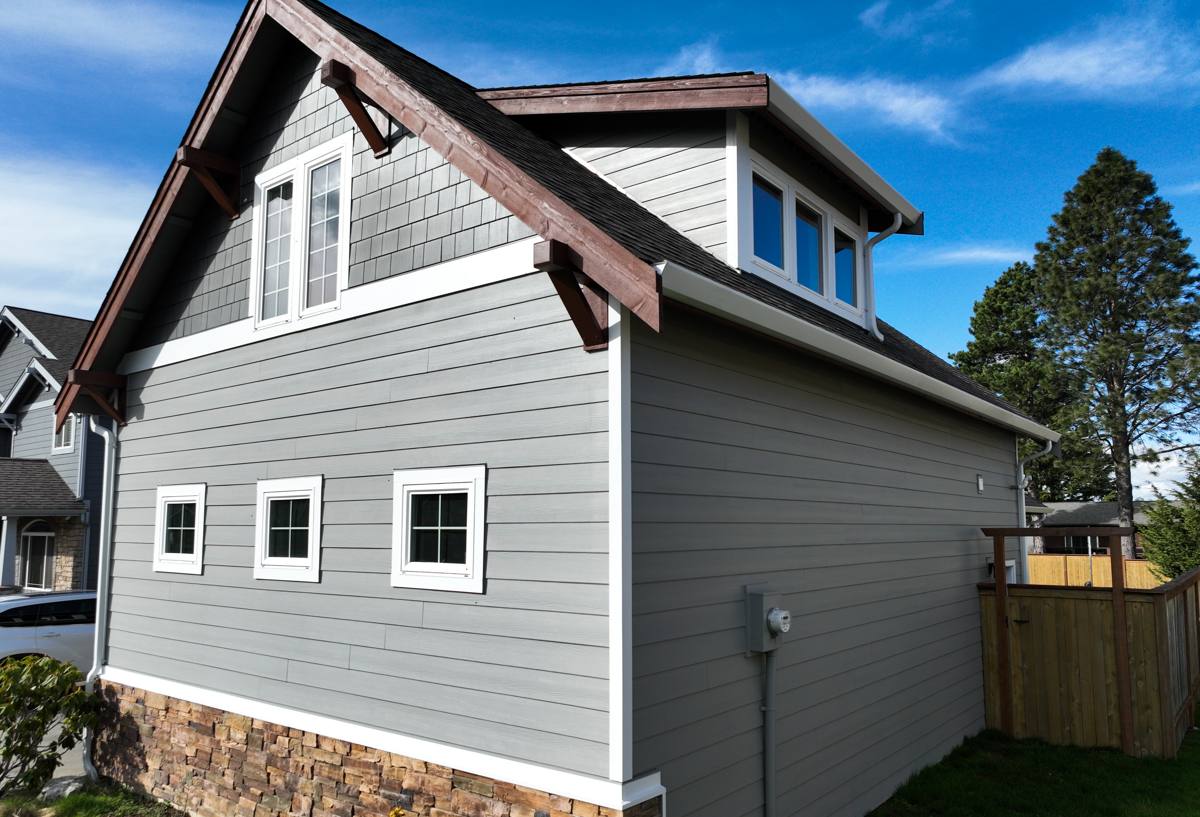
Why We Install Only James Hardie Fiber Cement
We made a decision as a company to install James Hardie fiber cement siding exclusively — not vinyl, not LP SmartSide, not Cemplank or Allura, not primed spruce or cedar. That's not a marketing angle; it's a standard we hold because of what we've seen play out on real exteriors in exactly this kind of maritime climate. Fiber cement is fundamentally a cement-and-cellulose composite, which means it doesn't absorb and hold water the way wood-based products can, and it doesn't expand and contract with temperature swings the way vinyl does. In a climate where a wall can stay damp for days at a time in winter, that difference matters more than it does in a drier region.
James Hardie also engineers specific product lines for different climate zones, and the Pacific Northwest falls into their wetter-climate (HZ5) engineering category. That means the plank composition, moisture resistance, and installation specifications are built around exactly the conditions Ballard sees — not a generic national spec. We're not choosing Hardie because it's the only fiber cement brand that exists; we're choosing it because the combination of climate-specific engineering, a factory-applied finish, and a strong transferable warranty is the best match for what King County weather actually does to a house over 20-30 years.
What "Climate-Engineered" Actually Means
In practice, HZ5 engineering shows up in the plank formulation and the installation requirements — things like recommended fastener patterns, minimum clearances above grade and roofing, and flashing details around windows and doors. None of that is exotic, but it's the sort of detail that separates siding that performs for decades from siding that starts failing at the seams within a few years. It's also why installation quality matters as much as the product itself, which we get into below.
What We Actually See on Ballard Siding Jobs
A few patterns show up often enough on Ballard homes that they're worth mentioning directly:
- Moss and algae staining on shaded north and west walls, especially under eaves or near mature trees, where surfaces stay damp longer
- Paint and caulk failure on older wood siding and trim, usually where sun exposure is low and drying time between rain events is short
- Soft or delaminating trim boards around windows and at butt joints, where water has been getting behind the surface for a while before it becomes visible
- Salt-air related finish breakdown on homes closer to the water, where painted or lower-grade finishes wear faster than they would further inland
- Gaps and caulk cracking at siding-to-trim transitions, often from original installation that didn't account for how much this climate moves and settles a house over time
None of these are unusual or a sign of a badly built house — they're just what steady marine-climate exposure does to exterior materials over years. The point of choosing the right siding system, and installing it correctly, is to push that timeline out from a handful of years to multiple decades.
James Hardie Product Lines We Work With
Hardie's product lineup gives us options for different house styles without stepping outside the fiber cement standard we've committed to:
| Product | Typical Use | Notes for Ballard Homes |
|---|---|---|
| HardiePlank lap siding | Most common siding profile, various textures | Fits craftsman and mid-century homes well; smooth or cedar-textured finish options |
| HardieShingle | Shingle-style accent or full siding | Common on craftsman gable ends and accent details |
| HardiePanel | Vertical panel siding | Used on modern infill builds and ADUs common in Ballard |
| HardieTrim | Window, corner, and fascia trim | Fiber cement trim to match, rather than pairing with wood trim that weathers differently |
Most of these are available with Hardie's ColorPlus factory finish, which is baked on and warranted separately from the substrate rather than a field-applied paint job. In a climate where repainting is a real recurring cost, that factory finish is a meaningful part of why we recommend it over site-painted alternatives.
Correct Installation Matters as Much as the Product
Fiber cement siding is only as good as the installation behind it. A lot of the failures we get called out to inspect on other companies' work trace back to installation shortcuts, not the product itself — gaps left too tight, fasteners placed wrong, or flashing details skipped around windows and roof lines. In a climate that gives water this many chances to find a way in, those details aren't optional extras.
What Proper Installation Includes
- Correct clearance between siding and grade, decks, roof lines, and other horizontal surfaces
- Proper flashing and integration at windows, doors, and any wall penetrations
- Manufacturer-specified fastener type, spacing, and placement
- A drainage plane and house wrap installed to let any incidental moisture escape rather than get trapped behind the siding
- Correctly sealed and caulked joints, sized for how much the assembly will move seasonally
This is also where a crew's familiarity with Seattle-area homes pays off. Older Ballard houses often have wall assemblies, sheathing, or framing quirks that a generic install crew from outside the region may not anticipate — a local crew that's worked on a range of Ballard housing stock knows what to check for before the new siding goes up.
Siding Doesn't Work in Isolation
We handle siding, roofing, windows, and decks, and on a lot of Ballard projects those systems overlap more than homeowners expect. Roof edge flashing affects how water sheds onto the top course of siding. Window replacement changes the flashing details siding has to tie into. A deck built tight against the house wall changes clearance requirements for the siding above it. When one contractor is coordinating all of it, those transitions get built correctly the first time instead of becoming the gap where water gets in three years later — which is often exactly where we find problems on inspection.
What Affects the Cost of a Ballard Siding Project
Every house is different, but a few factors consistently drive cost on siding projects in this neighborhood:
| Factor | Why It Matters |
|---|---|
| Existing siding removal | Tear-off and disposal of old wood or other siding adds labor and dump costs |
| Sheathing and moisture damage | Rot found once old siding comes off has to be repaired before new siding goes on |
| House complexity | Gables, dormers, multiple stories, and detail trim take more time than a simple rectangular wall |
| Product selection | Plank profile, texture, and ColorPlus finish choice affect material cost |
| Access and lot constraints | Narrow Ballard lots, alleys, and close-set neighboring houses can affect staging and scaffolding |
We won't quote a number without seeing the house, but these are the variables that move a project up or down in price, and we'll walk through them plainly during an estimate rather than leaving them as a surprise later.
Why a Local Crew Is Worth Insisting On
Siding work in Ballard isn't the same job as siding work in a drier or more sheltered part of King County. A crew that installs here regularly knows how much clearance to leave, how the moss and shade patterns on a given lot behave, and how to sequence a job around the rain rather than fighting it. That local pattern recognition is hard to replace with a generic national install standard, which is part of why we treat Hardie's HZ5 specifications as a floor, not a ceiling, on how we detail a project.
Before hiring anyone for exterior work in this neighborhood, it's worth asking:
- Are they licensed and insured to work in Washington State?
- Do they install James Hardie as manufacturer-certified applicators, or as a side product alongside vinyl and other materials?
- Will they put the flashing and clearance details in writing, not just the siding brand?
- Do they coordinate siding with roofing, window, and deck work, or hand you off between separate trades?
- Can they explain, specifically, how the design accounts for Ballard's rain and shade patterns on your particular lot?
A contractor who can answer those clearly, without hedging, is one who's actually thought about the climate — not just the sale.
Ready to Talk Through Your Home
If your Ballard home has moss buildup, failing paint, soft trim, or siding that's simply reaching the end of its service life, we're happy to take a look and talk through what James Hardie fiber cement would mean for your specific house — no pressure, no obligation. Fill out the form below and we'll set up a free estimate.