 Seattle Siding
 Framing the Decision Correctly
Most homeowners start this comparison by asking "which siding is better?" That's the wrong first question. The better first question is "which siding is built for what my walls actually face?" A house in Ballard a few blocks from Puget Sound, a house tucked under fir trees in Shoreline, and a house on an open lot in Kent all deal with different combinations of wind-driven rain, salt-laden air, and shade-driven moss growth — but all three sit inside the same general King County marine climate, and that climate is the real variable driving this decision, not brand preference.
We install James Hardie fiber cement exclusively and don't offer vinyl as an alternative. This page isn't trying to talk you out of vinyl by exaggerating its downsides — it's trying to lay out, plainly, how the two materials actually differ so you can weigh the decision the same way we did before we standardized on one product.
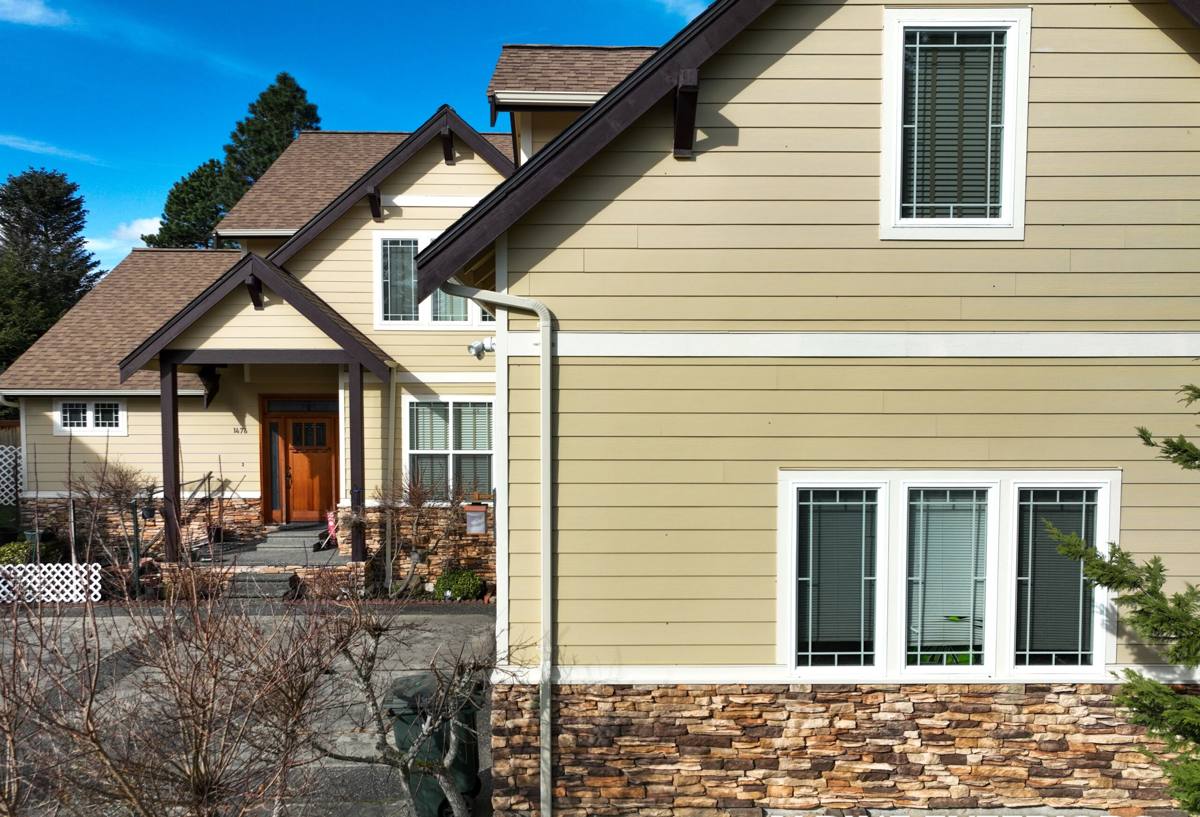
What Each Material Is, at the Material Science Level
Vinyl
Vinyl siding is extruded PVC plastic, formed into panels with a locking profile and colored all the way through the material rather than painted on the surface. That through-body color is genuinely one of vinyl's better features — a scratch doesn't reveal a different color underneath. But PVC is a petroleum-based plastic, and like most plastics it responds to temperature swings by expanding and contracting more than a mineral-based product would, and it becomes noticeably more brittle in cold weather.
James Hardie Fiber Cement
James Hardie siding is a composite of Portland cement, ground sand, and cellulose fiber, formed under pressure and cured. It behaves more like a dense masonry product than a plastic or a wood product — dimensionally stable across temperature swings, resistant to impact when installed correctly, and non-combustible. It's finished either with a factory-applied ColorPlus coating or field-applied paint, rather than color running through the board itself.
Neither description tells you which is "better" in the abstract. What matters is how each behaves once it's installed on an exterior wall in a climate that stays wet for months at a stretch.
The Four Questions That Actually Decide This for Most Seattle Homeowners
1. How exposed is your home to wind-driven rain?
Homes on open lots, elevated sites, or anywhere with a clear path for weather coming off the Sound take a harder hit from sideways rain than homes tucked between neighboring houses or behind a wind break. Wind-driven rain is what pushes moisture past loose seams and into wall assemblies, which affects lap and panel-based products like vinyl more than a product with tighter, better-sealed joint detailing.
2. How much shade and moisture does your lot hold onto?
North-facing walls, tree cover, and homes built close together all slow down drying time. In King County that can mean a wall surface stays damp for days after a storm rather than hours. That's the exact condition moss and algae need, and it affects the finish and appearance of any siding material, though the two materials show that wear differently.
3. How long do you plan to own the home?
If you're re-siding a home you plan to sell in three to five years, the calculation is different than if you're re-siding a forever home. Fiber cement's longer lifespan and stronger resale recognition matter more the longer the ownership horizon; vinyl's lower upfront cost matters more if you're optimizing for a shorter hold.
4. What's your tolerance for maintenance versus upfront spend?
Every siding material needs some upkeep. The honest question isn't "which one is maintenance-free" — neither is — it's whether you'd rather pay more upfront for a system engineered to need less attention over time, or less upfront and accept more maintenance and a shorter service life.
Vinyl in Seattle's Climate: The Honest Version
Vinyl's real advantages are real: lower material cost, faster installation labor, no field painting, and a wide range of colors and profiles. On a budget-driven project, or a home with simple wall planes and good weather exposure, vinyl can be a defensible choice, and there are contractors in this region who install it competently.
Where it struggles here specifically comes down to three things. First, vinyl panels rely on overlapping laps and a drainage plane rather than a sealed surface, so wind-driven rain has more opportunities to get behind the panel than it would with a product installed with sealed joints and factory-applied trim detailing. Second, vinyl's surface texture and lower surface temperature in shaded areas make it a comfortable substrate for moss and algae, and because vinyl's color is baked into the plastic rather than a separate finish coat, there's no way to simply recoat it if it fades or chalks — the whole panel run has to be replaced to fully restore the original look. Third, vinyl becomes more brittle in cold weather, so impact damage — a ladder, a thrown branch, hail — tends to crack rather than dent, and color-matching a years-old, sun-faded panel to a new replacement one is close to impossible.
James Hardie in Seattle's Climate: What "Climate-Engineered" Means in Practice
James Hardie produces regional product formulations, and the HZ5 line is engineered specifically for cold, wet climate zones like ours — it's built to handle moisture cycling without the swelling, cupping, or rot risk that affects wood-based siding, and without the expansion and contraction that affects vinyl. The board itself is dense enough to resist moss and algae staining better than a plastic surface, though it still needs periodic gentle washing like any exterior surface exposed to King County's wet season.
The ColorPlus factory finish is a separate consideration from the substrate itself. It's a baked-on finish applied under controlled conditions, and it carries its own finish warranty apart from the warranty on the fiber cement board underneath — two different guarantees covering two different failure modes, which is worth understanding when you're comparing warranty paperwork side by side.
A 30-Year Cost Perspective
Upfront price is only one part of the real cost. Here's how the two materials tend to compare over a longer ownership window, based on typical maintenance and replacement cycles rather than any specific project quote:
| Cost Factor | Vinyl Siding | James Hardie Fiber Cement |
|---|---|---|
| Upfront material and installed cost | Generally lower | Generally higher |
| Typical service life, installed correctly | Roughly 20-30 years | Roughly 30-50+ years |
| Refinishing needs | None possible — color is through-body; fading means replacement | ColorPlus finish rated for long-term color retention; field-painted boards can be repainted |
| Moss/algae cleaning | Needed periodically; more visible on shaded walls | Needed periodically; finish holds up to gentle washing |
| Damage repair | Cracked panels hard to color-match once faded | Repairs blend more predictably, especially with factory finish |
| Warranty structure | Often prorated; payout shrinks over time | Longer-term, transferable substrate warranty; separate finish warranty |
| Resale recognition | Considered a standard, budget-friendly upgrade | Widely recognized by buyers and appraisers as a premium, durable choice |
Fire, Insurance, and Resale — the Less-Discussed Factors
Two considerations often get left out of siding conversations entirely. The first is combustibility: fiber cement is non-combustible, while vinyl can melt or deform under heat exposure, which is a relevant difference to raise with your insurance agent, particularly as Washington summers have brought more wildfire smoke and regional fire risk into homeowners' planning in recent years. The second is resale. Appraisers and buyers in this market increasingly recognize fiber cement, and James Hardie specifically, as a premium, long-life exterior — it's a detail that can show up in a home inspection report or a listing description in a way that vinyl typically doesn't.
Common Mistakes Homeowners Make When Comparing Quotes
- Comparing a vinyl quote to a Hardie quote purely on total price, without adjusting for the 10-20 year difference in expected service life
- Not asking whether a warranty is full-value or prorated — a prorated warranty can look generous on paper and pay out very little a decade in
- Assuming "fiber cement" is one product — quality, product line, and factory finish vary between manufacturers, and not every fiber cement product carries the same climate engineering
- Not asking how the crew plans to handle flashing and clearance details, since both materials fail at the installation details, not just the material choice
- Choosing based on a sample board indoors rather than seeing how a finish and color actually reads on a shaded, rain-exposed King County wall
A Practical Checklist Before You Decide
- Walk your own property and note which walls get direct wind-driven rain and which stay shaded and damp longest
- Ask how long you realistically plan to own the home
- Get the full warranty document, not just the sales sheet, for any product you're considering
- Ask any contractor for their specific installation experience with the exact product, not just "siding" broadly
- Price the project as installed cost divided by expected service life, not just as a single upfront number
Why We Only Install Hardie
We didn't arrive at a single-product standard casually. After years of repairing water damage behind failed siding across Seattle and King County, the pattern was consistent enough that we stopped offering products that didn't hold up to the conditions we kept finding behind walls. James Hardie's HZ5 formulation, the ColorPlus finish, the non-combustible material, and a warranty that actually transfers to a future owner all matched what this climate demands. We'd rather install one system exceptionally well than spread our crews' expertise across several products.
If you're weighing vinyl against fiber cement for your own home, we're glad to walk the exterior with you, point out which walls face the toughest exposure, and put together a straightforward, no-pressure estimate for a correctly installed Hardie system.