 Seattle Siding
 Why the Color Decision Is Bigger Than It Looks
Most homeowners treat siding color like a paint chip decision — pick something you like, move on. On a fiber cement job, that's a mistake. The color you choose isn't a coat of paint sitting on top of the board; with James Hardie ColorPlus siding, it's baked into the product before it ever reaches your house, and it's tied directly to the manufacturer's warranty. Get the color conversation wrong and you're not just stuck looking at a shade you don't love — you may also be signing up for touch-up work, uneven fading, or a warranty that doesn't cover what you assumed it would.
Factory Finish vs. Field-Applied Paint
There are two ways fiber cement siding gets its color: factory-applied (baked on before installation) or field-applied (primed at the factory, then painted on-site after the boards go up). These are fundamentally different products in terms of durability, and understanding the difference is the whole reason ColorPlus exists as a separate line rather than just "Hardie siding, any color."
How ColorPlus Technology Actually Works
ColorPlus is a multi-coat baked-on finish applied to Hardie boards at the factory, under controlled temperature and humidity, then cured before the boards are boxed and shipped. That process matters because paint adhesion and durability depend heavily on the conditions during application — something you can't fully control on a ladder in Seattle in October.
The Cure Process
Each board goes through multiple coating and baking cycles. The result is a finish that's more uniformly bonded to the fiber cement substrate than a field-applied coat, which has to adhere to a factory primer under whatever weather shows up on installation day — including the damp, cool conditions that are common here more months than not.
The Warranty Tied to the Finish
James Hardie backs ColorPlus finishes with a separate finish warranty from the substrate warranty (the fiber cement board itself). That's worth understanding upfront: the board warranty and the finish warranty are not the same document, and if a contractor field-paints a primed board instead of using a ColorPlus color, that separate finish warranty doesn't apply — you're relying on whatever the painter or paint manufacturer backs, which is a different, usually shorter, promise.
The Seattle Color Palette: What Actually Reads Well Here
Puget Sound light is different from what you get in Phoenix or Denver — more diffuse, more gray-sky days, more moisture in the air softening contrast. Colors that look sharp and saturated on a sunny showroom sample can read flat or muddy under our typical cloud cover, and colors that look "too dark" on paper often look right once they're up against wet evergreens and gray skies for eight months of the year.
| Color Family | How It Reads in Seattle Light | Common Pairing Notes |
|---|---|---|
| Deep charcoal / black-based | Reads crisp and modern, but shows moss and pollen streaking faster on north-facing walls | Pairs well with black-framed windows and metal roofing |
| Warm gray / greige | Holds up well under overcast light, doesn't shift blue or green the way some cool grays do | Works with wood-tone accents, common on craftsman remodels |
| Cream / soft white | Brightens a lot on our gray days, but shows algae and dirt streaking soonest of any family | Needs the most consistent gutter and roof-wash maintenance |
| Deep blue / slate | Reads well against Douglas fir and cedar backdrops, common in wooded King County lots | Complements natural wood trim and stone accents |
| Muted green | Blends into tree cover rather than standing out — a deliberate choice on wooded lots | Best paired with a lighter trim color for contrast |
None of these are "wrong" choices — the table is about trade-offs, not rankings. A dark charcoal house on a shaded, tree-covered lot in the Central District will need more attention to moss and algae than the same color on an open, sun-exposed lot in Ballard.
Matching Color to Seattle's Housing Stock
Seattle's neighborhoods run through a real mix of eras and styles, and color choice should follow the house, not just personal taste.
Craftsman and Early 20th-Century Homes
These houses were often built with visible shingle or lap siding and heavier trim details. Warm neutrals, muted greens, and deep reds tend to sit naturally with the proportions and trim work common on these homes, without fighting the architecture.
Midcentury Ranch and Split-Level
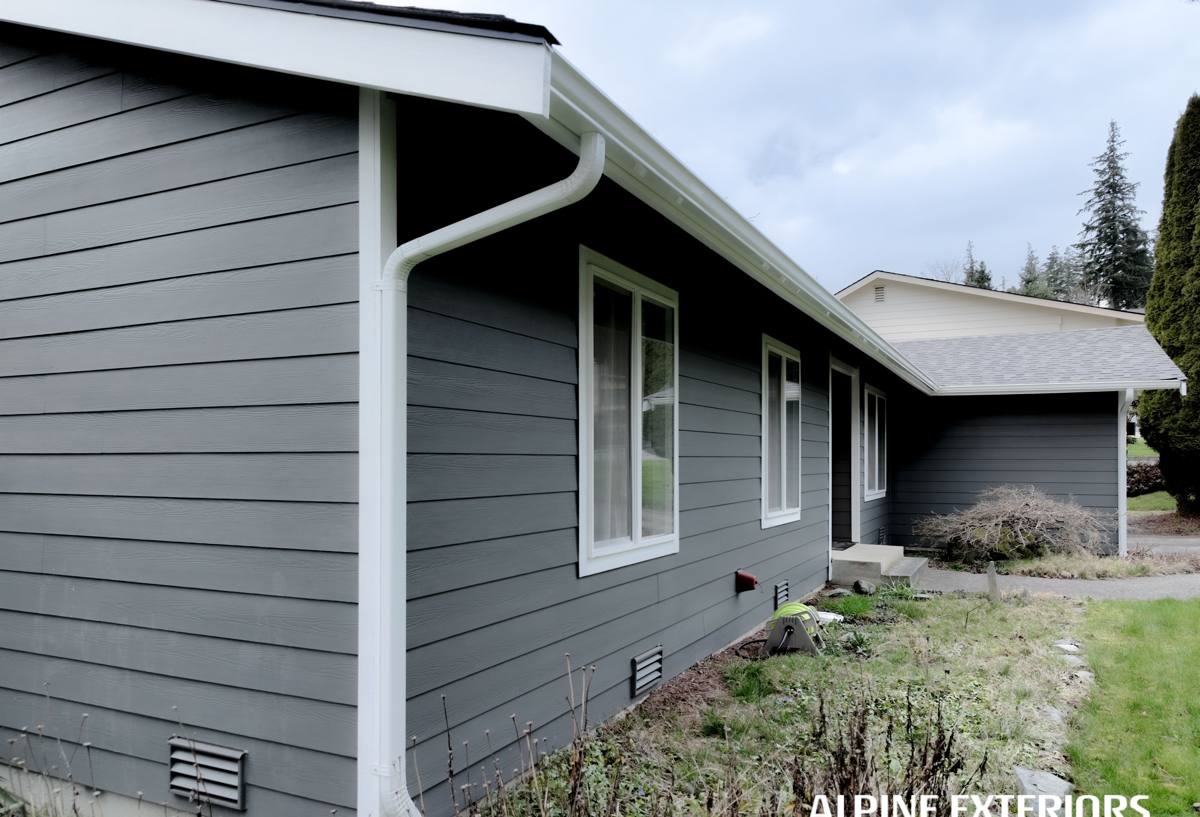
Horizontal lap siding in a warm gray or soft charcoal generally reads well against the low rooflines and horizontal window bands typical of this era, especially with a contrasting trim color to define the roofline.
New Construction and Modern Infill
Board-and-batten or mixed-panel installations in near-black or deep charcoal have become common on newer builds around the city. It's a striking look, but it's also the combination that shows moss and water streaking fastest, so it comes with the highest maintenance expectation of any palette on this list.
Salt Air, Driving Rain, and Moss: The Three Things That Test a Finish Here
King County's climate isn't brutal in the way hail or extreme freeze-thaw cycles are brutal elsewhere, but it's relentless in its own way, and that has real implications for color.
Salt Air Near the Sound
Homes closer to Puget Sound and Elliott Bay deal with airborne salt that can accelerate finish breakdown and hardware corrosion over time. A baked-on finish with consistent coating thickness holds up to that exposure more evenly than a field-applied coat, which is more likely to have thin spots at cut edges and fastener heads.
Driving Rain and Wind-Driven Moisture
Seattle doesn't get the heaviest rainfall totals in the country, but it gets a lot of sideways, wind-driven rain, especially on exposed west- and south-facing walls. That kind of exposure tests not just the color coat but the caulking and flashing details around every joint — which is an installation issue as much as a color one, but the two are connected: a poorly sealed joint on a dark-colored board shows staining and streaking faster than the same flaw on a lighter color.
Moss Season
Between the shaded, tree-heavy lots common across the city and the long stretch of wet months, moss and algae growth on siding is close to unavoidable somewhere on most homes — usually on north-facing walls and anywhere overhung by trees. Darker colors show this growth sooner visually; lighter colors hide it longer but show dirt streaking sooner. There's no color that avoids the issue entirely — it's a maintenance conversation, not a paint-chip conversation.
ColorPlus vs. Field-Painted Fiber Cement: What It Costs Over Time
Some fiber cement is sold primed only, with painting left to the installer or a separate painting contractor. It's a legitimate approach some homeowners choose for a lower upfront number, but it shifts real costs and risk downstream.
| Factor | ColorPlus (Factory Finish) | Field-Applied Paint on Primed Board |
|---|---|---|
| Upfront cost | Built into the material cost, no separate paint labor | Lower material cost, but adds a painting labor line item |
| Finish warranty | Separate factory finish warranty backing the color coat | Typically only whatever the paint manufacturer or painter offers, if anything |
| Repaint cycle | Often stretches well beyond a decade before touch-up is needed | Field paint on siding generally needs repainting on a shorter cycle, especially in a wet climate |
| Weather dependency at install | None — finish is already cured before installation | Paint quality depends on temperature and humidity on install day, a real constraint here |
| Long-term cost | Lower lifetime cost once repaint cycles are factored in | Higher lifetime cost due to recurring repaint labor |
This is the core reason this company standardized on ColorPlus rather than installing primed-and-painted fiber cement: the upfront savings on a field-painted job tend to get eaten up, and then some, by repaint labor over the life of the siding — and that's before accounting for the coverage gap on the finish itself.
HZ5 and Why the Product Line Matters Here
James Hardie engineers its products by climate zone, and the Pacific Northwest falls into the HZ5 category — formulated for regions with significant moisture exposure. That engineering affects moisture management and durability, but it's separate from the color question: the HZ5 substrate is what the color coat sits on top of, and getting both right — the right climate-engineered board with the right factory finish — is what the ColorPlus system is built around. Choosing a color without accounting for the underlying product line, or vice versa, misses half of what makes the system work.
What Correct Installation and Color Care Involves
A great color choice on a poorly installed job will still fail early — gapped joints, unsealed cuts, and fasteners driven wrong all show up as staining or finish damage regardless of the shade. A few things worth confirming with any contractor before work starts:
- Cut edges and field-cut ends are sealed with a Hardie-approved touch-up product, not left raw
- Fastener spacing and depth follow Hardie's published installation guide for your specific product line
- Proper flashing and clearance are maintained at grade, roofline, and window/door openings
- Caulk color at joints and trim is matched to the ColorPlus color, not a generic off-white
- The installer can tell you which specific ColorPlus color and product line is going on the house, in writing, before the order is placed
On the color-care side, most ColorPlus finishes hold up with periodic gentle washing — a garden hose and soft brush for general dirt, with a mild detergent for moss and algae spots on shaded or north-facing walls. Pressure washing directly at the siding surface can force water behind joints and isn't recommended.
Getting the Color Decision Right the First Time
Ordering ColorPlus siding is a factory order, not a can of paint you can swap out next weekend if you change your mind. That's a good reason to look at large sample boards outdoors, at your own house, at different times of day, rather than relying on a small chip or a screen — Seattle's light shifts enough through the day and the seasons that a color needs to be judged in place, not in a showroom.
If you're weighing colors, product lines, or just want a straight answer on what a ColorPlus job would look like on your specific house, we're happy to walk the property with you and put together a free, no-pressure estimate.