 Seattle Siding
 Siding, Roofing, Windows, and Decks for Redmond Homes
Redmond sits on the Eastside of King County, wedged between Lake Sammamish and the foothills of the Cascades, and that geography shapes what a house here has to put up with year after year. Heavy tree cover, long wet stretches from fall through spring, and a marine-influenced climate that carries moisture and salt air in off Puget Sound all combine to put steady pressure on the exterior of a home. We work throughout the Eastside and understand what that combination does to siding, trim, roofing, and decking over time — and what it takes to build an exterior that actually holds up to it.
This page covers what Redmond homeowners tend to run into with their exteriors, how we approach siding, roofing, window, and deck work in this area, and why we standardized on one siding product instead of offering the usual lineup of options.
What Redmond's Climate Does to a House
Driving Rain and Wind-Driven Moisture
Redmond doesn't get the wind exposure of the immediate waterfront, but weather systems moving through the region still bring sustained, driving rain — the kind that doesn't just fall straight down but gets pushed sideways into wall assemblies, window flanges, and trim joints. Over years, that pattern finds every gap in flashing, every poorly caulked seam, and every siding product that wasn't designed to handle repeated wetting and drying.
Moss, Shade, and Slow-Drying Surfaces
Redmond's mature tree canopy is part of what makes the area attractive, but it also means a lot of homes sit in partial shade for large stretches of the day. Shaded, north-facing walls and roof planes stay damp far longer after a storm than sun-exposed ones. That extended dampness is exactly what moss and mildew need to establish, and it's harder on materials that absorb moisture than on materials that shed it.
Salt Air and Regional Humidity
Further inland than the immediate Sound shoreline, Redmond still sits within the broader Puget Sound air pattern, and that means homes here deal with persistent regional humidity even when they're not getting direct salt spray. Combined with the driving rain and shade, it adds up to an exterior environment that rewards materials engineered for the Pacific Northwest specifically, not just materials rated for "weather resistance" in general.
What This Adds Up To
- Wood-based and wood-composite sidings that swell, delaminate, or rot at cut edges and seams over time
- Paint and caulk failing faster on shaded, slow-drying wall sections
- Moss and algae staining that keeps coming back without ongoing maintenance
- Roofing and flashing details that need to actually shed water, not just resist it in ideal conditions
- Windows and trim that need tight, correctly flashed installation to avoid slow hidden moisture intrusion
Why We Only Install James Hardie Fiber Cement Siding
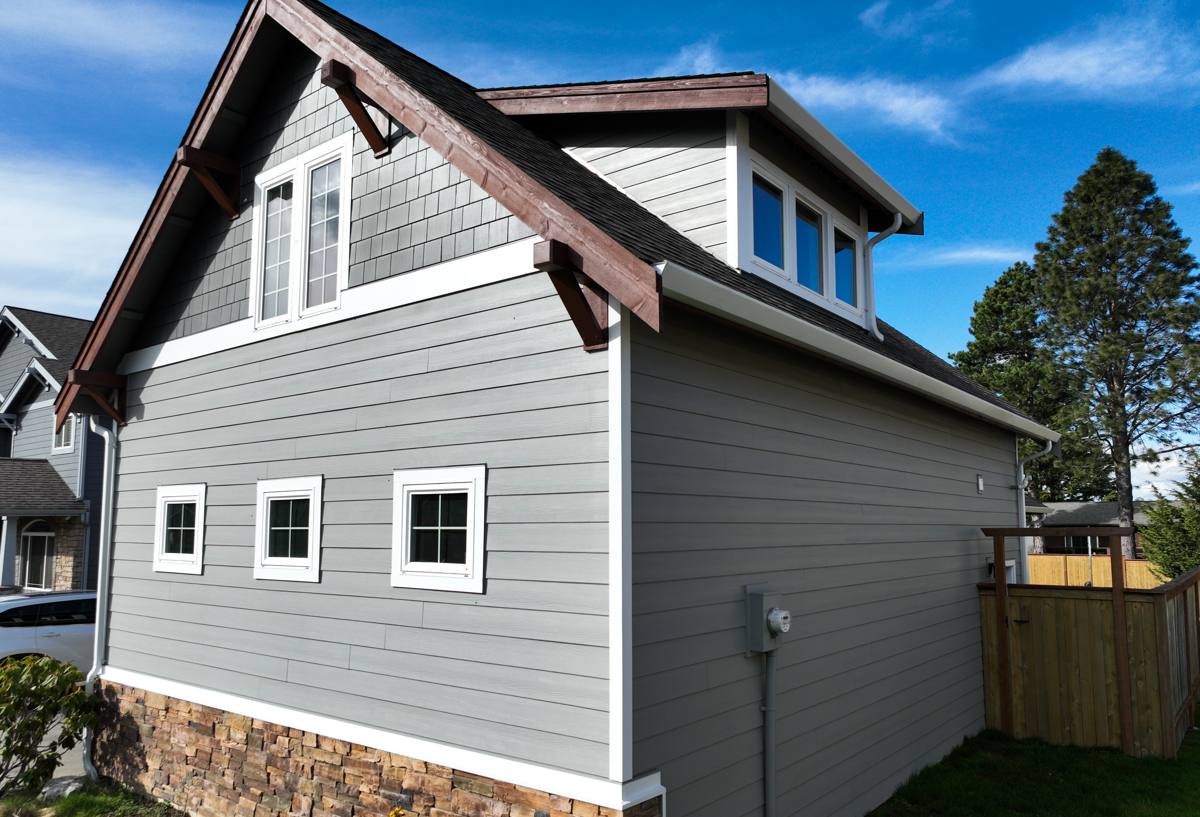
We get asked fairly often why we don't offer vinyl, LP SmartSide, or a primed wood product alongside Hardie. The honest answer is that we made a call as a company: we'd rather install one product extremely well and stand behind it, than offer a menu of options and let price alone decide which one goes on a house that has to survive Redmond winters for the next 30-plus years.
Fiber cement isn't magic — it's a mix of cement, sand, and cellulose fibers, engineered to be dimensionally stable and non-combustible. It doesn't absorb water the way wood-based products can, it doesn't expand and contract with humidity the way vinyl does, and it holds paint and factory finish far longer than primed wood siding typically does in this climate. James Hardie specifically manufactures HZ5 product engineered for the moisture and temperature patterns of the Pacific Northwest, which matters more here than it does in a drier climate.
What We're Not Saying
We're not telling homeowners that other siding products are junk. Vinyl is inexpensive and low-maintenance in mild climates. LP SmartSide is a legitimate engineered wood product with real fans. Cedar has a look people love. Each of those has real trade-offs in a climate like Redmond's — moisture sensitivity, seam and edge vulnerability, repainting cycles, or impact and fire performance — that we weren't comfortable installing and standing behind long-term. That's a professional standard we hold ourselves to, not a claim that every other product fails.
How Our Siding Process Works in Redmond
Assessment
We start by walking the exterior and looking specifically at how the house has aged: which walls show moss or staining, where paint or caulk has failed first, whether there's evidence of moisture behind the current siding, and how the roofline, gutters, and grading are managing water around the building. That tells us as much as the siding itself does.
Installation Standards
James Hardie siding performs the way it's rated to perform only when it's installed to the manufacturer's specifications — correct fastening, proper clearances, correctly lapped and sealed joints, and flashing details that actually direct water away from the wall assembly rather than trapping it. In a climate that gets as much sustained rain as Redmond does, installation quality matters as much as the product itself.
Finish and Color
We install Hardie's ColorPlus factory-finished panels, which apply the topcoat under controlled conditions rather than on-site. That finish is engineered to resist fading and to hold up to UV and moisture exposure significantly longer than field-applied paint, which reduces how often a homeowner has to think about repainting.
Roofing, Windows, and Decks: The Rest of the Exterior
Siding doesn't work in isolation — a roof that's shedding water poorly, windows that aren't properly flashed, or a deck that's trapping moisture against the house will undermine even the best siding job. We handle all four because they need to work together as one weather-resistant system.
Roofing
In a shaded, moss-prone area like Redmond, roof material and roof maintenance both matter. We look at ventilation, flashing at valleys and penetrations, and how well the current roof is managing the volume of rain and debris this area sees.
Windows
Old or poorly flashed windows are one of the most common sources of hidden moisture damage we find when we open up a wall during a siding project. Replacing windows at the same time as siding lets us verify and correct flashing details in one pass instead of two.
Decks
Decks in this climate take a beating from the same driving rain and shade that affects siding, plus standing moisture on horizontal surfaces. We build and repair decks with drainage and material choices suited to staying outside through Pacific Northwest winters.
Cost Factors to Expect
| Factor | Why It Matters in Redmond |
|---|---|
| Home size and wall complexity | More corners, dormers, and trim details mean more labor and flashing work |
| Extent of existing damage | Hidden rot or moisture behind old siding adds repair scope before new siding goes on |
| Tree cover and access | Mature landscaping common on Eastside lots can affect staging and cleanup |
| Siding profile and color | Lap, shingle, and panel styles carry different material and labor costs |
| Trim and accent work | Fascia, soffit, and trim replacement often makes sense to bundle with siding |
Why a Local Crew Matters
A crew that works this region regularly knows what shaded, tree-covered lots do to an exterior differently than an open, sun-exposed lot does. They know how much of a factor moss and slow drying really are here, and they don't have to guess at how James Hardie's HZ5 product should be detailed for this specific climate. That local familiarity shows up in fewer callbacks and an exterior that's actually built for the weather it's going to face, not weather from somewhere else.
Signs Your Redmond Home Needs Exterior Attention
- Moss or dark streaking on siding, especially on shaded or north-facing walls
- Paint that's peeling, bubbling, or chalking faster than it used to
- Soft spots, warping, or visible gaps at siding seams and corners
- Water stains or soft drywall near window and door openings
- Missing, curling, or moss-covered roof shingles
- Deck boards that stay damp long after rain has stopped, or visible rot at ledger boards
Get a Free, No-Pressure Estimate
If you're noticing any of the signs above, or you're just planning ahead for a home in Redmond that's due for exterior work, we're happy to take a look and give you a straight, honest assessment. There's no pressure and no obligation — just a clear picture of what your home needs and what it would cost to do right. Fill out the form below to get started.