 Seattle Siding
 Beacon Hill's Siding Problem Isn't Like Every Other Seattle Neighborhood
Beacon Hill sits on an exposed ridge south of downtown Seattle, and that elevation cuts both ways. Homeowners get views and better drainage off the hill than low-lying blocks get, but the same exposure means more wind-driven rain hitting walls at an angle, more direct weather off the water, and less tree cover shielding some stretches of the neighborhood than you'd find in denser, more wooded parts of King County. Add in a housing stock that mixes early-1900s bungalows with newer infill construction, and you get a neighborhood where siding has to handle two very different jobs: protecting century-old wall assemblies that were never built with today's moisture standards in mind, and keeping newer builds performing the way they were designed to.
Salt-tinged air off the Sound, driving rain that doesn't fall straight down here, and a moss season that can run most of the year all put steady stress on exterior materials. None of that is dramatic on any single day. It's cumulative — siding that looks fine in year one can be trapping moisture by year six if it wasn't installed correctly for this specific kind of exposure.
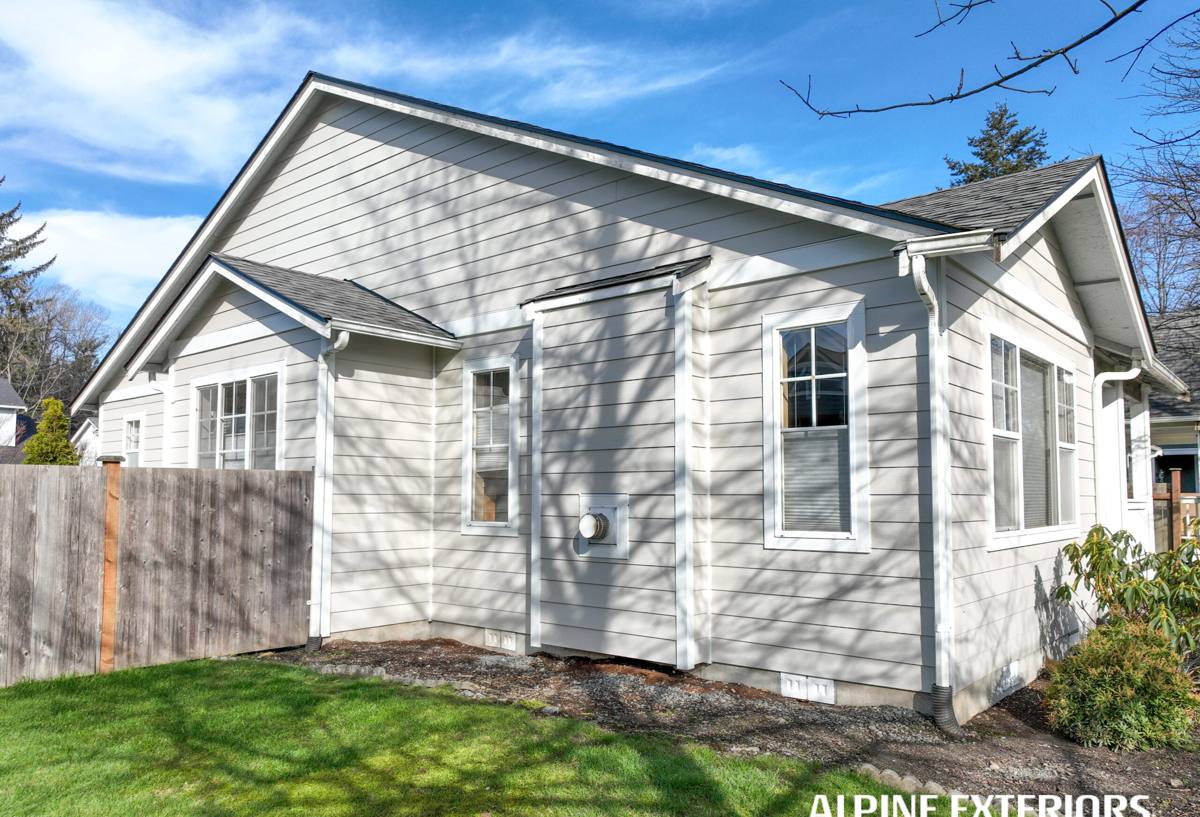
Why We Only Install James Hardie on Beacon Hill Homes
We don't install vinyl, LP SmartSide, cedar, or primed spruce, and Beacon Hill's climate is a big part of why. Vinyl expands and contracts with temperature swings and can warp or pull away from fastening points over time, which opens gaps for wind-driven rain to get behind it. Wood-based products, including engineered wood siding, rely on their outer coating to keep moisture out — once that coating is compromised by a scratch, a poorly sealed cut edge, or years of moss and algae holding dampness against the surface, the substrate underneath can start to swell or soften. Cedar and primed spruce need real maintenance discipline — repainting, recaulking, moss treatment — to keep performing, and that upkeep schedule is a lot to ask of a busy homeowner.
James Hardie fiber cement is cement, sand, and cellulose fiber. It doesn't rot, it isn't a food source for organic growth the way wood is, and it's not vulnerable to the kind of moisture-driven swelling that lets water damage spread quietly behind wood or engineered wood siding. It's also non-combustible, which matters more every year in Washington. None of that means Hardie is maintenance-free or installation-proof — it still has to be flashed, gapped, and finished correctly, and we'll get into that below — but it gives Beacon Hill homes a material that's actually built for sustained wet, windy exposure rather than one that's fighting it.
What a Correct James Hardie Installation Actually Involves
Most siding failures we get called out to inspect aren't material failures — they're installation shortcuts. Fiber cement is forgiving in a lot of ways, but it's specific about a few things, and skipping them is what turns a 30-plus-year siding job into a 10-year problem.
The weather barrier comes first
Before any siding goes up, the wall needs a continuous, properly lapped weather-resistant barrier with correctly flashed windows, doors, and penetrations. On Beacon Hill's older homes, this is often the step that gets skipped in a re-side — siding gets nailed over old sheathing without addressing what's underneath. We don't do that. If the barrier and flashing aren't right, the best siding in the world won't keep water out.
Gaps, clearances, and fastening
James Hardie specifies exact gaps between boards and trim, minimum clearance from grade, decks, and roof lines, and specific nailing patterns depending on the product and exposure. Beacon Hill's wind-driven rain makes these tolerances matter more than they would in a sheltered inland location — undersized gaps trap moisture, and incorrect fastening can cause boards to crack or pull loose over time.
Caulking and sealants
Hardie's factory-finished boards are engineered to be field-caulked at specific joints, not sealed everywhere. Over-caulking traps moisture just as reliably as under-caulking lets it in. Knowing which joints get sealed and which are designed to stay open is a detail that separates a correctly installed Hardie job from one that just looks right on install day.
- Weather-resistant barrier installed and lapped correctly before any siding goes up
- Windows, doors, and penetrations flashed to shed water outward and downward
- Manufacturer-specified gaps maintained at all board, trim, and corner joints
- Minimum clearance held from grade, decking, roofing, and other hardscape
- Fastener type, spacing, and placement matched to the product and wall type
- Caulking applied only at joints designed for it, using a sealant rated for the exposure
- Cut edges primed or factory-sealed before installation, not left raw
Product Lines That Make Sense for This Neighborhood
James Hardie makes several siding profiles and a climate-specific product line, and the right choice depends on the home's exposure, age, and style — not just personal preference. For a ridge-top neighborhood like Beacon Hill, we generally steer conversations toward Hardie's HZ5 formulation, which is engineered for the wetter, harsher weather zones on the West Coast, over the standard HZ10 formulation more common in milder inland climates.
| Product Line | Best Fit For | Why It Matters on Beacon Hill |
|---|---|---|
| HardiePlank lap siding | Bungalows, traditional and craftsman-style homes | Matches the horizontal lap look common on the hill's older housing stock while upgrading moisture performance |
| HardiePanel vertical siding | Modern infill, accent walls, garages | Clean lines for newer construction; pairs well with trim to define distinct wall sections |
| HardieShingle siding | Craftsman and cottage-style homes | Preserves a traditional shingle look without the moisture and moss vulnerability of cedar shingles |
| ColorPlus factory finish | Any home wanting long-term color performance | Baked-on, weather-tested finish holds up better against UV and moisture than field-applied paint, reducing repaint cycles |
Moss, Algae, and Why Surface Prep Matters Before Install
A long moss season is one of the more underestimated stressors on Seattle siding. Moss and algae don't just look bad — they hold moisture against the wall surface for extended periods, which is exactly what accelerates degradation in wood-based products and can stain even durable materials if left unaddressed. Fiber cement resists the kind of organic growth that actually damages a wall assembly, but that doesn't mean a home is immune to surface staining, especially on shaded or north-facing walls, which are common on a hillside neighborhood with a mix of mature trees and closely spaced lots.
Before we install, we look at how the home sits relative to shade, drainage, and prevailing wind, because that tells us where moisture is going to want to collect after the job is done — not just where it's collecting today. Grading, gutter placement, and vegetation clearance near the wall all factor into how the finished siding will actually perform over the following decade, and we'll flag anything on-site that undercuts the siding before we ever pick up a nail gun.
How Our Process Works, Start to Finish
- Walkthrough and assessment — We look at the existing siding, sheathing condition, flashing, drainage, and any problem areas specific to how the house sits on the lot.
- Honest scope and estimate — You get a clear breakdown of what needs to happen, including any sheathing repair or moisture damage found during assessment, before we commit to a number.
- Weather barrier and flashing — Old material comes off, the wall is inspected, and a correctly lapped weather-resistant barrier with proper window and door flashing goes on before any Hardie board.
- Installation to manufacturer spec — Boards are cut, gapped, fastened, and caulked according to James Hardie's published installation requirements for this climate zone.
- Final walkthrough — We go over the finished job with you, point out anything you should know for long-term care, and make sure the work matches what was scoped.
What Drives the Cost of a Beacon Hill Siding Job
We're not going to throw out a number that doesn't mean anything without seeing the house — every home on the hill is a little different. But these are the real factors that move the price up or down, and being upfront about them is part of giving you an honest estimate instead of a guess.
| Factor | Why It Affects Cost |
|---|---|
| Sheathing and moisture damage found at tear-off | Older homes, especially those with prior wood or vinyl siding, sometimes have hidden water damage that needs repair before new siding can go on correctly |
| Home height and roofline complexity | Multi-story homes and steep or complex rooflines require more staging, scaffolding, and careful flashing work |
| Siding profile selected | Lap, panel, and shingle profiles differ in material and labor time, and trim detailing adds to both |
| Access and lot constraints | Narrow side yards, retaining walls, and steep grades common on hillside lots can slow material staging and setup |
| Existing siding removal | Full tear-off versus working with an already-stripped wall changes both labor and disposal costs |
Why a Crew That Already Works This Neighborhood Matters
Siding installation isn't identical from one Seattle neighborhood to the next, even within the same city. A crew that's worked Beacon Hill's mix of older bungalows and newer builds already knows what to expect when they pull old siding off a house built decades ago — where moisture tends to have collected, how the original construction was likely detailed, and what a hillside lot's drainage patterns usually look like before they even open the walls. That's not something you can fully substitute with a generic install checklist. It shows up in fewer surprises mid-project, fewer change orders, and a finished install that accounts for how this specific neighborhood's weather actually behaves rather than a textbook climate zone.
It also matters for something less visible: knowing which details actually matter for King County's weather versus which are boilerplate. Every siding crew can quote you gap tolerances off a spec sheet. Fewer have actually seen what happens on a Beacon Hill wall five years after a job was done wrong, and can point to the specific step that would have prevented it.
Get a Straight Answer for Your Home
If your siding is showing its age, holding moss longer than it used to, or you're just planning ahead for a home on the hill, we're glad to take a look and give you a straight, no-pressure estimate — no invented urgency, just an honest read on where your home actually stands. Use the form below to get started.