 Seattle Siding
 Bellevue's Climate Is Harder on Siding Than It Looks
Bellevue gets credit for milder weather than the rest of King County, and on a sunny July afternoon that reputation feels earned. But the exterior of a house doesn't experience Bellevue in July — it experiences Bellevue in November, February, and every damp week in between. The Eastside sits inside the same Puget Sound marine climate as the rest of the region: moisture-laden, occasionally salt-tinged air moves inland off the Sound, wind-driven rain arrives sideways during fall and winter storms, and shaded, moisture-trapping conditions produce a moss and mildew season that can run half the year on north- and west-facing walls.
None of that is dramatic on its own. The problem is what it does cumulatively, year after year, to siding that wasn't built for it. Wood-based products swell, absorb, and eventually rot at seams and butt joints. Vinyl can warp and gap, opening pathways for moisture behind the cladding. Paint film on cedar or primed wood breaks down faster under repeated wet-dry cycling than it would in a drier climate. This page is about one material, installed correctly, for one job: fiber cement siding on Bellevue homes.
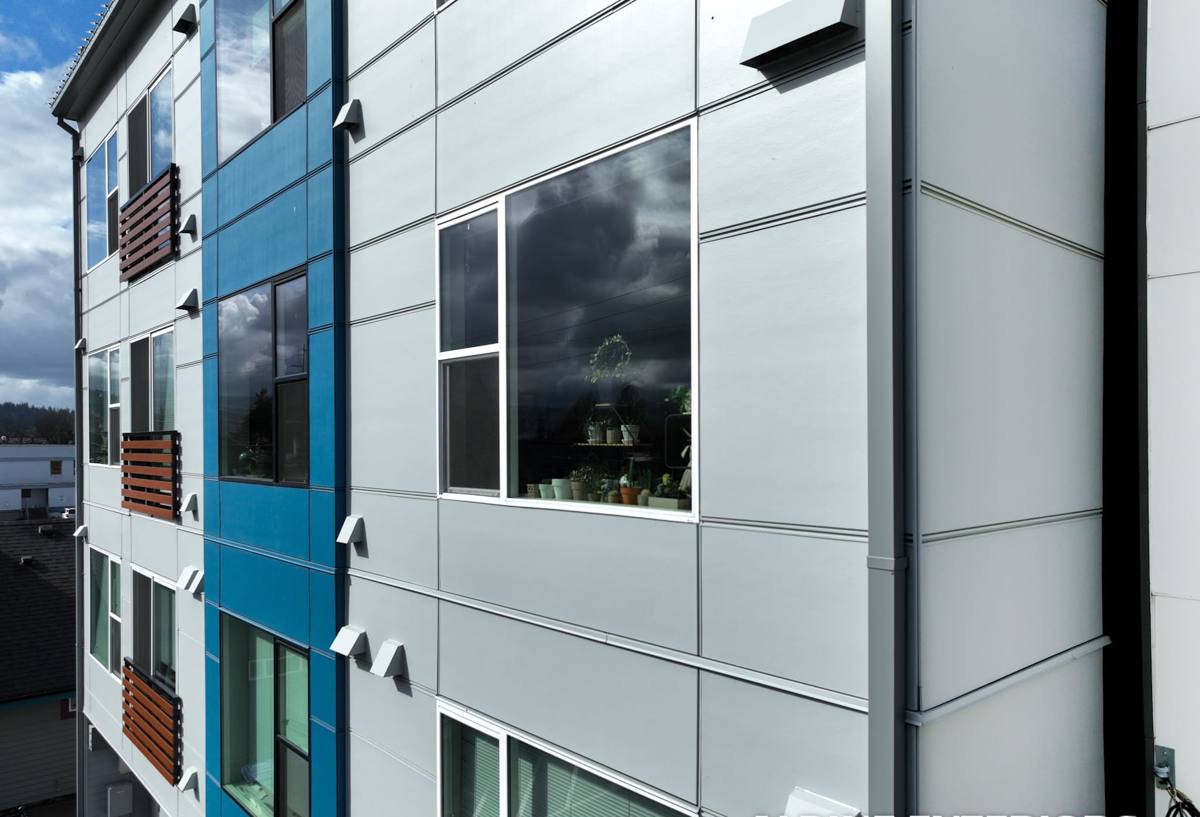
Why We Install Only James Hardie Fiber Cement
We don't install LP SmartSide, vinyl, Cemplank, Allura, primed spruce, or cedar. That's not a marketing position — it's a standard we hold because of what we've seen these products do, and not do, in exactly this climate over time. Engineered wood products can perform well for years but remain vulnerable at cut edges and fastener penetrations where moisture finds a way in. Vinyl is inexpensive and low-maintenance but can't match fiber cement's rigidity, fire resistance, or paint retention, and it telegraphs every imperfection in the wall behind it. Cedar and primed wood are beautiful but demand a maintenance schedule most homeowners can't keep up with in a climate this wet.
James Hardie fiber cement is non-combustible, dimensionally stable, and manufactured in HZ5 and HZ10 formulations specifically engineered for climate zones like ours — freeze-thaw cycling, high moisture exposure, and extended damp seasons. The ColorPlus factory finish is baked on under controlled conditions, which gives it better adhesion and UV/moisture resistance than field-applied paint, and it carries a substantial, transferable limited warranty. That combination is why it's the only fiber cement product we put on Bellevue homes.
What Correct Fiber Cement Installation Actually Involves
Moisture Management Comes First
Fiber cement siding is only as good as what's behind it. On every Bellevue project we install a code-compliant weather-resistant barrier, properly lapped and taped, with correctly integrated flashing at windows, doors, and every horizontal trim transition. In a climate with sustained wind-driven rain, this drainage plane is what actually keeps water out of the wall assembly — the siding itself is the visible layer, but the flashing and house wrap underneath do the real work.
Clearance and Fastening
James Hardie's installation manual specifies minimum clearances from grade, roofing, decks, and other transitions, along with fastener spacing and placement tolerances. Skipping these details is the single most common cause of premature siding failure we see on re-side jobs — not the material, but how it was hung. We follow the manufacturer's fastening schedule to the letter, which also matters for warranty coverage.
Caulking and Joint Treatment
Butt joints, trim intersections, and penetrations get treated with the correct sealants and gaps, not just caulked shut. Overuse of caulk to compensate for poor fit is a shortcut that traps moisture rather than shedding it — we build the joint right instead.
James Hardie Compared to Other Siding Options
| Material | Moisture/Moss Resilience | Maintenance Burden | Fire Resistance | Typical Warranty |
|---|---|---|---|---|
| James Hardie fiber cement | High — engineered HZ line, factory finish | Low — occasional wash, no repainting cycle | Non-combustible | Long-term, transferable limited warranty |
| LP SmartSide / engineered wood | Moderate — vulnerable at cut edges and joints | Moderate — edge sealing and inspection needed | Combustible (wood-based) | Manufacturer limited, edge-sensitive |
| Vinyl | Moderate — can warp/gap, traps moisture behind panels | Low, but limited repair options | Combustible, can deform under heat | Varies widely by grade |
| Cedar / primed wood | Low without diligent upkeep | High — repainting/staining cycle required | Combustible | Typically none beyond installer workmanship |
This isn't a claim that every alternative fails — it's why, given Bellevue's rain and moss exposure, we've chosen to build our business around one product installed correctly rather than offer several and let climate risk fall on the homeowner.
Signs Bellevue Siding Needs Attention
Because moss, moisture, and wind-driven rain are constants here, siding problems often show up gradually rather than all at once. Homeowners on the Eastside should watch for:
- Soft or spongy spots when pressed, especially near the bottom courses or around window trim
- Persistent moss or dark streaking on north- and west-facing walls that returns quickly after cleaning
- Visible gaps, warping, or bowing between panels, especially after a windy storm season
- Paint or finish that's peeling, chalking, or bubbling rather than wearing evenly
- Interior signs — musty smell, discoloration, or soft drywall — near exterior walls, which can indicate moisture getting past the cladding
- Caulk that's cracked, shrunk, or pulling away at trim and joints
Any one of these on its own may be minor. Several together, especially on a home more than 15-20 years old with its original siding, usually means it's worth having someone look at the whole wall assembly, not just the visible surface.
Our Process for a Bellevue Fiber Cement Project
- On-site assessment. We walk the exterior, check for moisture intrusion, evaluate the existing wall assembly, and note drainage, grading, and trim conditions specific to the property.
- Scope and product selection. We recommend the appropriate James Hardie line, profile, and ColorPlus finish for the home, and explain the reasoning rather than just presenting a package.
- Tear-off and inspection. Old siding comes off and the sheathing underneath gets inspected — this is often where hidden moisture damage from a prior installation surfaces.
- Weather barrier and flashing. A new, correctly lapped weather-resistant barrier goes on with proper flashing at every penetration and transition before a single piece of siding is hung.
- Installation to manufacturer spec. Clearances, fastener spacing, and joint treatment follow James Hardie's published installation requirements.
- Final walkthrough. We review the completed work with the homeowner and cover basic care so the siding performs the way it's designed to for decades.
Why a Crew That Already Works Bellevue Matters
Fiber cement installation is not forgiving of guesswork, and neither is the permitting and inspection process in King County jurisdictions. A crew that regularly works Bellevue and the surrounding Eastside already understands local permitting expectations, common HOA or design-review considerations in established neighborhoods, and — just as important — how the specific microclimate on a given lot behaves. A heavily treed, shaded lot near Lake Washington sheds moisture differently than an open, wind-exposed one, and that affects clearance details, ventilation, and where moss is most likely to become a recurring problem. Experience with these local variables, not just general siding knowledge, is what keeps a job from needing rework two winters later.
Cost Factors on a Bellevue Fiber Cement Project
| Factor | Why It Affects Bellevue Projects |
|---|---|
| Existing wall condition | Hidden moisture or rot found during tear-off adds repair scope before new siding goes on |
| Home size and wall complexity | Dormers, multiple stories, and trim detail increase labor and flashing work |
| Siding profile and finish | Lap width, panel vs. shingle-style, and ColorPlus color selection affect material cost |
| Access and site conditions | Sloped lots, mature landscaping, and tight setbacks common on the Eastside can add labor time |
| Trim and accessory work | Corner boards, window trim, and soffit work done alongside siding affect total scope |
We don't publish blanket price lists because these variables genuinely change the number from house to house — but we'll always walk a homeowner through what's driving their specific estimate before any work starts.
Living With Fiber Cement Siding in a Marine Climate
One advantage of James Hardie fiber cement in a climate like Bellevue's is how little ongoing work it actually asks for. It doesn't need repainting on the cycle wood siding does, and the factory-baked ColorPlus finish holds color and adhesion better through repeated wet-dry cycling than field-applied paint. That said, "low-maintenance" isn't "no-maintenance" — an occasional gentle wash removes the moss spores and organic buildup that accumulate on shaded walls during the long wet season, and keeping gutters clear and landscaping trimmed back from the siding reduces the moisture load on any exterior wall. These are small habits, not a maintenance program, and they're worth mentioning honestly rather than pretending the material needs zero attention.
If you're weighing a siding replacement or repair on a Bellevue home and want a straight answer about what your walls actually need, we're glad to take a look. The estimate is free, there's no pressure, and you'll get a clear explanation of what we find — fill out the form below to get started.