 Seattle Siding
 Composite Decking in Columbia City: Built for the Weather We Actually Get
Columbia City homeowners know their decks don't get a break. Between the long wet season, the shoulder months of drizzle that never quite stop, and the moss that creeps into anything shaded or slow to dry, a deck in this part of Seattle works harder than one in a drier climate. Composite decking has become the go-to answer for a lot of King County homeowners precisely because it holds up to that pattern better than raw wood does, but "composite" isn't one product — the boards, the substructure, and the installation details all matter, and getting any one of them wrong shortens the life of the whole deck.
We install and repair composite decking around Columbia City and the rest of Seattle, and this page covers what actually matters for a deck in this neighborhood: what the climate does to decking over time, what a correctly built composite deck looks like underneath the surface, and how we run the job from first look to final walk-through.
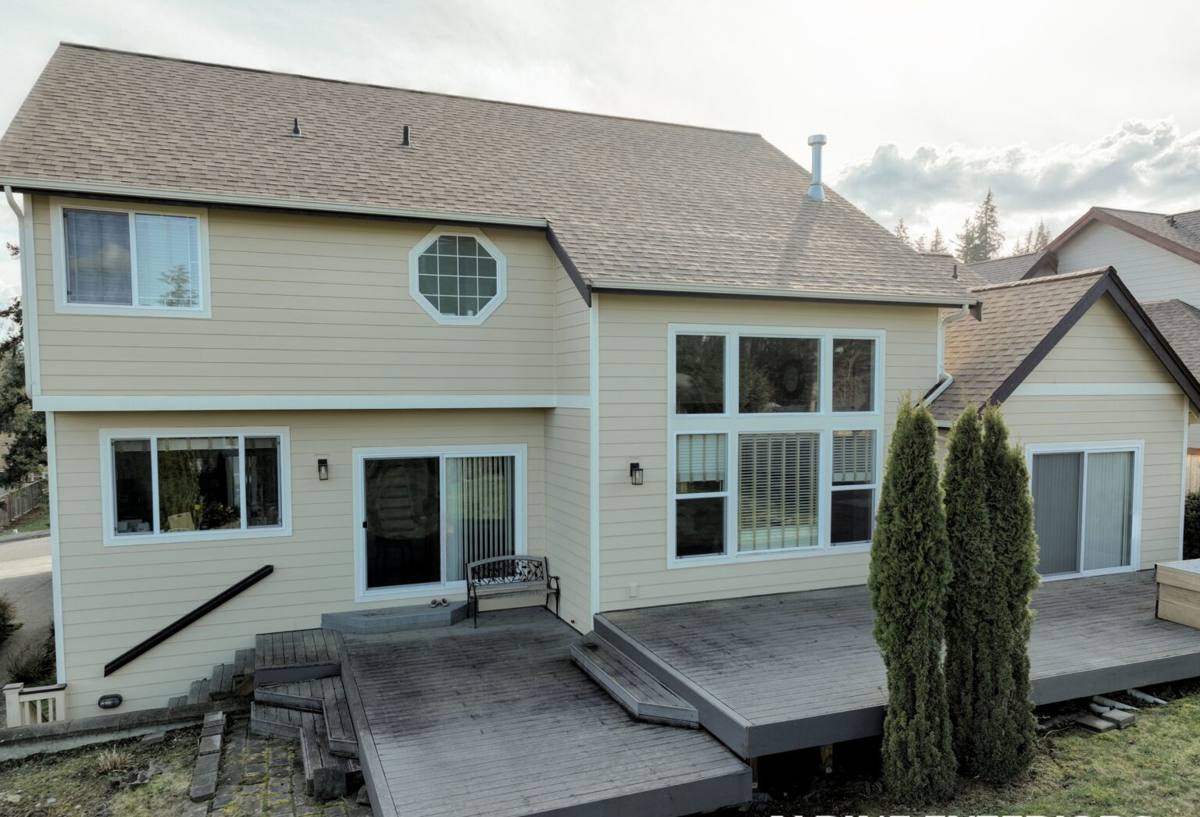
What Seattle's Climate Does to a Deck
The Pacific Northwest doesn't get extreme heat or hard freezes very often, but it makes up for that with duration. Rain here isn't usually a downpour — it's weeks of steady, low-intensity moisture that keeps every horizontal surface damp for days at a time. That matters more for decking than a single hard storm would.
Moss and Organic Growth
Moss needs shade and standing moisture to get established, and Columbia City has plenty of tree cover and fence-shaded yards that fit the bill. On wood decking, moss holds moisture against the board and accelerates rot from the surface down. On composite, moss doesn't rot the board the way it does wood, but it will grow on the surface if drainage and airflow underneath are poor, and it makes the deck slippery — which is a real safety issue on stairs and ramps.
Driving Rain and Wind-Driven Moisture
Storms off the Sound don't just fall straight down — wind pushes rain sideways into siding, rail posts, and the gaps where a deck meets the house. That's where a lot of deck failures actually start: not on the open deck surface, but at the ledger board connection and around post bases where water collects and can't evaporate quickly.
Long Damp Stretches Between Dry Spells
Seattle's dry season is short. That means any part of a deck's structure that stays wet longer than it should — because of poor drainage, tight board spacing, or blocked airflow underneath — never gets a real chance to dry out before the next system rolls in. Over years, that's what turns a small moisture problem into a structural one.
Why Composite Makes Sense Here — With Honest Trade-Offs
Composite decking (a blend of wood fiber and plastic, capped with a protective outer layer on most modern boards) doesn't absorb water the way solid wood does, doesn't need annual staining or sealing, and resists the surface rot that eventually takes down untreated wood decking in a climate like ours. For a lot of Columbia City homeowners, that's the whole appeal: less maintenance, more consistent performance through our wet season.
It's not maintenance-free, though, and we'd rather tell you that up front than have you find out the hard way. Composite still needs to be kept clean — algae and moss film can build up on the surface just like it can on wood, concrete, or pavers, and a build-up left unaddressed gets slick and starts to look dull. It also still depends entirely on what's underneath it: the best composite board in the world will cup, sag, or loosen if it's fastened to an undersized or poorly ventilated frame. We treat the substructure as just as important as the decking itself, because in this climate, it usually is.
What a Correct Composite Deck Build Includes
A composite deck that's going to hold up through Seattle winters isn't just boards screwed to joists. The details that matter most are mostly invisible once the job is done:
- Proper joist spacing for the specific board being installed — composite manufacturers spec tighter joist spacing than typical wood decking, especially on angled or diagonal patterns.
- Ledger board flashing where the deck meets the house, so wind-driven rain can't work its way behind the connection over time.
- Joist tape or a moisture barrier on top of the framing, protecting the substructure — which is often still wood — from the moisture the decking itself sheds.
- Consistent board gapping that allows for drainage and airflow without leaving gaps so wide they become a hazard or a moss trap.
- Ventilation underneath the deck, particularly on low decks close to grade, so the space beneath the joists can actually dry between rain events.
- Correct fastening — hidden fastener systems, screws, or clips rated for the specific board profile, installed per manufacturer spec so warranty coverage stays intact.
Skip any one of these and the deck can still look fine for a season or two. The problems that show up from cutting corners here — soft framing, board movement, water intrusion at the house — tend to surface two, three, or more years in, which is exactly when they're most expensive to fix.
Composite Decking Options: What the Trade-Offs Actually Look Like
Composite decking spans a wide range of price and performance. We'll walk you through actual product options and samples during your estimate, but here's the general landscape so you know what questions to ask:
| Factor | Entry-Level Composite | Mid-Tier Composite | Premium Capped Composite |
|---|---|---|---|
| Moisture resistance | Decent; uncapped edges more vulnerable | Good; capped on most surfaces | Best; fully capped, including board ends on some lines |
| Fade/stain resistance | Fades and stains faster | Moderate fade resistance | Strong UV and stain resistance |
| Surface grip when wet | Varies by texture | Textured surfaces common | Textured, slip-resistant surfaces standard |
| Warranty length | Shorter, often prorated | Moderate, sometimes limited lifetime | Longer, often full lifetime on staining/fading |
| Upfront cost | Lowest | Middle | Highest |
The right choice depends on your budget, how much sun or shade the deck sits in, and how long you plan to be in the home. A shaded, moss-prone deck benefits more from a fully capped, textured board than a sun-exposed deck might — moisture and grip matter more than UV fade resistance in that situation.
New Composite Decks vs. Wood-to-Composite Conversions
We see two main types of composite decking jobs in Columbia City: brand-new deck builds, and conversions where an aging wood deck gets replaced with composite on some or all of the existing structure.
New Builds
Starting from scratch means we control every detail — joist spacing, flashing, ventilation, and layout — from the ground up, matched exactly to the board system going in. This is the more straightforward path to a deck that performs the way it should for its full expected life.
Conversions
Converting an existing wood deck to composite decking on top of the current frame can work well, but only if that frame is actually sound. Given how much moisture Seattle framing takes on over the years, we always inspect the joists, ledger, and posts before quoting a conversion — not after. Composite boards installed over compromised framing just hide a structural problem instead of fixing it, and that's not a trade-off we're willing to make on your behalf.
Our Process, Start to Finish
- On-site assessment. We look at the existing structure (if there is one), drainage, sun/shade exposure, and how the deck ties into the house.
- Material walkthrough. We show you real board samples and talk through the cost and performance trade-offs for your specific site conditions.
- Written estimate. Clear scope, materials, and pricing before any work starts — no surprise change orders for things we should have caught up front.
- Framing and flashing. If it's a new build or the old framing needs work, this is where we get the substructure right before a single composite board goes down.
- Decking installation. Boards, fasteners, and spacing installed to manufacturer spec so your warranty stays valid.
- Final walk-through. We go over the finished deck with you, including basic care so it stays looking good through our wet season.
Simple Maintenance That Keeps Composite Looking Right
Composite decking cuts down on maintenance, but "low-maintenance" isn't "no-maintenance," especially with our moss season. A short checklist covers most of it:
- Sweep debris and leaves off the deck regularly, especially in fall — trapped organic matter holds moisture against the board surface.
- Rinse the deck periodically with a hose and, if moss or algae film shows up, clean it with a soft-bristle brush and a cleaner rated for composite (avoid pressure washers on high settings — they can damage the cap layer).
- Keep gutters and downspouts near the deck clear so runoff isn't dumping directly onto the decking or framing below.
- Check that furniture feet and planters aren't trapping moisture against the board surface for long stretches.
- Glance underneath the deck once or twice a year to confirm airflow isn't blocked by stored items or overgrown landscaping.
Why a Local Columbia City Crew Matters for This Job
Composite decking installation isn't exotic work, but doing it right in this specific climate takes judgment that comes from repetition in these conditions. A crew that installs decks in Columbia City and the surrounding Seattle neighborhoods regularly has already seen how these boards, fasteners, and framing details hold up through several wet seasons — not just how they look on installation day. That shows up in small decisions: how tight to run board gaps given the shade pattern on your lot, whether a low deck needs extra ventilation work before decking goes down, where flashing needs the most attention on your particular roofline and ledger connection.
It also matters for accountability. We're not a crew that flew in for one job — we're working in this area regularly, which means we stand behind what we install here.
Get a Straight-Forward Estimate
If you're weighing a new composite deck or thinking about converting an aging wood deck in Columbia City, we're glad to take a look and give you an honest read on what your site needs — no pressure, no inflated scope. Fill out the form below for a free estimate.