 Seattle Siding
 Decks in University District Face a Specific Kind of Wet
A deck in University District doesn't fail because of one big storm. It fails slowly, from months of low gray skies, standing moisture in shaded corners, and the kind of soft rot that hides under a coat of stain until a board finally gives way underfoot. Building or rebuilding a deck here means designing around that reality from the first footing, not patching for it later.
Salt-tinged air and driving rain
Seattle sits close enough to Puget Sound that airborne salt is part of the equation even away from the immediate waterfront, and it accelerates corrosion on cheap fasteners, connectors, and railing hardware. Combine that with driving, wind-pushed rain that gets up under flashing and around ledger boards, and you have two separate attack fronts on the same structure — one chemical, one moisture-driven. A deck built without that in mind ages fast.
Moss season is longer than people expect
In much of the country moss is a summer nuisance. In this climate it's closer to a nine-month tenant. Shaded decking, north-facing stairs, and any spot where leaves collect will grow moss and algae almost year-round unless the surface, spacing, and airflow are designed to shed water instead of holding it. That's a design problem as much as a maintenance one.
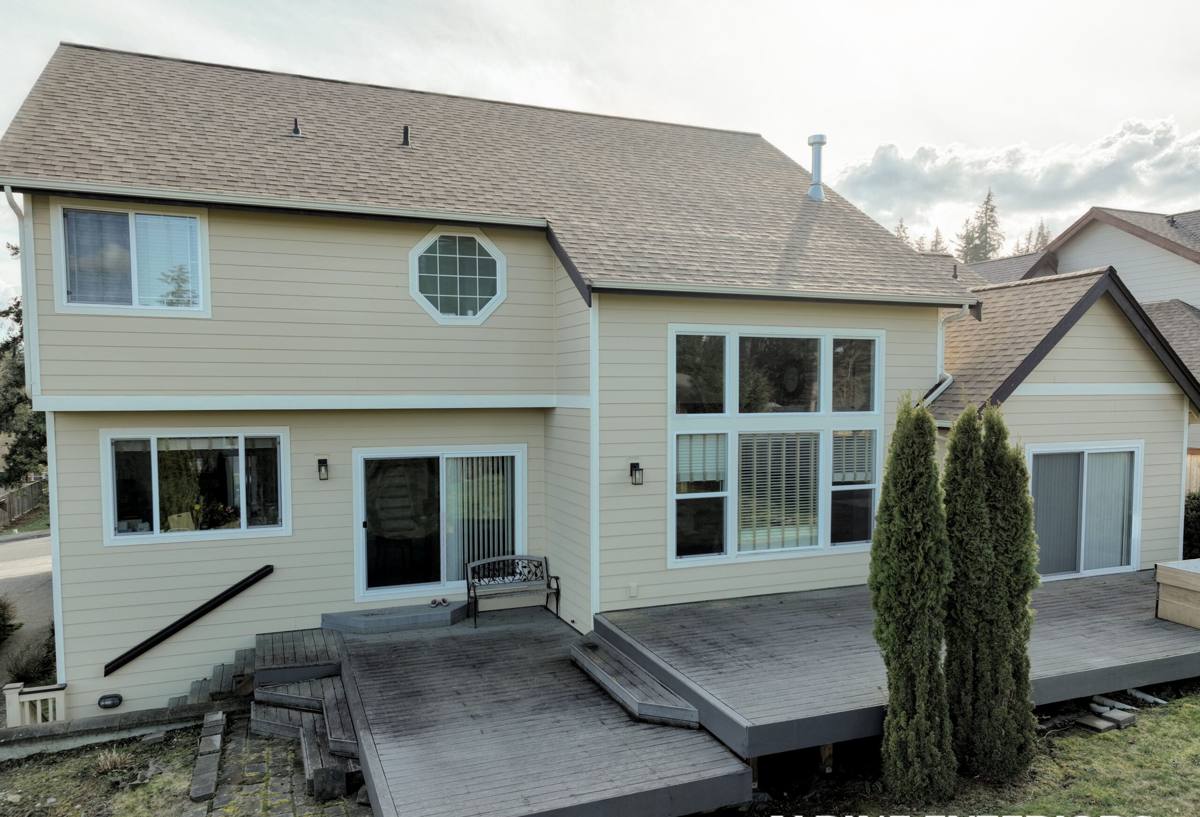
What a Deck Built for This Climate Actually Needs
Footings that don't shift
King County soils vary block to block — some University District lots sit on well-drained glacial till, others hold water longer than you'd expect. Footings need to be sized and set to local frost depth and soil conditions, not just poured to a generic minimum. A footing that's marginal on day one becomes a bouncy, uneven deck within a few wet winters.
Fasteners and hardware that won't stain or fail
Every screw, joist hanger, and post base on an exterior deck should be rated for the pressure-treated lumber it touches and for constant moisture exposure. Mismatched or bargain-grade hardware is one of the most common causes of black staining streaks and premature corrosion we see on rebuild jobs — it's cheap to skip and expensive to fix once it's been rained on for a few seasons.
Drainage built into the structure, not bolted on after
Ledger boards need proper flashing where the deck meets the house, joists need protective tape or wrap where decking fasteners penetrate, and the framing layout needs enough slope and gap spacing to let water actually leave the structure. None of this is visible once the decking goes down, which is exactly why it has to be done right the first time.
Choosing the Right Decking Material for University District
There's no single "best" decking material — there's the right trade-off for how the deck will be used, how much shade it sits in, and how much upkeep the homeowner actually wants to do.
| Material | Moisture Behavior | Maintenance | Typical Lifespan |
|---|---|---|---|
| Pressure-treated lumber | Resists rot when properly sealed; absorbs water if coatings lapse | Annual cleaning, re-stain/seal every 2-3 years | 15-25 years with upkeep |
| Cedar | Naturally moisture and insect resistant, but surface finish needs attention | Cleaning plus re-oiling or staining every 1-2 years to hold color | 15-20 years |
| Capped composite | Shrugs off moisture; won't rot or splinter | Periodic washing to keep moss/algae from taking hold | 25-30+ years |
| PVC decking | Fully synthetic, essentially immune to moisture damage | Lowest upkeep of the group; occasional cleaning | 25-30+ years |
We don't push homeowners toward one product line. We do steer people away from uncapped, budget composite boards in shaded, moss-prone spots — the exposed core can hold moisture and support algae growth in ways a fully capped board won't, and the warranty terms on those lower-tier products tend to reflect that trade-off. That's a maintenance and moisture judgment call, not a knock on any brand.
Our Process, Start to Finish
Site visit and design
We walk the actual lot, check drainage patterns, sun and shade exposure, and how the deck will tie into the house, before drawing anything up. A design that looks fine on paper but ignores where water already wants to go on that property is a design that will need repair work in a few years.
Permitting
Most new decks and many rebuilds in Seattle require a permit, and setback or height rules can affect the footprint. We handle the paperwork and inspections as part of the job rather than leaving it to the homeowner to sort out.
Framing and structural work
This is the part nobody sees once it's finished, and it's the part that determines whether the deck is solid in year fifteen or wobbly in year five — proper footings, correctly sized joists, flashing, and fastener hardware all go in at this stage.
Decking, railing, and finish work
Surface material goes down with attention to spacing and drainage, railings are set to current code height and baluster spacing, and stairs are checked for consistent rise and run — a detail that matters more for everyday safety than it gets credit for.
Final walkthrough
We go over the finished deck together, cover basic care for whatever material was installed, and make sure everything meets what was agreed on before we call the job done.
Permits and Code Basics for University District Homeowners
Because University District is within Seattle city limits, deck permits generally run through the city's building department rather than King County directly, though property-specific rules can still apply. Height above grade, proximity to property lines, and guardrail requirements on any deck significantly elevated off the ground are the details that most often affect what can be built and where. We confirm the specifics for your lot before design work is finalized rather than assuming a one-size-fits-all layout.
Cost Factors on a Custom Deck Project
Two decks of the same square footage can cost noticeably different amounts once you account for site conditions and material choices. The broad ranges below reflect the kind of factors that move a quote up or down — actual numbers depend on the specific property.
| Factor | Effect on Cost |
|---|---|
| Deck height / elevation | Taller decks need more substantial footings, framing, and code-required guardrails |
| Decking material | Composite and PVC cost more upfront than wood, less over the deck's lifetime in upkeep |
| Site access and slope | Difficult access or a sloped lot adds labor and sometimes equipment costs |
| Old deck removal | Demolition and disposal of an existing structure is its own line item |
| Railing style | Cable, glass, and custom metal railings cost more than standard baluster rail |
| Roof or cover integration | Tying a deck into a pergola, roof line, or covered structure adds design and framing complexity |
Keeping a University District Deck Ahead of Moss and Rot
A well-built deck still needs seasonal attention in this climate — the maintenance burden is lower with composite and PVC, but it never disappears entirely.
- Sweep leaves and debris off the surface regularly in fall — trapped organic matter is what feeds moss and stains boards
- Wash the deck surface at least once a year with a deck-safe cleaner, more often in heavily shaded areas
- Check and clear gaps between boards so water can drain instead of pooling
- Inspect ledger board flashing and railing post connections for movement or staining, which can signal water getting where it shouldn't
- Re-seal or re-stain wood decking on the schedule appropriate to the product — don't wait until it looks obviously gray and dry
- Trim back overhanging branches and vegetation that keep sections of the deck in constant shade and damp
Signs an Existing Deck Needs Attention
- Soft or spongy spots underfoot, especially near the ledger board or stair stringers
- Persistent black streaking around fasteners or hardware
- Visible gaps or separation where the deck meets the house
- Wobble in railings or posts that wasn't there a year or two ago
- Moss or algae that returns within weeks of cleaning
Any one of these is worth a look before it becomes a full rebuild. Some are a repair; some point to a structural issue that's cheaper to fix now than after another wet winter.
Why a Crew That Already Works University District Matters
Every neighborhood in Seattle has its own mix of lot slopes, tree cover, soil, and older housing stock, and University District is no exception. A crew that's already built and repaired decks in this specific area has a working sense of which lots drain poorly, which older homes have ledger connections that need extra attention, and how much shade a given block actually gets through the winter. That local familiarity shows up in fewer surprises during construction and a deck that's designed for the property it's actually sitting on, not a generic template.
If you're planning a new deck or need an honest look at one that's showing its age, we're happy to walk the property with you and talk through what it would take — there's no pressure and no obligation. Use the form below to request a free estimate.