 Seattle Siding
 Building Decks for Columbia City's Wet, Shaded Climate
Columbia City sits inland from the water, but it doesn't escape the weather pattern that defines the whole Seattle area. From fall through spring, the neighborhood gets long stretches of steady, driving rain rather than short downpours — the kind of weather that finds every gap in flashing and every low spot in a deck surface over time. Summers are milder and drier, but the marine air that moves through the Puget Sound region carries a faint salt content even well away from the shoreline, and that air reaches fasteners, brackets, and any exposed metal on a deck year-round. Add the mature tree canopy common in older Seattle neighborhoods like Columbia City, and you get decks that spend a good part of the year shaded and damp — exactly the conditions that grow moss and algae fastest.
None of that means a deck can't hold up here. It means the deck has to be built with this climate in mind from the footings up, not treated like it's going into a dry-summer state. That's the difference between a deck that needs real repair work in five or six years and one that's still solid after twenty.
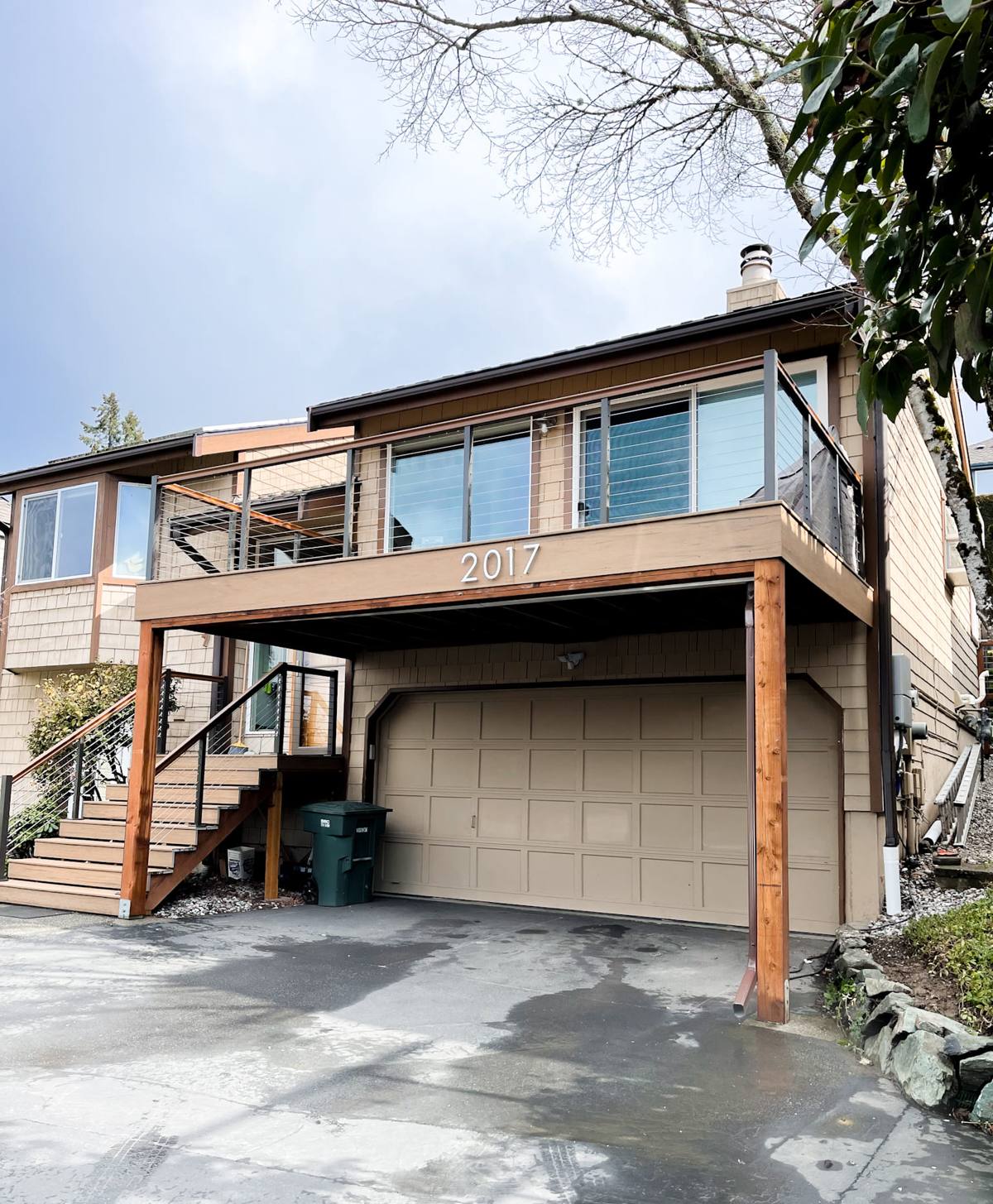
What a Correctly Built Deck Involves
A deck is a structure first and a surface second. The boards you walk on get all the attention, but the parts underneath — footings, framing, and the connection back to the house — determine whether the whole thing stays safe and dry.
Footings and Framing
Footings need to sit below frost depth and bear on undisturbed or properly compacted soil, which matters in Columbia City's mix of native and fill soils depending on the lot. Joists should be sized and spaced for the actual span and the decking material going on top — composite decking, for example, generally wants tighter joist spacing than solid wood to avoid flexing over time. Every cut end and every piece of hardware should be rated for exterior, ground-contact, or fastener-compatible use, since mismatched metals in a wet climate corrode faster and can stain the decking above them.
Ledger Attachment and Flashing
If the deck attaches to the house, the ledger board connection is the single most important detail on the whole project. It needs proper flashing that sheds water away from the house's wall assembly, correct fasteners or structural screws (not just nails), and in most cases a positive slope or gap so water doesn't sit against the siding. This is also the area inspectors look at closest, and for good reason — a poorly flashed ledger is a slow, hidden path for water into the house framing, and it's expensive to fix once rot sets in behind the siding.
Choosing Deck Materials for This Climate
There's no single "best" decking material — there's a best fit for how the deck will be used, how much upkeep the owner wants to do, and how much shade and moisture it will sit in. In a neighborhood like Columbia City, where tree cover keeps some decks shaded most of the day, that last factor carries extra weight.
| Material | Upfront Cost | Maintenance | How It Handles Shade & Moisture |
|---|---|---|---|
| Pressure-treated wood | Lowest | Annual cleaning, periodic staining/sealing | Prone to graying, splintering, and moss growth in shaded spots if not maintained |
| Cedar | Mid-range | Regular sealing to keep natural rot resistance intact | Naturally more rot- and insect-resistant, but still needs upkeep in constant shade |
| Composite (e.g., Trex- or TimberTech-style boards) | Higher | Occasional washing, no staining or sealing | Doesn't rot, but can grow surface algae in deep shade if not rinsed periodically |
| Hardware & fasteners (all materials) | Small % of budget | None if specified correctly up front | Stainless or coated fasteners matter more here than in drier climates |
We'll walk through these trade-offs honestly rather than push whatever has the best margin. A composite deck under heavy tree cover still needs periodic washing — it just won't rot or need refinishing the way wood does. A cedar deck in full sun with good airflow can outperform expectations with modest care. The right call depends on the specific spot on the property, not a blanket rule.
Moss, Algae, and Surface Care
Moss doesn't damage decking directly, but it holds moisture against the surface and makes boards dangerously slick, especially on stairs. In shaded Columbia City yards, moss and green algae film can build up on wood and even composite surfaces during the wetter months. Board spacing, surface texture, and grain orientation all affect how fast this happens and how easy it is to keep clean — smooth-faced wood decking sheds moss more easily than deeply grooved composite in a shaded spot, for instance, while grooved composite offers hidden-fastener attachment that some owners prefer for appearance.
We factor this into the design, not just the material choice: board orientation relative to the sun, gaps between boards for drainage and airflow, and keeping decking a reasonable distance from overhanging branches where practical, all reduce how often a deck needs to be scrubbed.
Drainage and Rot Prevention Beneath the Deck
What happens under a deck matters as much as what happens on top of it. In a climate that gets sustained rain rather than brief storms, water needs somewhere to go — both off the decking surface and away from the framing, footings, and any structure the deck is attached to.
- Decking boards spaced to let water drain through rather than pool on the surface
- Ledger flashing that directs water out and away from the house wall assembly
- Joists and beams kept clear of standing water or poor-draining soil below
- Metal hardware rated for exterior and, where dissimilar metals meet, corrosion-resistant fasteners
- Any under-deck skirting or storage area designed with airflow, not sealed damp and dark
Skipping any one of these is usually invisible for a year or two — the problems show up later as soft framing, rusted brackets, or a ledger connection that's been slowly failing behind the siding. It's cheaper by a wide margin to build it right the first time than to open up a deck for structural repair.
Permits, Code, and Inspections in Seattle
Most raised decks in Seattle require a permit, and inspectors pay particular attention to a handful of items: the ledger attachment and flashing, footing depth and bearing, guardrail height and baluster spacing on any deck significantly above grade, and stair rise-and-run consistency. These aren't paperwork formalities — they're the same items that cause real injuries and real water damage when they're done wrong. We handle the permit process as part of the job rather than leaving it to the homeowner, and we build to pass inspection the first time, not to squeak by.
Our Deck Building Process
- On-site assessment — we look at the actual lot: sun and shade patterns, drainage, soil, and how the deck will attach to the house.
- Design and material selection — sizing, layout, and an honest conversation about material trade-offs for that specific spot.
- Permit and plan submission — we prepare and submit what the City of Seattle requires and handle the back-and-forth.
- Footings and framing — built to span and load requirements, not just "what's always worked."
- Ledger, flashing, and structural connections — the details that determine whether water stays out of the house.
- Decking, railing, and stairs — installed to the spacing and fastening spec for the material chosen.
- Inspection and walkthrough — we schedule required inspections and go over care and maintenance with the homeowner before we consider the job finished.
Why a Crew That Already Works in Columbia City Matters
A deck built to a generic national spec can still fail in a specific climate. Crews who work regularly in Seattle neighborhoods like Columbia City already know how tree-shaded lots drain, how King County's inspectors evaluate ledger and guardrail details, and how differently a deck ages under mature canopy versus an open, sunny yard. That local pattern recognition shows up in small decisions — board spacing, fastener choice, where a downspout or grade slope will eventually send water — that don't appear on a basic set of plans but make the difference in year eight or ten.
It also matters for the practical side of the job: knowing realistic timelines around Seattle's wetter months, sequencing work so framing isn't sitting exposed through a long rain stretch, and understanding what King County permitting actually expects rather than guessing.
Signs an Existing Deck Needs Attention
Not every deck project is new construction — a lot of what we see in established neighborhoods is repair, partial rebuild, or a full replacement of a deck that's reached the end of its usable life. A few signs it's time to have a deck looked at:
- Soft, spongy, or discolored decking boards, especially near the house or in shaded corners
- Rust streaks running down from screws, bolts, or brackets
- Persistent moss or algae that comes back within weeks of cleaning
- Any wobble or movement in the railing or stairs
- Visible gaps or staining where the deck meets the house siding
- A ledger board or support post that looks darker or swollen compared to surrounding wood
Any one of these on its own might be minor. Several together, especially near the ledger connection, usually mean it's worth a real inspection rather than a surface fix.
Get an Honest Look at Your Project
Whether you're planning a new deck, replacing an aging one, or just want a second opinion on something that doesn't look right, we're happy to come take a look and give you a straight answer — no pressure, no upsell. Use the form below to request a free estimate for your Columbia City property.