 Seattle Siding
 Siding Installation Built for How Green Lake Actually Weathers
Green Lake is one of Seattle's most walkable, tree-shaded neighborhoods, and that's exactly what makes its siding conditions a little different from a house sitting in the open on a treeless lot. Mature trees and dense landscaping keep a lot of these homes in partial shade for long stretches of the year, which sounds pleasant until you think about what shade does to a wet exterior wall: it slows drying time. Combine that with King County's long, wet fall-through-spring stretch, occasional wind-driven rain off Puget Sound, and a moss season that can run the better part of the year, and you get siding conditions that punish anything that isn't installed to hold up wet, correctly flashed, and finished with a factory-cured coating rather than a field-applied one.
This page is specifically about siding installation for Green Lake homes — not a generic overview. We'll walk through what the local climate actually does to siding, what a correct installation involves to counter it, how our process works, and why it matters to hire a crew that already knows this neighborhood's housing stock and conditions rather than one learning on your dime.
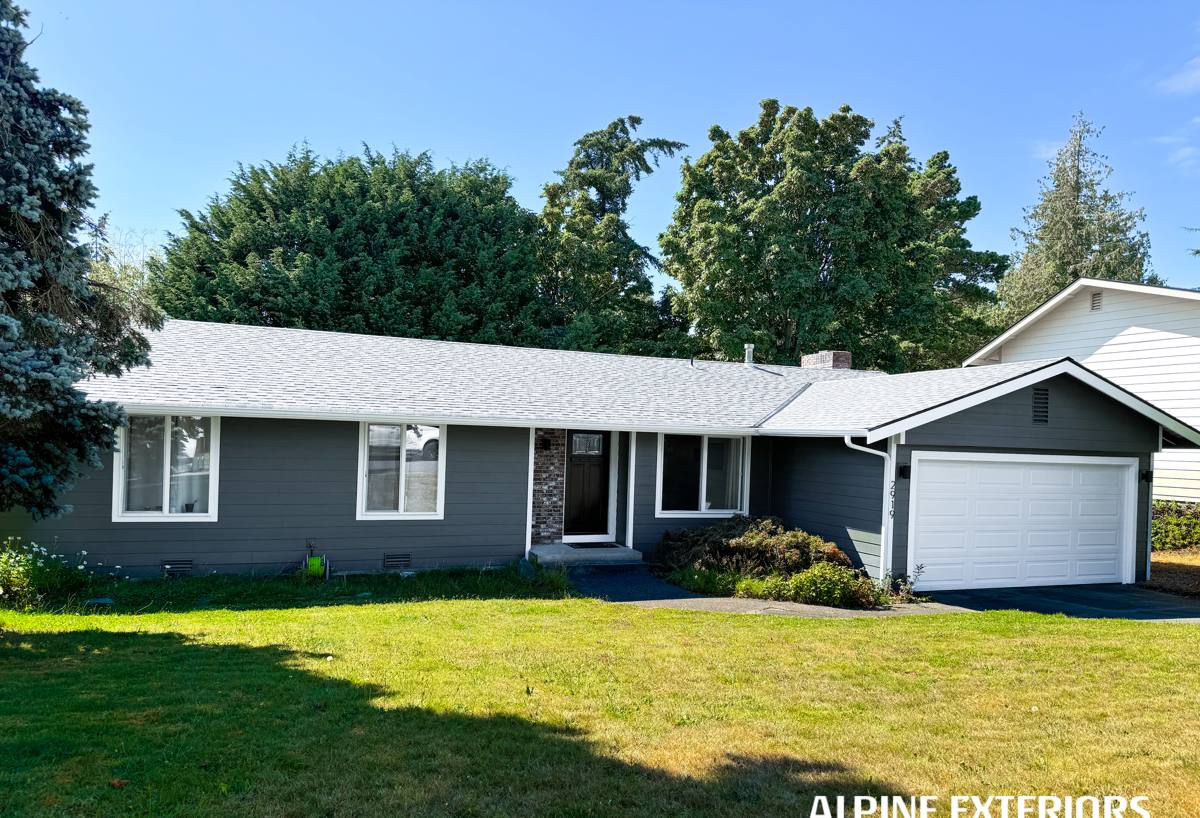
What Green Lake's Climate Does to Siding Over Time
Seattle's marine climate is mild in temperature but relentless in moisture, and Green Lake gets the full effect. A few specific stressors show up again and again on homes in this part of the city:
Driving Rain
Seattle rain is rarely a downpour, but it's frequent, and wind off the Sound can push it sideways into wall assemblies, working moisture into any gap, seam, or fastener hole that wasn't sealed and flashed correctly. Over years, that slow intrusion is what causes rot and hidden damage — not one big storm, but hundreds of small ones.
Salt-Influenced Marine Air
Even away from the immediate waterfront, Seattle's air carries salt influence off Puget Sound. That air accelerates corrosion on unprotected fasteners and metal trim, and it's part of why fastener choice and flashing detail matter as much as the siding material itself.
A Long Moss and Mildew Season
Shade from mature trees plus consistent moisture is a near-perfect recipe for moss, algae, and mildew growth on exterior surfaces. Siding that holds moisture at the surface — or that has open seams and rough texture for spores to grab onto — will show green and black staining faster than siding designed to shed water and resist organic growth.
None of this means Green Lake homes need anything exotic. It means the installation details that are "nice to have" in a drier climate become non-negotiable here.
What a Correct Siding Installation Actually Involves
Siding failures in this climate are almost never about the siding panel itself — they're about what's underneath and around it. A correct installation gets the details right in places most people never look:
- Weather-resistive barrier installed continuously and lapped correctly, with no gaps at penetrations
- Rainscreen gap behind the siding so any moisture that gets past the surface can drain and the wall can dry
- Flashing at every window, door, deck ledger, and roof-to-wall transition — the single most common source of hidden rot when skipped or done wrong
- Correct fastener type and placement for the specific siding product, driven to the manufacturer's spec, not overdriven or underdriven
- Proper clearance between siding and grade, roofing, decks, and hardscape so water doesn't wick up from below
- Sealed and caulked joints only where the manufacturer calls for sealant — not as a substitute for proper flashing
Skip any one of these and the siding can look fine for a few years while moisture works underneath it unnoticed. That's the trap with re-siding jobs done fast and cheap: the failure shows up two, five, or ten years later, after the damage is already done to the sheathing and framing behind it.
Why We Install Only James Hardie Fiber Cement
We made a deliberate decision to install James Hardie fiber cement siding exclusively — not vinyl, not LP SmartSide, not Cemplank or Allura, not primed spruce or cedar. That's not a marketing position; it's a standard we hold because of what we've seen these products do over time in exactly this kind of climate.
Wood products like cedar and primed spruce look great on day one, but they require ongoing maintenance — repainting, caulking, and moisture monitoring — to hold up in a climate this wet, and they're more sensitive to the rot and pest issues that come with prolonged dampness. Vinyl is low-maintenance and inexpensive, but it can warp or become brittle with age, its seams and profile don't handle wind-driven rain as tightly as a properly installed fiber cement system, and it's not something we can back with the kind of warranty we're comfortable standing behind. LP SmartSide and other engineered-wood products perform reasonably well when installation and maintenance are followed to the letter, but they're wood-based at their core, which means moisture sensitivity is always part of the equation.
James Hardie fiber cement is non-combustible, dimensionally stable in wet-dry cycling, and available in ColorPlus factory-finished colors that are baked on rather than field-painted — which matters directly for a moss-and-mildew climate, because a tighter, more consistent factory finish gives organic growth less to hold onto than a field-applied coat. Hardie also engineers specific product lines (their HZ5 line, used in this region) for climate zones like ours, which is a level of climate-specific engineering the alternatives don't offer.
| Factor | James Hardie Fiber Cement | Vinyl | Wood / Engineered Wood |
|---|---|---|---|
| Moisture behavior in PNW conditions | Dimensionally stable, engineered for wet climates | Can warp or distort with age and temperature swings | Moisture-sensitive; relies on maintenance to stay protected |
| Maintenance burden | Low — factory finish, periodic washing | Low, but repairs can be visible and mismatched | High — regular repainting/resealing needed |
| Fire characteristics | Non-combustible | Combustible | Combustible |
| Finish durability | Factory-cured ColorPlus finish | Color molded through material, can fade | Field-applied paint/stain, fades and peels over time |
| Warranty structure | Strong, transferable manufacturer warranty when installed to spec | Varies by manufacturer | Varies; often limited on finish |
Our Installation Process
Every Green Lake project follows the same disciplined sequence, whether it's a full re-side or a targeted section replacement:
- On-site assessment — we inspect existing siding, sheathing, flashing, and any moisture damage before quoting anything
- Tear-off and substrate inspection — old siding comes off and we check the sheathing underneath for rot or damage that needs repair before new siding goes on
- Weather barrier and rainscreen installation — the drainage plane goes in first, correctly lapped and sealed
- Flashing at every penetration — windows, doors, and roof transitions get flashed before siding covers them
- Hardie panel or plank installation — installed to manufacturer fastening spec, with correct clearances maintained throughout
- Trim, caulking, and touch-up — finish details completed and inspected
- Final walkthrough — we review the completed work with the homeowner before calling the job done
We don't skip the substrate inspection step to save time. It's the single most important step for catching hidden problems before they get sealed behind new siding for another 20-plus years.
Signs a Green Lake Home May Need New Siding
Given the local climate, here's what we tell Green Lake homeowners to watch for:
- Visible warping, buckling, or separation at seams
- Soft spots when pressed, especially near the bottom of walls or under windows
- Persistent moss, algae, or dark streaking that returns quickly after cleaning
- Paint that's peeling, bubbling, or failing faster than it should
- Gaps opening up around trim, windows, or corner boards
- A noticeable rise in heating costs, which can point to moisture-compromised insulation behind the siding
- Visible rot or soft wood at any exposed edge or cut end
Any one of these on its own might be minor. Several at once, especially on a shaded or wind-exposed wall, usually means it's time for a real inspection rather than another round of caulk and paint.
What Affects the Cost of a Siding Installation
Every home is different, so we don't publish blanket pricing, but these are the factors that most commonly move a project up or down in scope and cost:
| Factor | Typical Impact |
|---|---|
| Home size and wall complexity (dormers, gables, multiple stories) | More surface area and cut lines increase labor |
| Condition of existing sheathing | Rot or moisture damage found during tear-off adds repair scope |
| Existing siding removal | Multiple layers or difficult-to-remove materials add time |
| Trim and detail level | Custom trim, corner details, and accent siding increase labor |
| Site access | Tight lots, mature landscaping, and limited staging space affect crew efficiency |
| Siding profile chosen | Lap, shingle, and panel profiles differ in material and labor cost |
We walk through all of this on-site before giving a number, so the estimate reflects your actual house rather than a generic square-footage guess.
Why Hiring a Crew That Already Works Green Lake Matters
Siding work in Green Lake isn't the same job as siding work on a dry, open lot elsewhere in King County. A crew that regularly works this neighborhood already understands how shade patterns from mature trees affect drying time on different walls of the same house, how to sequence work around tight, landscaped lots, and what moisture and moss issues tend to show up first on this housing stock. That familiarity shows up in fewer surprises mid-project and a finished job that's actually built for the conditions it has to survive, not just for the day it goes up.
If your Green Lake home needs new siding, repair, or you're just not sure what shape your current siding is in, we're happy to take a look. Reach out for a free, no-pressure estimate using the form below.