 Seattle Siding
 Building Decks for Ballard's Marine Climate
Ballard sits close to the water, and that changes what a deck has to deal with compared to a build a few miles inland. Salt-laden air off Puget Sound accelerates corrosion on anything metal. Driving rain off the water pushes moisture sideways into places a deck in a drier climate would never see it. And Seattle's long, wet stretch of fall through spring gives moss and algae months to colonize any surface that doesn't shed water and dry out quickly. None of this makes deck building in Ballard impossible — it just means the details that get skipped in easier climates are exactly the details that determine whether a deck lasts eight years or twenty-five.
A deck built the same way you'd build one in a dry inland climate will show it within a few seasons: rust bleeding through fasteners, soft spots where a ledger board has been absorbing water it can't shed, and a slick green film on any board that doesn't get afternoon sun. A deck built for this specific climate looks and performs differently a decade later, and the difference isn't cosmetic — it's structural.
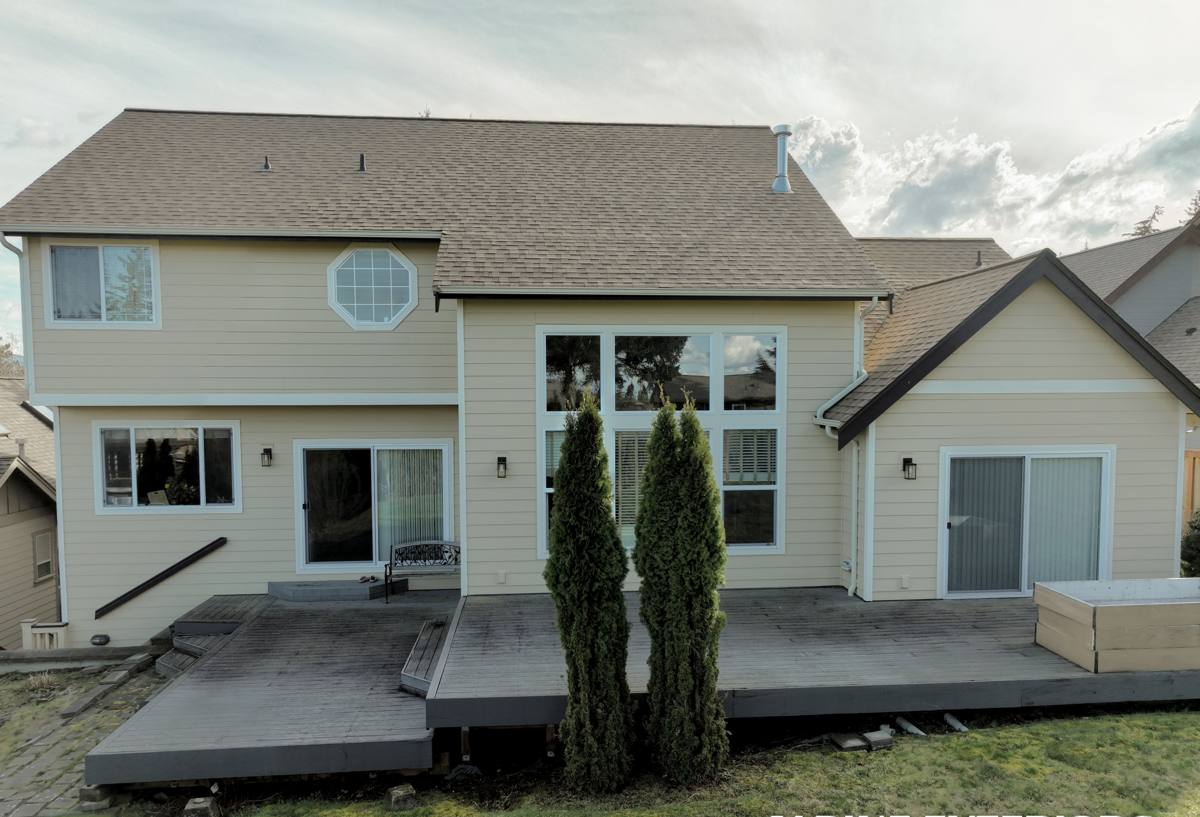
What a Deck Needs to Survive Here
Fasteners and Hardware
This is the single most common shortcut we see on decks that have failed early. Standard zinc-coated fasteners hold up fine in a lot of the country, but in a marine-influenced climate like Ballard's, that coating gets eaten through faster than most homeowners expect — sometimes within a handful of years. Once the coating is gone, the steel underneath rusts, streaks the decking, and eventually loses grip strength. We use fasteners and structural hardware rated for coastal or treated-lumber exposure — typically stainless steel or heavy hot-dip galvanized — on every connection that matters: joist hangers, post bases, ledger bolts, and the screws holding the decking down.
Ledger Attachment and Flashing
The ledger board — where the deck attaches to the house — is the single highest-risk point on any deck in a wet climate. If water gets behind it and can't escape, it rots the ledger, the rim joist behind it, and sometimes the wall framing above it, often invisibly for years. Correct flashing (metal flashing over the ledger, plus a rain screen gap where the deck meets siding) and structural bolting rather than nails are non-negotiable here, not upgrades.
Footings and Drainage
Ballard's soil and drainage vary block to block, but the principle doesn't change: footings need to sit below frost depth and on undisturbed or properly compacted soil, and the ground under and around the deck needs somewhere for water to go. A deck built low to grade without attention to drainage traps moisture underneath it, which is exactly the environment moss, mold, and rot organisms want.
Decking Material Options: Cost, Maintenance, and How They Handle Wet Weather
There isn't one "correct" decking material — there's a correct material for your budget, your maintenance appetite, and how much sun the deck actually gets. Here's how the common options compare for a climate like this one:
| Material | Upfront Cost | Maintenance in Our Climate | Typical Lifespan |
|---|---|---|---|
| Pressure-treated lumber | Lowest | Needs re-staining/sealing every 1-2 years to resist moss and moisture; will show wear fastest in shaded, damp areas | 10-15 years with upkeep |
| Cedar | Moderate | Naturally more rot-resistant, but still needs regular sealing and cleaning to prevent graying and moss growth | 15-20 years with upkeep |
| Composite (capped) | Higher | Low — occasional washing to keep pores clear of algae/moss; no staining or sealing | 25-30 years |
| PVC decking | Highest | Lowest — fully moisture-resistant surface, easiest to keep moss-free | 30+ years |
Shaded, low-airflow decks — which describes a lot of yards on smaller Ballard lots with tall fences or dense landscaping — are where moss and algae take hold fastest, regardless of material. On those sites, we'll often steer homeowners toward capped composite or PVC even if the budget was originally set for wood, simply because the maintenance burden on wood in a shaded, damp spot is a lot higher than most people expect going in. That's a judgment call we make honestly, based on the specific site, not a blanket recommendation.
Framing You Won't See (But Will Matter in Ten Years)
A lot of what separates a deck that ages well from one that doesn't happens below the decking boards, where nobody looks after the ribbon-cutting. We joist-tape the tops of framing members before decking goes down, which keeps standing water from sitting in the wood grain at every fastener point — a small step that meaningfully slows rot at the most failure-prone spots on the frame. Beams and posts get sized for the actual span and load, not the minimum the code will technically allow, and post bases are set to keep end-grain wood off concrete and standing water. None of this is visible once the deck is finished. All of it is the reason a deck either needs major structural work at year twelve or doesn't.
Permits and Code for a Ballard Deck
Most new decks in Seattle require a permit, and decks attached to the house or built above a certain height off grade almost always do — the exact threshold and requirements depend on your specific deck's height, size, and attachment. Guardrails are required above a certain height and have to meet spacing and load requirements; stair and landing details are code-checked too. We handle the permit application and inspection scheduling as part of the job so you're not the one chasing City paperwork, and we build to pass inspection the first time rather than treating code minimums as a target to shave.
Our Deck Building Process
- Site visit and assessment — we look at sun exposure, drainage, existing structure (if replacing a deck), and how the space will actually be used before recommending anything.
- Design and material selection — layout, decking material, railing style, and any features (stairs, built-in benches, multi-level layouts) get worked out with you, with honest trade-offs on cost and maintenance for each option.
- Permitting — we prepare and submit what's needed for your specific project and schedule required inspections.
- Demolition (if replacing an existing deck) — including a check of the ledger and rim joist behind it for hidden rot before anything new goes up.
- Framing — footings, posts, beams, joists, and ledger attachment, built to the loads and spans your design actually calls for.
- Decking, railing, and finish work — installed with fastener spacing and gapping set for wood movement and drainage, not just a fast install.
- Final walkthrough and inspection — we review the finished deck with you and make sure it passes any required City inspection.
Living With Moss Season: Deck Maintenance That Actually Works
Even a well-built deck needs some seasonal attention here — the goal of good construction is to make that maintenance minor instead of structural. A few habits go a long way:
- Sweep leaves and debris off the deck regularly through fall — trapped organic material is what moss and algae feed on first.
- Keep gaps between boards clear of debris so water can actually drain through instead of sitting on the surface.
- Wash the deck surface once or twice a year (a stiff brush and deck cleaner, or a gentle pressure wash on wood) before moss gets a foothold rather than after.
- Re-seal or re-stain wood decking on the schedule the product calls for — skipping a cycle in a climate this wet compounds fast.
- Check the ledger board area and any spots that stay shaded and damp longer than the rest of the deck — that's where problems show up first.
- Trim back overhanging landscaping that keeps sections of the deck from drying out between rains.
Why a Crew That Already Works in Ballard Makes a Difference
Deck building looks similar on paper everywhere in the country — footings, framing, decking, railings. What's different is knowing, before the first shovel goes in the ground, that this specific neighborhood's proximity to the water means fastener choice isn't optional, that a shaded lot on a narrow street is going to fight moss harder than an open one, and that Seattle's permitting requirements need to be sorted correctly the first time. A crew that builds decks across King County generally knows the code. A crew that regularly works in Ballard specifically knows how the water, the rain patterns, and the local lot conditions actually play out on a deck five and ten years after it's built — and builds accordingly from day one instead of learning it on your project.
If you're planning a new deck or replacing one that's showing its age, we're happy to take a look and give you a straightforward, no-pressure estimate — just fill out the form below.