 Seattle Siding
 Why Board & Batten Suits Kirkland Homes
Board and batten has become one of the most requested siding profiles in Kirkland and across the Eastside, and it's not just a style trend. The vertical lines read as clean and modern on newer builds, but they also pair naturally with the craftsman and farmhouse-influenced homes that make up a lot of Kirkland's housing stock. It works on a full elevation or as an accent over gables, entry bays, and dormers alongside horizontal lap siding elsewhere on the house.
What most homeowners don't realize is that board and batten is less forgiving than lap siding when it comes to water management. The vertical seams, the battens themselves, and the flat panel behind them all create places where water can either shed cleanly or get trapped, depending entirely on how the assembly was built. In a climate like Kirkland's — steady rain through fall and winter, humidity that lingers under tree cover, and a long stretch of the year where surfaces rarely fully dry out — that detail work is the difference between siding that lasts decades and siding that fails from the inside out.
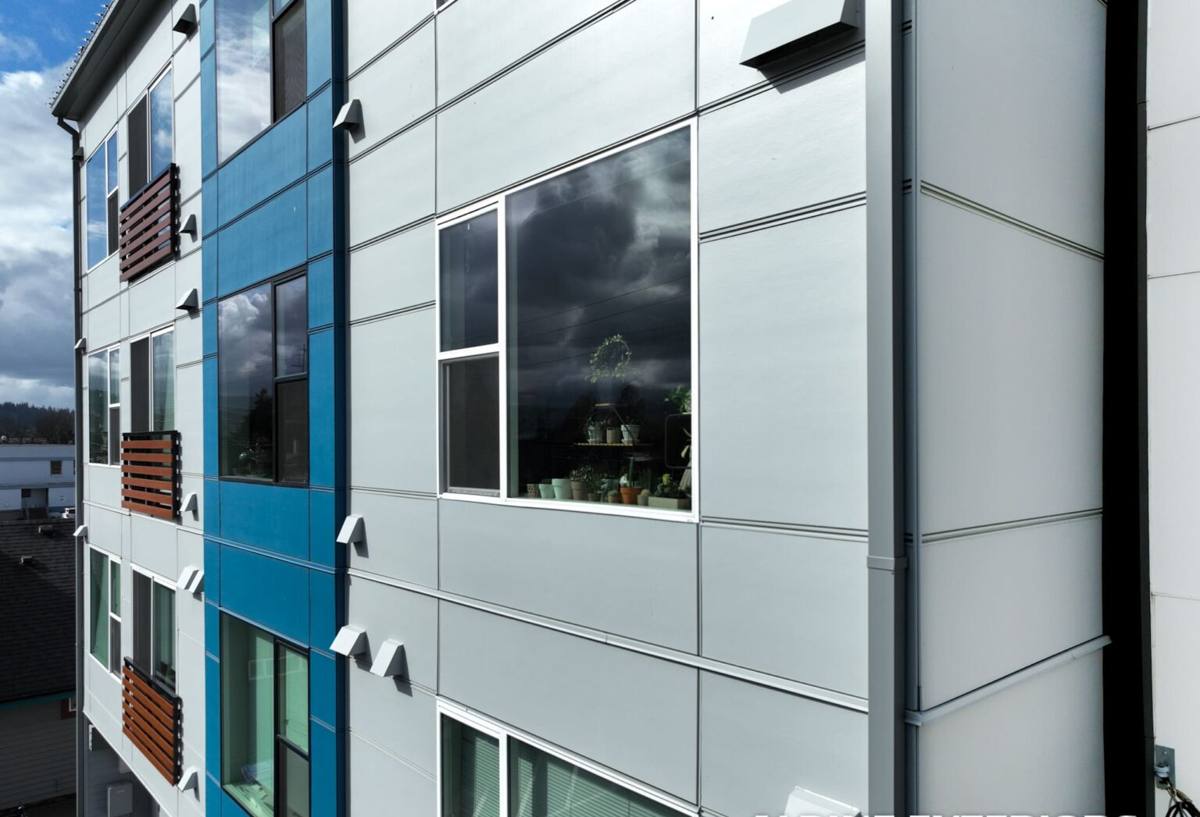
What Kirkland's Climate Does to Siding Over Time
Kirkland sits on Lake Washington in King County, and the exposure here is a mix of moisture off the lake, driving rain that comes in sideways during winter storms, and the broader marine influence that reaches inland from Puget Sound. None of that is unique to any one neighborhood — it's the baseline every exterior surface in this region has to survive.
- Driving rain: Wind-driven rain doesn't just fall straight down — it gets pushed up and under laps, into seams, and behind trim that isn't flashed correctly. Board and batten has more vertical seam length than lap siding, so poor flashing details show up faster.
- Salt-influenced air: Proximity to Puget Sound means airborne moisture carries more than fresh water. Over years, that accelerates corrosion on exposed fasteners and speeds up the breakdown of coatings that aren't built to handle it.
- Moss and algae season: Shaded, north-facing, and tree-covered elevations — common on Kirkland lots with mature landscaping — stay damp for long stretches. That's exactly the environment moss and algae need to take hold on porous or poorly finished siding.
- Freeze-thaw swings: Not as severe as inland climates, but Kirkland still sees enough cold snaps that trapped moisture behind siding can freeze, expand, and stress joints and fasteners over repeated cycles.
Individually, none of these are dramatic. Stacked together over 10, 15, 20 years, they're what separates siding that still looks good from siding that's cupping, staining, or rotting at the bottom courses.
What a Correct Board & Batten Installation Actually Involves
The Water-Resistive Barrier Comes First
Before a single board goes up, the wall needs a continuous water-resistive barrier (WRB) with properly lapped and taped seams, correctly integrated flashing at every window, door, and penetration, and a plan for how incidental water that gets behind the siding will drain back out. This step is invisible once the job is done, which is exactly why it's the step that gets shortcut on rushed installs.
Drainage Behind the Panel
Board and batten installed flat against the WRB with no gap behind it can trap moisture against the wall assembly, especially in a climate as wet as this one. A drainage gap or rainscreen strategy — furring strips, a drainage mat, or an engineered drainage wrap — gives any moisture that does get behind the panel a path to escape instead of sitting against the sheathing.
Fastening and Batten Placement
Fasteners need to land in framing, at the manufacturer's specified spacing, and be corrosion-resistant given the salt-influenced air in this area. Battens have to be spaced and fastened so they cover the panel seams fully without restricting the panel's ability to move slightly with temperature and moisture changes. Get the batten layout wrong and you either get visible gaps opening up over time or fasteners fighting the panel's movement.
Trim, Corners, and Bottom Terminations
The bottom edge of any board and batten wall is the highest-risk zone — it's closest to grade, splashback, and standing water. Correct installs hold the siding off any hard surface, flash the bottom termination so water sheds away from the wall, and use corner and trim details that don't create a ledge for water to collect on.
Why We Only Install James Hardie for Board & Batten
We don't install LP SmartSide, vinyl, Cemplank, Allura, primed spruce, or cedar board and batten — not because those products can't be installed, but because we've standardized on one system we can stand behind fully in this climate. James Hardie fiber cement is non-combustible, doesn't swell or rot the way wood-based products can when moisture gets past the surface, and is engineered specifically for high-moisture climate zones like the Pacific Northwest under Hardie's HZ10 product line.
ColorPlus Factory Finish
Hardie's ColorPlus finish is baked on in a controlled factory environment rather than field-applied paint over primed material. That matters directly for board and batten, because the vertical seams and cut edges are exactly where a lower-quality or field-applied finish tends to fail first — chalking, fading, or peeling right where moisture exposure is highest.
Panel and Trim System
For board and batten, that typically means HardiePanel vertical siding paired with HardieTrim battens, or a plank-style vertical product depending on the look a homeowner wants. Both are fiber cement through and through — not a coating over a wood substrate — so the material itself doesn't absorb water and swell the way primed spruce or cedar can.
Warranty That Actually Transfers
Hardie backs its siding with a strong, transferable warranty, which matters both for homeowners planning to stay long-term and for resale. A warranty is only as good as the installation behind it, which is why correct flashing, fastening, and drainage detail work isn't optional — it's what keeps that warranty valid.
Board & Batten vs. Other Siding Approaches for Kirkland Homes
| Factor | Fiber Cement Board & Batten (Hardie) | Wood Board & Batten | Vinyl Vertical Panel |
|---|---|---|---|
| Moisture behavior | Doesn't absorb water or swell; engineered for wet climates | Absorbs moisture; prone to rot if any detail fails | Doesn't absorb water, but seams can allow moisture behind it |
| Finish durability | Factory-baked ColorPlus finish resists fading and chalking | Field-applied paint or stain needs recoating on a shorter cycle | Color is through the material but can fade and chalk over time |
| Fire resistance | Non-combustible | Combustible | Can deform or melt under heat exposure |
| Moss/algae resistance | Dense, factory-finished surface resists growth better than porous wood | Porous surface is more hospitable to moss and algae | Resists moss but seams and channels can collect debris and moisture |
| Long-term maintenance | Periodic washing; recoating only if the finish is ever compromised | Regular repainting/staining and rot inspection | Low maintenance but limited repair options if damaged |
Our Process, Start to Finish
- On-site walkthrough: We inspect the existing wall assembly, sheathing condition, and any moisture or moss issues already present before quoting anything.
- Design and layout: We work out board width, batten spacing, and where board and batten transitions to other siding profiles or trim on the elevation.
- Tear-off and prep: Old siding comes off, sheathing is inspected and repaired as needed, and any existing moisture damage gets addressed before anything new goes up.
- WRB and flashing: A continuous water-resistive barrier goes on with correctly lapped seams and integrated flashing at every window, door, and penetration.
- Drainage plane: Furring or a drainage product is installed so the wall assembly can dry out behind the siding, not just on the surface.
- Panel and batten installation: HardiePanel and HardieTrim go up to manufacturer spec — fastener placement, spacing, and terminations included.
- Final detailing: Caulking, touch-up, and a walkthrough so you understand what maintenance, if any, the finish will need going forward.
Cost Factors for Board & Batten Siding in Kirkland
| Factor | Why It Moves the Price |
|---|---|
| Tear-off vs. new construction | Removing old siding and repairing any hidden moisture damage adds labor beyond a fresh install |
| Wall complexity | Dormers, gables, and multiple roof lines mean more cuts, more flashing detail, and more trim work |
| Panel size and batten spacing | Wider battens or a custom spacing pattern changes material takeoff and install time |
| Drainage strategy | A full rainscreen system costs more upfront than a basic drainage wrap but pays off in a wet climate |
| Trim and corner detailing | Custom corners, window trim, and transitions to other siding profiles add labor |
We don't publish flat per-square-foot pricing because every Kirkland home's wall condition, layout, and complexity is different. A walkthrough gets you a real number, not a guess.
Maintenance in a Moss-Prone, Salt-Influenced Environment
Correctly installed Hardie board and batten is low-maintenance, but "low" doesn't mean "none" — especially with the moss and algae pressure common on shaded Kirkland lots.
- Rinse siding annually (garden hose pressure, not a pressure washer aimed directly at seams or battens) to clear pollen, dust, and early moss growth
- Keep gutters clear so overflow doesn't run down the wall behind battens
- Trim back landscaping that keeps any elevation shaded and damp longer than necessary
- Inspect caulking at trim and penetrations every couple of years and recaulk if it's cracking or pulling away
- Watch the bottom courses near grade and any splashback zones — that's where problems show up first if they're going to show up at all
Why a Crew That Already Works Kirkland Matters
Board and batten done wrong doesn't usually fail in year one — it fails in year eight or ten, after moisture has had time to work behind a panel that was never given a drainage path, or through a bottom edge that was never flashed correctly. A crew that already works Kirkland and the broader Seattle area has seen how local wall assemblies, roof lines, and exposure patterns actually behave through a full wet season, not just how a spec sheet says a product should perform. That local repetition is what catches the details — flashing at a tricky roof-to-wall transition, drainage on a shaded north wall, fastener choice given the salt-influenced air — before they become the reason a wall has to be opened back up.
If you're weighing board and batten for a Kirkland home, we're glad to walk the exterior with you, look at what the existing wall assembly is dealing with, and put together a straightforward, no-pressure estimate — just fill out the form below.