 Seattle Siding
 Siding That Actually Holds Up in Columbia City
Columbia City sits in a part of Seattle where weather doesn't ask permission. Homes here deal with the same marine influence that touches the whole Puget Sound region — salt-laden air drifting in off the Sound, long stretches of driving rain through fall and winter, and a moss season that can run most of the year on shaded, north-facing walls. Add in the mature tree canopy that gives many Columbia City blocks their character, and you get siding that stays damp longer, gets less direct sun to dry out, and takes on more organic growth than siding in a drier, more exposed part of King County.
None of that is unusual for Seattle. But it does mean the siding choice on a Columbia City home isn't cosmetic — it's a functional decision about how well the exterior sheds water, resists moisture intrusion, and holds its finish over 20, 30, or 40 years. This page is about one product, installed one way, for this one neighborhood: James Hardie fiber cement siding, done right for Columbia City conditions.
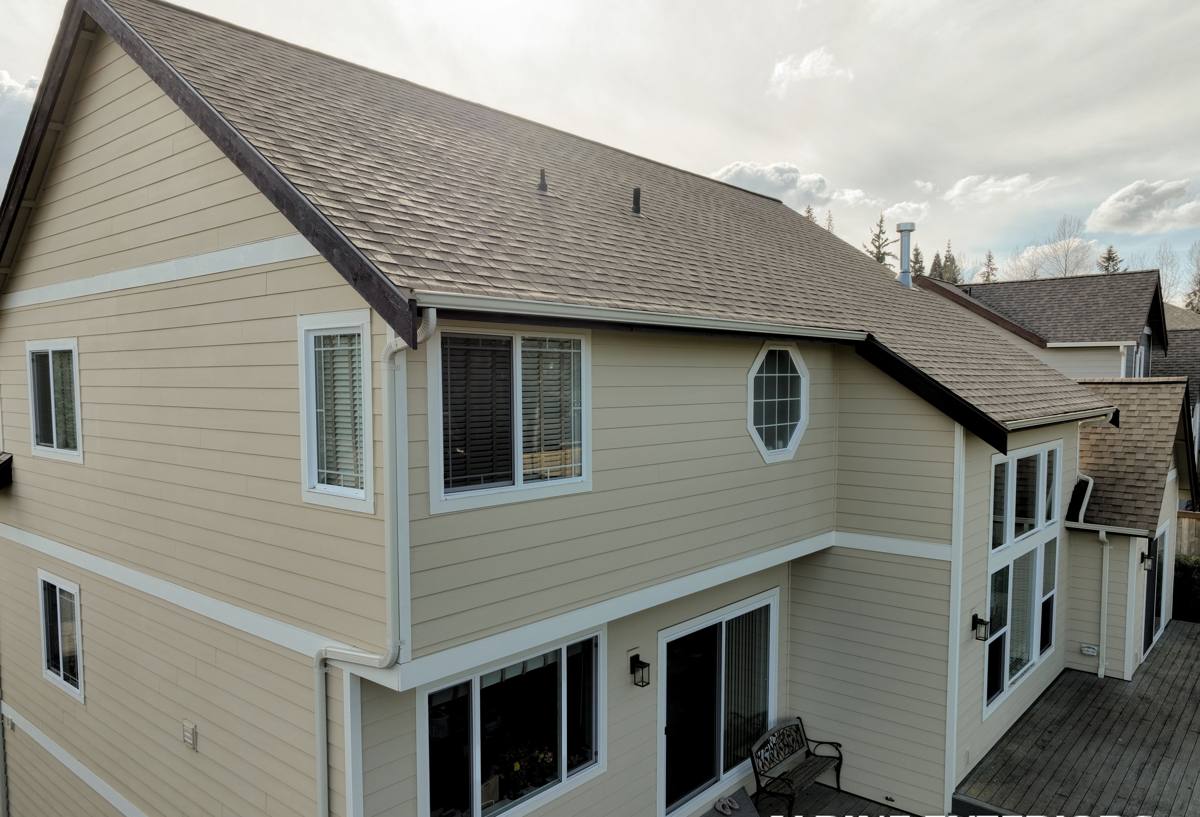
What Driving Rain and a Long Moss Season Do to Siding
Wind-driven rain doesn't just hit a wall — it gets pushed sideways and upward, working into laps, seams, and fastener points that vertical rain would never reach. Over time, siding that isn't installed with the right clearances and flashing details lets moisture behind the cladding, where it can sit against sheathing and framing far longer than anyone walking by would guess.
Moss and mold thrive in exactly those damp, shaded conditions. On siding materials that absorb moisture or hold onto surface texture, moss gets a foothold, retains water against the wall, and accelerates whatever decay process is already underway. Salt air compounds the problem in a different way — it accelerates corrosion on fasteners, flashing, and any metal trim that isn't rated for coastal exposure. A siding system that ignores any one of these three factors — wind-driven rain, moss, salt air — tends to show it within the first several winters, not the first several decades.
Why This Matters More on Some Columbia City Lots Than Others
Not every home faces identical exposure. A wall shaded most of the day by neighboring trees or structures will stay damp longer and grow moss faster than a south-facing wall that gets regular sun. Homes closer to Lake Washington pick up additional ambient humidity. Part of doing this job correctly is reading the specific exposure of each elevation of your house, not applying a one-size-fits-all spec to every wall.
Why We Install Only James Hardie Fiber Cement
We made a deliberate decision as a company to install James Hardie fiber cement siding exclusively — not vinyl, not LP SmartSide or other engineered wood products, not primed spruce or cedar, and not other fiber cement brands. That's not a marketing position; it's a standard we hold because of what we've seen hold up in this climate and what hasn't.
James Hardie fiber cement is non-combustible, doesn't expand and contract with moisture the way wood-based products do, and is engineered specifically for climate zones like the Pacific Northwest through its HZ5 product line. The factory-applied ColorPlus finish is baked on and warranted separately from the substrate, which matters in a climate where UV exposure is lower but moisture cycling is constant. The combination of dimensional stability, moisture resistance, and a finish that isn't reliant on job-site painting is why we standardized on it rather than offering multiple options.
Other products have real strengths — vinyl is inexpensive and low-maintenance in mild conditions, engineered wood siding installs quickly and takes paint well, cedar has genuine curb appeal. We simply won't put our name behind installing them here, because we've made a professional judgment that the trade-offs — moisture sensitivity, seam and caulk maintenance, or long-term appearance retention — aren't worth it on homes we're putting a warranty behind in this specific climate.
What a Correct Fiber Cement Installation Actually Involves
Fiber cement siding is only as good as the installation behind it. The material itself resists moisture well, but the assembly around it — flashing, fastening, clearances, and joint treatment — is what determines whether water gets managed or trapped. A rushed or generic install can undercut even the best siding product.
- Proper weather-resistive barrier and, where called for, a rainscreen gap to let incidental moisture drain and the wall assembly breathe
- Correct flashing at every window, door, and roof-to-wall intersection — the details where driving rain actually finds its way in
- Minimum clearances from grade, roofing, decks, and walkways so siding never sits in standing water or constant splash-back
- Fasteners placed per manufacturer spec, driven flush (not overdriven), and corrosion-resistant given the salt air this region sees
- Factory-cut or properly sealed field cuts, since exposed raw edges are where moisture absorption starts
- Correctly sized gaps at butt joints and trim, caulked with a product rated for this climate rather than whatever's on the truck
Skipping any one of these doesn't show up on day one. It shows up in year three or four, usually as a stain, a soft spot, or moss taking hold at a seam that was never properly sealed.
Our Process for Columbia City Projects
1. Site Walk and Exposure Assessment
We look at each elevation of the house separately — sun exposure, tree cover, proximity to grade, and any existing moisture staining or soft siding. This tells us where extra attention to flashing or ventilation is warranted before a single board goes up.
2. Tear-Off and Sheathing Check
Once old siding comes off, we inspect the sheathing underneath. This is often the only point in a home's life where that layer is fully visible, and catching hidden rot or water damage here prevents it from being sealed behind new siding.
3. Weather Barrier and Flashing
House wrap, flashing, and rainscreen components (where the assembly calls for one) go in before any cladding. This is the layer that actually keeps water out — the siding itself is the second line of defense, not the first.
4. Hardie Installation to Spec
Siding, trim, and fasteners go in per James Hardie's published installation guidelines, not a generalized approach borrowed from other materials. Clearances, fastener spacing, and joint treatment are checked as we go, not at the end.
5. Final Walkthrough
We walk the finished job with the homeowner, checking sightlines, caulk lines, and trim details before calling it complete.
Comparing Siding Options for a Columbia City Home
| Factor | Vinyl Siding | Engineered Wood (e.g., LP SmartSide) | James Hardie Fiber Cement |
|---|---|---|---|
| Moisture behavior in driving rain | Sheds water but seams can allow intrusion | Wood-based core is moisture-sensitive if seals fail | Dense fiber cement resists moisture absorption |
| Moss and mildew resistance | Surface growth possible, easy to wash | Organic content can support growth if damp | Non-organic substrate resists sustained growth |
| Fastener and trim corrosion (salt air) | Low metal exposure, but can warp with heat | Standard fasteners can corrode without upgrades | Installed with corrosion-resistant fasteners per spec |
| Finish longevity | Color molded in, can fade over decades | Field-painted, needs repainting over time | Factory ColorPlus finish, separately warranted |
| Fire resistance | Combustible | Combustible | Non-combustible |
This isn't a claim that other products fail outright — it's a summary of the trade-offs that led us to standardize on one system rather than offer several. Homes in Columbia City's climate benefit most from a siding that doesn't rely on a perfect paint job or flawless seam sealing to perform for decades.
Why Local Experience in Columbia City Matters
A siding crew that's worked Columbia City's streets knows the practical realities of the neighborhood: narrow lots and shared property lines that affect staging and access, mature street trees that shade certain walls year-round, and the mix of older homes with original sheathing alongside newer construction with different wall assemblies. Permitting through the City of Seattle also has its own process and inspection expectations that a crew working across multiple jurisdictions in King County already knows how to navigate without adding delays to your project.
Familiarity with a specific neighborhood also means fewer surprises during tear-off. A contractor who has opened up walls on similar-vintage Columbia City homes has a better sense of what's likely underneath the existing siding — and how to handle it — before it becomes a change order.
Maintaining Fiber Cement Siding in This Climate
- Rinse siding annually, focusing on shaded, north-facing walls where moss and grime build up fastest
- Inspect caulk lines at trim and joints every year or two, and re-caulk any that have cracked or pulled away
- Keep gutters clear so overflow doesn't run down the siding face repeatedly during heavy rain
- Trim back vegetation that keeps a wall shaded and damp, where practical
- Have any soft spots, staining, or bubbling paint checked promptly rather than waiting for the next scheduled maintenance
Fiber cement is low-maintenance compared to wood, but "low-maintenance" doesn't mean "no maintenance" — especially in a climate that gives siding a genuine workout every winter.
What Affects Cost on a Columbia City Project
Every home is different, but a few factors consistently move the price on a fiber cement job in this neighborhood: the condition of the existing sheathing once old siding comes off, the complexity of the home's trim and roofline, how much of the wall assembly needs new flashing or a rainscreen added, and the total square footage being sided. We won't quote a number without seeing the house, but we're glad to walk through those factors honestly during an estimate.
If you're weighing a siding replacement or new construction project in Columbia City, we're happy to come take a look, walk the exterior with you, and put together a straightforward, no-pressure estimate using the form below.