 Seattle Siding
 Window Replacement Built for Kirkland Homes
Kirkland sits in one of the wetter, more humid corners of King County, tucked along Lake Washington with the Cascades to the east and Puget Sound's marine air moving through the region. That combination means windows here work harder than windows in drier climates. Frames sit through months of driving rain, humidity that never fully clears, and a moss season that can stretch from fall through spring. If you've owned a home in Kirkland for more than a decade, you've probably already noticed what that does to a window: swollen sashes, foggy glass, sills that feel soft under a thumbnail, or a draft that shows up every time the wind comes off the water.
This page is about one thing specifically: replacing windows correctly on a Kirkland home, given the climate we actually have here, not a generic national installation process. We'll cover what local homes need, what a correct job looks like, how our process runs, and why it matters to hire a crew that already works in this area rather than one passing through.
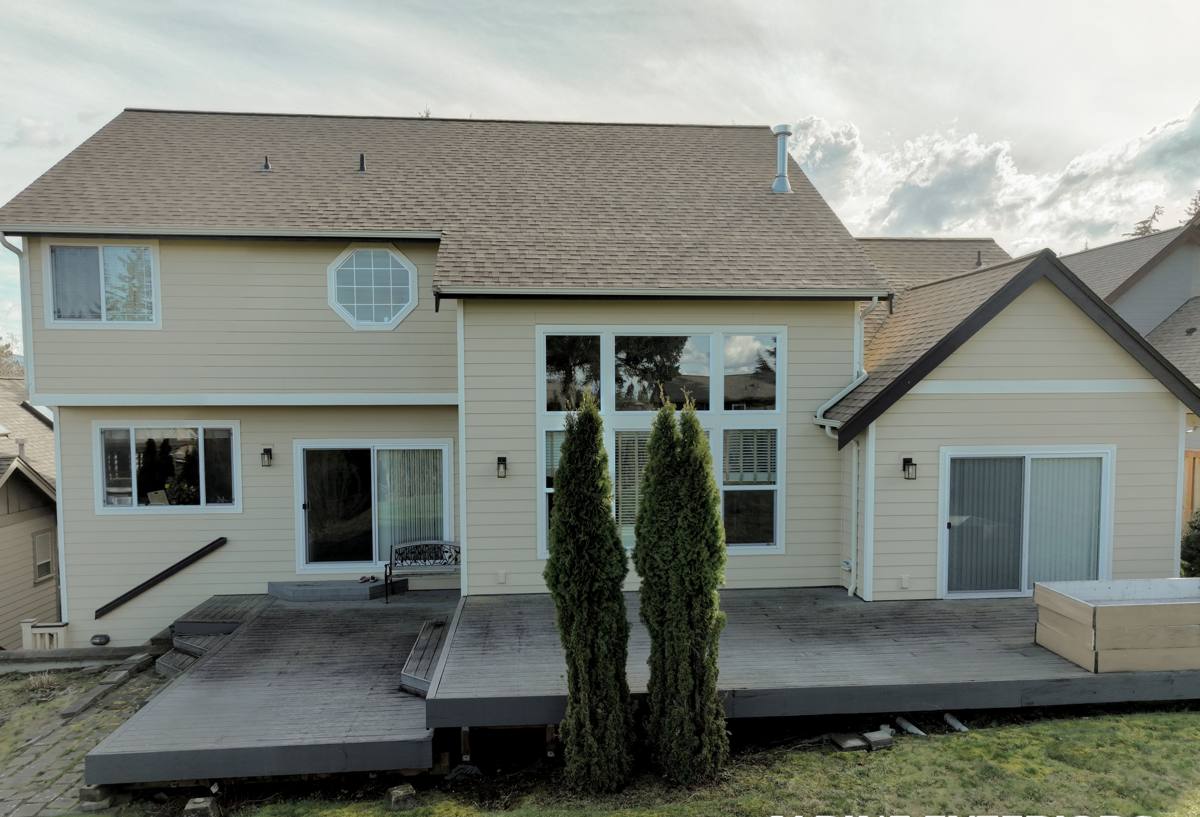
Why the Local Climate Is Hard on Windows
The Puget Sound region doesn't get the temperature extremes some parts of the country deal with, but it makes up for that with sustained moisture. That's the real enemy of a window system — not any single storm, but months of low-grade dampness working into wood, caulk, and flashing.
The main stressors we see in Kirkland
- Driving rain: Wind-driven rain off the lake and from Pacific storm systems pushes water sideways into gaps that would stay dry in a calmer climate, which is why flashing and sealant quality matter more here than in most regions.
- Long moss season: Moss and algae thrive in the shade and moisture that many Kirkland lots have, and they hold water against wood trim and sills far longer than open sun would allow.
- Marine and lakefront humidity: Air moving in from Puget Sound and off Lake Washington keeps ambient humidity elevated much of the year, which slows drying time for any window assembly that does take on moisture.
- Freeze-thaw cycling: Our winters aren't brutal, but repeated mild freezes and thaws still stress caulk joints and glazing seals over the years.
None of these are dramatic on their own. The problem is cumulative — a window that could handle one bad storm has a much harder time handling twenty years of this climate without proper materials and installation.
Signs a Window Needs Replacing, Not Just Repair
Not every problem means a full replacement. But there's a point where patching stops making financial sense, especially in a wet climate where a small issue becomes a bigger one quickly.
- Fogging or a visible haze between panes of a double-pane window — this means the seal has failed and the gas fill is gone; it cannot be fixed, only replaced.
- Wood trim or sills that are soft, discolored, or crumbling when pressed.
- Visible moss or dark staining building up in the corners of the frame or on the sill.
- Sashes that stick, won't stay open, or won't latch fully closed.
- A noticeable draft or cold spot near the frame even when the window is shut.
- Condensation forming on the inside of the glass regularly during colder months.
If you're only seeing one of these on one window, a repair or a resealing job may be enough. If you're seeing several of these across multiple windows, especially on the sides of the house that face prevailing weather, replacement is usually the more honest recommendation.
What a Correct Window Replacement Job Actually Involves
A window replacement is not just swapping glass in a frame. Done correctly in a climate like ours, it's as much about water management as it is about the window unit itself.
Full-frame versus insert replacement
There are two general approaches, and the right one depends on the condition of the existing frame:
- Insert (pocket) replacement: A new window unit is fitted into the existing frame, which stays in place. This works well when the original frame is still structurally sound and dry.
- Full-frame replacement: The old frame is removed down to the rough opening, allowing us to inspect and repair the surrounding framing, install new flashing, and set the new window from scratch. This is the right call whenever there's evidence of moisture damage behind or around the old frame — which, given our climate, is common on older Kirkland homes.
Choosing insert replacement on a frame that already has hidden rot just seals the problem behind a new window instead of fixing it. Part of doing this job correctly is being willing to recommend full-frame work even when it costs more, if that's what the wall actually needs.
The details that matter in a wet climate
- Flashing sequencing: Water needs a continuous path down and out, layered correctly with the house wrap or building paper so nothing can work backward into the wall.
- Sill pan installation: A sloped, sealed sill pan under the window gives any water that does get past the frame somewhere to go besides into the framing.
- Sealant selection and placement: Not every gap should be sealed — some need to stay open as drainage or ventilation paths. Sealing everything shut is a common mistake that traps moisture instead of releasing it.
- Insulation at the rough opening: Low-expansion foam or backer rod fills the gap between the frame and the rough opening without bowing the new frame out of square.
Comparing common window materials
| Material | Moisture performance | Maintenance | Typical lifespan |
|---|---|---|---|
| Vinyl | Good — won't rot, minor expansion/contraction with temperature | Low — occasional cleaning | 20–30 years |
| Fiberglass | Very good — dimensionally stable, resists moisture well | Low | 30–40 years |
| Wood (unclad) | Requires diligent upkeep in this climate; prone to rot if paint or finish fails | High — regular repainting/sealing | Varies widely with maintenance |
| Wood with aluminum or vinyl cladding | Good exterior protection with interior wood look | Moderate | 25–35 years |
| Aluminum | Durable but conducts heat/cold, higher condensation risk | Low | 20–30 years |
For most Kirkland homes, we lean toward vinyl or fiberglass for standard replacements because they handle sustained moisture and our mild freeze-thaw cycles with the least ongoing maintenance. Wood-clad options still make sense for homes where a specific architectural look matters, as long as the homeowner understands the added upkeep.
Glass and Performance Options Worth Understanding
The glass package matters as much as the frame material, especially for energy performance and condensation control.
- Double-pane vs. triple-pane: Double-pane with a low-E coating is the standard, cost-effective choice for most homes in our climate. Triple-pane adds insulation value and sound dampening but comes at a higher cost and added weight — worth it for north-facing rooms, homes near busier roads, or owners prioritizing energy performance over cost.
- Low-E coatings: A microscopically thin coating that reflects heat while letting visible light through, improving comfort in both summer and winter without darkening the glass.
- Argon or krypton gas fill: The gas between panes improves insulation value; this is also the seal that fails and causes visible fogging when a unit reaches the end of its life.
- Condensation resistance: Given our humidity, a window's condensation resistance rating is worth asking about — it affects how much moisture collects on interior glass during cold, damp stretches.
Our Process, Start to Finish
- On-site assessment: We look at each window from both sides, check the condition of the surrounding trim and framing, and identify which openings need insert replacement versus full-frame work.
- Honest scope and estimate: You get a clear breakdown of what each window needs and why, with straightforward pricing — no pressure to upgrade beyond what the house actually calls for.
- Precise measurement and ordering: Every opening is measured individually; older homes often have openings that aren't perfectly uniform even when they look it.
- Removal and inspection: When we open up a frame, we inspect the framing underneath for moisture damage before anything new goes in — this is the step that catches problems a quick estimate can't see.
- Correct installation: Flashing, sill pans, insulation, and sealant are installed in the right sequence for our climate, not just to make the window look finished from the outside.
- Cleanup and walkthrough: We clear debris, operate every window with you, and confirm everything latches, locks, and seals the way it should.
What Drives Window Replacement Cost
| Factor | Why it affects cost |
|---|---|
| Insert vs. full-frame replacement | Full-frame work involves more labor and often framing repair |
| Window material | Fiberglass and clad-wood typically cost more than standard vinyl |
| Glass package | Triple-pane, specialty coatings, and tinted or tempered glass add cost |
| Number and size of openings | Larger or custom-shaped windows require custom sizing |
| Access and height | Second-story or hard-to-access windows take more time and equipment |
| Hidden damage discovered during removal | Rot or moisture damage found behind old frames adds repair scope |
We'd rather walk you through these factors up front than give a number that doesn't hold once the old windows come out. If hidden damage turns up, we'll show it to you and explain the options before doing any additional work.
Why a Kirkland-Familiar Crew Makes a Difference
Window replacement isn't exotic work, but local familiarity still shows up in the details. A crew that regularly works in Kirkland and the surrounding King County area already knows the permitting expectations for exterior work, has a feel for how local building styles and ages of construction tend to be framed, and has seen firsthand what our specific rain and moss patterns do to a house over time. That translates into fewer surprises during the job and a scope that's realistic from the first estimate, rather than one that changes repeatedly once work starts.
It also means accountability. A contractor who plans to keep working in this community has every reason to install the job correctly the first time and to stand behind it afterward.
Questions worth asking before you hire
- Do you pull permits when the work requires them, and who's responsible for that?
- Will you inspect the framing behind old windows before installing new ones?
- What's your approach to flashing and sill pans on full-frame replacements?
- What warranty covers the installation itself, separate from the manufacturer's product warranty?
- Can I get a written, itemized estimate before work begins?
- How do you handle it if hidden damage is found once the old window comes out?
Maintaining New Windows in This Climate
Even a correctly installed window benefits from basic upkeep in a climate this wet.
- Rinse frames and sills periodically to keep moss and algae from taking hold, especially on shaded sides of the house.
- Check exterior caulking once a year and have any cracked or separated sealant addressed before the wet season sets in.
- Keep gutters and downspouts clear so runoff isn't sheeting directly across upper windows.
- Operate each window a few times a year, even ones you don't open often, so seals and hardware don't seize up.
If you're weighing whether it's time to replace the windows on your Kirkland home, we're happy to take a look and give you a straight answer — including telling you if repair is the more sensible option for now. Reach out for a free, no-pressure estimate using the form below.