 Seattle Siding
 Why Capitol Hill's Climate Is Harder on Siding Than It Looks
Capitol Hill sits close enough to Puget Sound and Lake Washington that homes here live in a genuinely marine climate: damp, salt-tinged air, driving rain that comes in sideways on windy days, and long stretches of gray, low-drying weather. None of that is dramatic on any single day. The damage shows up slowly, over years, which is exactly why so many Seattle homeowners don't notice a siding problem until it's already expensive.
Add in Capitol Hill's mature tree canopy and closely built lots, and you get blocks where certain walls almost never get direct sun or wind exposure to dry out after a storm. That's the recipe for what King County homeowners call moss season — a stretch that, on shaded siding, can run from early fall well into spring. Moss doesn't just look bad. It holds moisture against the siding surface for weeks at a time, which is a slow but steady attack on paint, seams, and any wood-based product underneath.
None of this means Capitol Hill is a bad place to own a home with wood-look siding — it just means the material and the installation details matter more here than they do in a drier climate. That's the whole focus of this page.
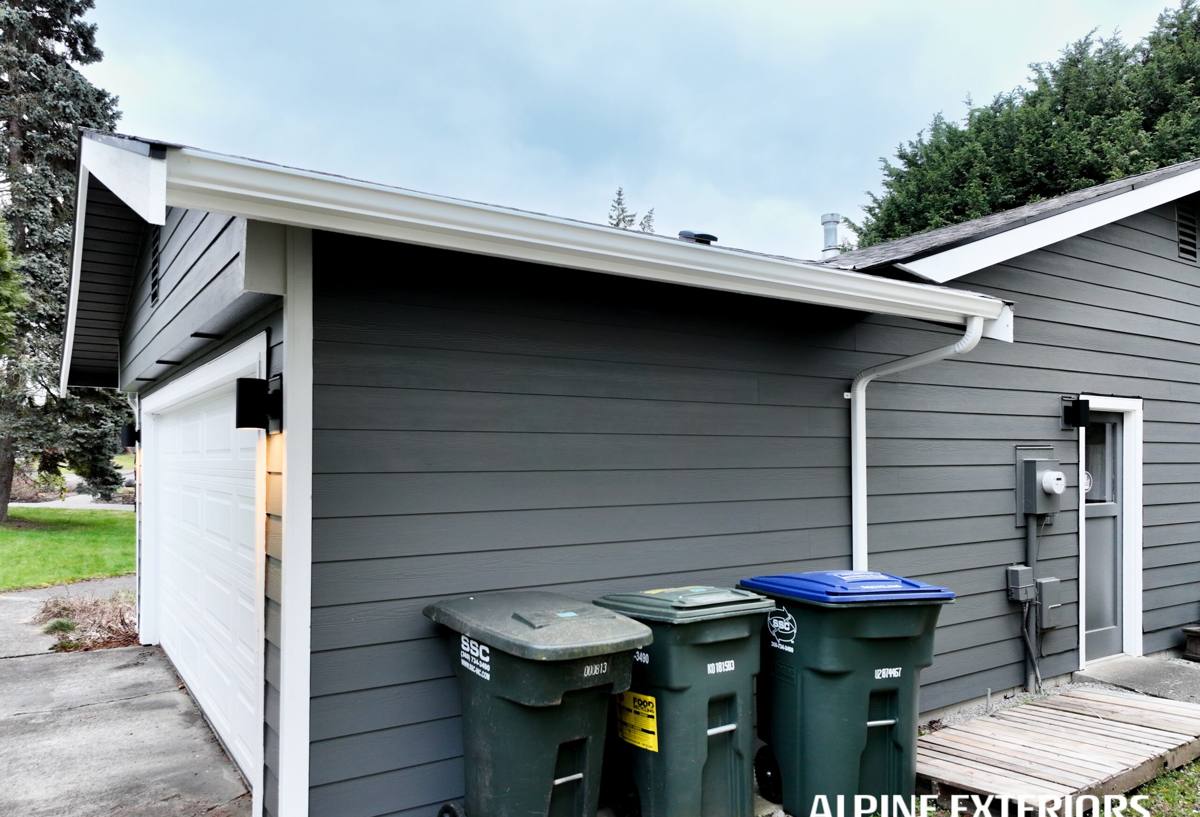
Signs a Capitol Hill Home Needs Siding Replacement
Most siding failures we see on Capitol Hill homes follow a familiar pattern: moisture gets behind the siding at a joint, corner, or fastener, and by the time it's visible from the street, the damage has been building for a while. Some of the more reliable signs to check for:
- Siding that feels soft, spongy, or gives slightly when you press on it, especially near the bottom courses or under windows
- Paint that won't hold anymore — chalking, peeling, or needing a repaint far sooner than it used to
- Moss or dark green-black staining building up on horizontal surfaces and laps, particularly on shaded, north- or west-facing walls
- Visible cracking, warping, or buckling, common on older wood or wood-composite siding after years of wet-dry cycling
- Gaps opening up at trim, corner boards, or butt joints where caulking has failed
- A noticeable jump in heating bills, which can point to moisture-compromised insulation behind the siding
- A musty smell in an interior room along an exterior wall
Any one of these on its own might just need a repair. Several at once, or damage that keeps coming back in the same spot, usually means the siding system itself has reached the end of its useful life.
Why Capitol Hill's Housing Stock and Lot Layout Change the Job
Tight Lots and Close-Set Neighbors
Capitol Hill is a dense, walkable neighborhood, and that density shows up on the job site. Setbacks are often narrow, driveways are short or nonexistent, and the house next door can be a matter of feet away. That changes how a crew has to work — where scaffolding and staging can go, how materials get moved in without blocking a sidewalk or a neighbor's access, and how much care goes into protecting the property line, not just your own home. A crew that hasn't worked this kind of lot before will move slower and make more mess doing it.
A Mix of Century-Old Homes and Newer Construction
The neighborhood has a real mix of building eras — older Craftsman-style and early-1900s homes with traditional narrow-lap siding profiles standing next to newer infill construction and multifamily buildings. On the older homes, matching the existing reveal, trim depth, and corner detailing matters if you want the house to still look like itself after the work is done. On newer homes, the priority is usually more straightforward performance and appearance. Either way, it's a job that benefits from a crew that has actually done this kind of matching before, not one working from a single standard template.
What a Correct Siding Replacement Actually Involves
Siding replacement is not just stripping old panels and nailing up new ones. Done right, it's really a whole-wall moisture-management job, and skipping steps is exactly how a home ends up with the same problems again in ten years instead of thirty.
- Full tear-off of the old siding rather than installing new siding over it — overlaying traps moisture and hides existing damage instead of fixing it
- Inspection of the sheathing once the old siding is off, since this is the only real chance to find rot or water damage before it's covered up again
- Repair or replacement of any compromised sheathing before new siding goes on
- Proper installation of a water-resistive barrier, lapped and sealed correctly so water sheds outward instead of working its way in
- Correct flashing at every window, door, and penetration — the single most common place we find past installation shortcuts
- A drainage gap or rain screen approach where it's appropriate for the wall assembly, which matters more in a climate as wet as ours
- Fastening to manufacturer spec — pattern, spacing, and depth all affect how the siding performs over decades, not just how it looks on day one
Every one of these steps is invisible once the job is finished. That's exactly why it's worth asking a contractor to walk you through their process before you hire them, not just their finished-product photos.
Why We Install James Hardie Fiber Cement — Not Vinyl or LP SmartSide
We standardized on James Hardie fiber cement siding, and we don't install vinyl, LP SmartSide, or other wood-composite products. That's a deliberate call, not a default. Vinyl is inexpensive and low-maintenance, but it can warp or crack over time and doesn't hold up as well in high-wind, driving-rain conditions like ours. LP SmartSide and similar engineered-wood products perform reasonably well when installation is flawless, but they're wood-based, which means they're more sensitive to the exact conditions Capitol Hill throws at siding — sustained moisture, shade, and moss.
James Hardie's fiber cement is non-combustible, doesn't feed moss and rot the way wood-based products can, and comes with a factory-applied ColorPlus finish that holds color and resists the constant UV-and-rain cycle here far longer than field-applied paint. Hardie also builds its HZ product lines to be climate-engineered for specific regions, which matters in a marine climate where moisture exposure is closer to constant than seasonal. It's backed by a strong, transferable warranty when installed to spec — which is also why correct installation, not just the material choice, is the other half of getting this right.
Our Siding Replacement Process in Capitol Hill
- On-site estimate and inspection — we look at your current siding, trim, and as much of the wall condition as we can assess before tear-off, and talk through what we're seeing.
- Sheathing and damage assessment — once tear-off begins, we identify any rot or water damage and give you a clear picture of what repair is actually needed, with no surprise scope creep hidden until the end.
- Material and color selection — choosing the right Hardie profile and ColorPlus color for your home's style, whether that's matching a traditional Capitol Hill lap profile or a more modern look.
- Site protection and staging — planning around tight lots, shared property lines, landscaping, and neighbor access before any material moves.
- Tear-off, repair, and installation — following manufacturer flashing, barrier, and fastening specs throughout, not just on the parts that show.
- Final walkthrough — going over the finished work with you directly and addressing anything on the punch list before we consider the job done.
Cost Factors for Siding Replacement in Capitol Hill
Every home is different, so we won't quote a number without seeing your house, but these are the factors that actually move the price up or down on a Capitol Hill siding replacement:
| Factor | Why It Matters |
|---|---|
| Home size and wall area | More square footage means more material and labor, the largest single cost driver |
| Sheathing repair needed | Rot found after tear-off adds material and labor that can't be priced until the old siding is off |
| Trim and detail complexity | Older Capitol Hill homes with corner boards, window trim, and multiple reveals take more time to do right |
| Siding profile and color | Different Hardie profiles and ColorPlus finishes carry different material costs |
| Site access and lot constraints | Tight lots, limited staging space, and close neighbors can add time for careful, respectful work |
| Condition of existing siding | Multiple layers or difficult-to-remove old siding adds to tear-off time |
Why Local Experience in Capitol Hill Matters
A crew that regularly works Capitol Hill knows what to expect before they even start: the narrow lots, the on-street parking realities, the mix of century-old framing and newer builds, and the specific shaded, tree-heavy blocks where moss and slow-drying walls are the norm rather than the exception. That familiarity shows up in small but real ways — staging a job without blocking a sidewalk for days, knowing where to look first for hidden rot on a home of a certain age, and setting realistic expectations about how weather will affect the schedule.
It also means fewer surprises for you. A contractor who's done this exact kind of job, on this exact kind of street, on this exact kind of housing stock, isn't guessing — they're applying what they've already learned here in Seattle and King County, not somewhere with a completely different climate.
If your Capitol Hill home is showing signs of siding wear, or you're just planning ahead, we're happy to take a look and walk you through what we find. Reach out for a free, no-pressure estimate using the form below.