 Seattle Siding
 Why Fremont Decks Wear Out Faster Than You'd Expect
Fremont's mix of mature tree canopy, close-set older homes, and proximity to the water means decks here deal with a specific combination of stress that drier climates never see. Seattle's long, wet season keeps wood and composite surfaces damp for weeks at a time, and King County's driving rain doesn't fall straight down — it comes in sideways during winter storms, working its way under flashing, around ledger boards, and into fastener holes that look fine from the top.
Add in the salt air that drifts inland off Puget Sound and the Ship Canal, and you get accelerated corrosion on anything metal — nails, screws, joist hangers, railing hardware. A fastener that would last decades in a dry inland climate can start rusting and weeping stains within a few winters here. Combine that with heavy shade from Fremont's tree cover, and you've got the ingredients for a long moss season that keeps deck boards perpetually damp and slick.
None of this means a deck in Fremont is doomed — it means a deck here needs to be built and repaired with those specific stresses in mind, not treated the way a contractor unfamiliar with the Pacific Northwest might treat it.
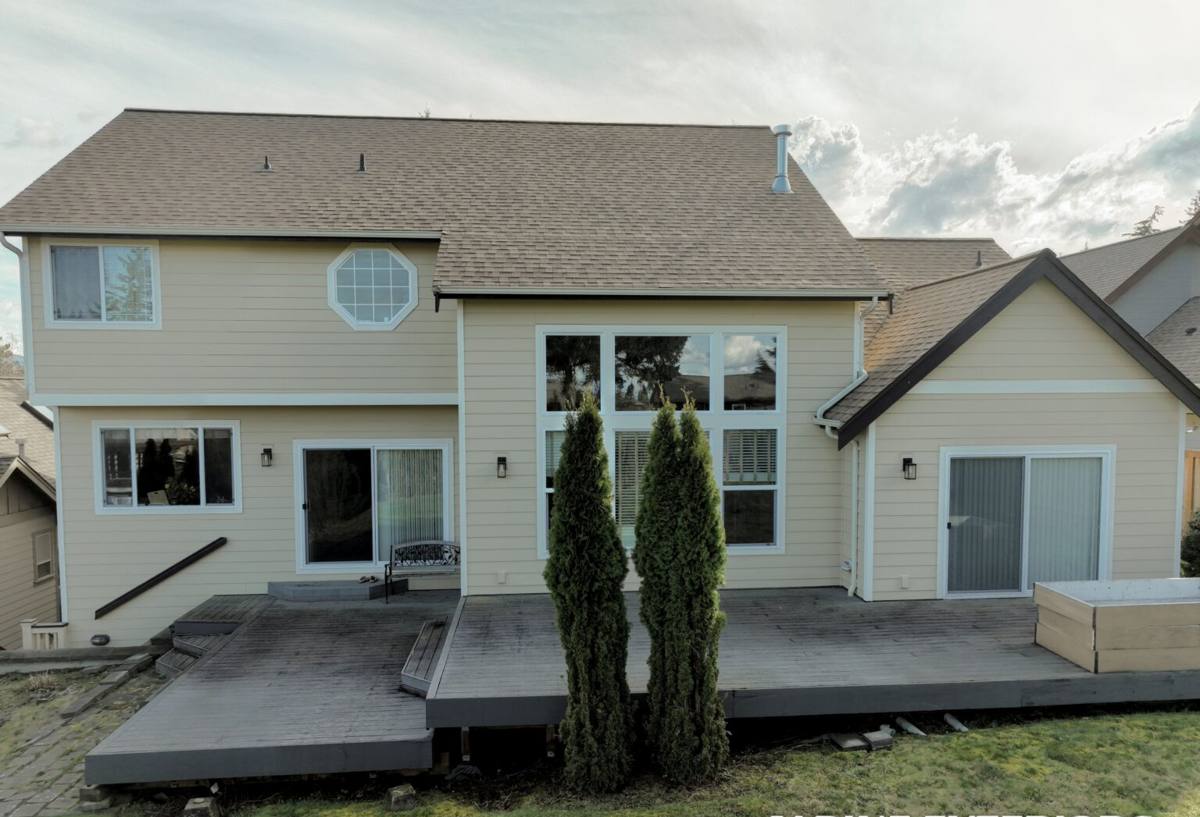
Signs Your Deck Needs Repair — Not Just a Cleaning
Structural Warning Signs
These are the ones that matter most, because they affect safety, not just appearance:
- Soft, spongy, or springy spots when you walk across the deck
- Rot or dark staining at the ledger board where the deck attaches to the house
- Loose, wobbly, or leaning railings and posts
- Visible gaps or separation between the deck and the house wall
- Rust streaks running down from screws, nails, or joist hangers
- Stairs that flex or feel unstable underfoot
Surface-Level Issues
These are worth fixing before they become structural problems: graying or checking (splitting) wood, boards that have cupped or warped, persistent moss or algae film that stays slick even after light rain, and fastener heads that have popped up above the board surface. Left alone through another Seattle winter, most of these turn into the structural issues above.
What an Honest Deck Repair Actually Involves
A repair that only addresses what's visible from the top is a repair that fails again in a season or two. A correct deck repair in this climate has to account for what's happening underneath and behind the surface.
Ledger and Attachment Points
The ledger board — where the deck ties into the house — is the single most common failure point on Pacific Northwest decks, because it's where water most easily gets trapped against wood. Proper repair means checking for correct flashing, verifying the ledger isn't rotted behind the rim joist, and confirming the attachment hardware is rated for exterior, corrosion-resistant use.
Framing and Joists
Rot doesn't always show on the surface. We check joists and beams for soft spots, especially near the ledger and anywhere water tends to pool or run. Damaged framing gets sistered or replaced — never just covered over with new decking on top of a compromised structure.
Decking Boards and Fasteners
Individual board replacement only makes sense when the framing underneath is sound. We match board profile and spacing so repairs don't stand out, and we use fasteners rated for the decking material and for coastal Washington's damp, salt-tinged air.
Railings and Stairs
Because these are the parts people lean on and grab, we check post attachment, baluster spacing against current code, and connection hardware — not just whether the railing looks straight.
Wood vs. Composite: What It Means for Repair
What your deck is built from changes what "repair" looks like and how often you'll need it. Here's the honest comparison for a home in this climate:
| Factor | Wood (Cedar / Pressure-Treated) | Composite |
|---|---|---|
| Common failure mode locally | Rot at ledger, fastener holes, and end grain from constant moisture exposure | Moisture behind capped boards, fastener pull-through, fading at seams |
| Moss and algae resistance | Low — porous surface holds moisture, needs regular cleaning | Better, but still grows in deep shade without airflow |
| Repair approach | Sand, treat, or replace individual boards; refinish periodically | Board replacement only — can't be sanded or refinished |
| Typical repair frequency | More frequent, smaller repairs over the deck's life | Less frequent, but individual board cost is higher |
| Long-term maintenance | Cleaning, staining/sealing every 2-3 years in this climate | Periodic cleaning; no staining or sealing needed |
Neither is the "wrong" choice — they're different maintenance commitments. Our job is telling you honestly what your specific deck needs, not steering you toward whatever's easiest for us to install.
How We Approach a Deck Repair Job
Our process is the same whether the job is one rotted stair tread or a full structural rebuild of the substructure:
- On-site inspection. We check the ledger, framing, decking, railings, and stairs — probing suspect wood rather than just looking at it, since surface graying can hide sound wood and a clean-looking board can hide rot underneath.
- Honest scope and estimate. We tell you what actually needs repair, what's still sound, and what's worth watching for next year. We won't pad a repair into a replacement just to increase the job size.
- Repair or replacement, matched to the deck's condition. Sound framing with damaged boards gets board-level repair. Compromised framing gets addressed at the structural level before any new decking goes down.
- Code-correct hardware and flashing. Especially at the ledger and any new post connections, since this is where Pacific Northwest decks most often fail again after a rushed repair.
- Cleanup and a final walkthrough. So you know what was done and what to keep an eye on going forward.
Repair or Replace? The Factors That Actually Decide It
Homeowners often assume any deck problem means full replacement, or the opposite — that everything can be patched. Neither assumption is reliable. What actually decides it:
- Age and condition of the framing. Sound joists and ledger under damaged boards almost always favor repair.
- Extent of rot. Isolated rot at a few boards or one stair is a repair. Rot tracking through multiple joists or the ledger itself usually isn't worth chasing board by board.
- How the original deck was built. A deck with poor flashing or undersized framing from the start will keep generating repair calls no matter how many individual boards get swapped.
- How long you plan to stay in the home. A deck that needs a repair every year or two costs more over five years than one solid rebuild.
We'll give you our honest read on which side of that line your deck falls on — including telling you when repair is clearly the right call, even if a rebuild would be the bigger job for us.
Moss, Shade, and Year-Round Deck Care in Fremont
Fremont's tree cover is part of what makes the neighborhood pleasant to live in, but it's also exactly what extends moss season and keeps decks damp long after the rain stops elsewhere in Seattle. A few habits go a long way toward stretching the life of a repair:
- Sweep leaves and debris off the deck regularly through fall — trapped organic matter holds moisture against the wood and feeds moss growth
- Clean moss and algae off with a deck-safe cleaner rather than a pressure washer alone, which can drive water into seams and fastener holes
- Check and clear gaps between boards so water can drain instead of pooling
- Keep an eye on any spot that stays shaded and damp longest after a storm — that's usually where problems start first
- Re-seal or re-stain wood decking on the schedule appropriate for your product, rather than waiting until it visibly needs it
Why a Crew That Already Works in Fremont Makes a Difference
Deck problems here aren't generic — they're shaped by this specific mix of rain patterns, tree shade, and the salt-tinged air that comes with living near Seattle's waterways. A crew that works Fremont regularly already knows which failure points show up most often in this neighborhood's housing stock, what King County permitting requires for structural deck work, and how to spec hardware that actually holds up through a Pacific Northwest winter instead of failing again in two years.
That local familiarity means less guesswork during the inspection and a repair scope you can trust the first time, instead of a second visit next season for a problem that should have been caught the first time around.
If your deck has soft spots, rust stains, stubborn moss, or just doesn't feel as solid as it used to, we're happy to take a look. Fill out the form below for a free, no-pressure estimate — we'll tell you honestly what your deck needs, and nothing more.