 Seattle Siding
 Deck Replacement in Rainier Valley: What Seattle's Climate Does to an Aging Deck
Rainier Valley is one of Seattle's larger residential neighborhoods, and a lot of the decks attached to homes here were built years or decades ago — some by the original builder, some added later by a previous owner. A deck that age has usually been through a long run of Puget Sound winters, and in this part of King County that means sustained exposure to salt-tinged marine air, driving rain that doesn't always fall straight down, and a moss season that can run most of the year on any surface that stays shaded and damp. None of that is unique to Rainier Valley, but it's the reality every deck in this region has to hold up against, and it's a big part of why decks here tend to show their age earlier than homeowners expect.
A deck replacement isn't just swapping old boards for new ones. The structure underneath — framing, posts, footings, and the ledger connection to the house — is usually where the real problems live, and those are the parts a homeowner can't always see from the surface. This page covers what actually causes decks to fail in this climate, how we decide whether a deck needs full replacement or can be repaired, and what a correctly built replacement involves for a Rainier Valley property.
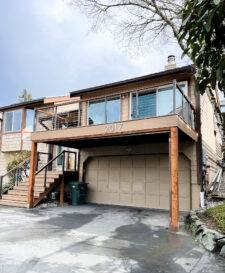
Signs a Rainier Valley Deck Has Reached the End of Its Life
Some deck problems are cosmetic and some are structural, and the difference matters for both safety and cost. These are the signs worth taking seriously:
- Soft, spongy, or spring-feeling boards anywhere on the deck surface
- Visible rot, splitting, or discoloration at the ledger board where the deck meets the house
- Posts that feel loose, wobble under weight, or show soft wood near ground contact
- Rust streaking around fasteners, joist hangers, or other hardware
- Persistent moss or algae buildup that comes back within weeks of cleaning
- Railings that flex, wobble, or don't feel solid when leaned on
- A deck that was never properly flashed or permitted when it was originally built
Any one of those on its own might be a repair. Several of them together, especially anything involving the ledger board, posts, or framing, usually means the deck has moved past the point where patching individual boards makes sense.
Why Decks Fail the Way They Do in This Climate
Ledger Board and Ledger Flashing
The ledger board — the piece that attaches the deck directly to the house — is the single most important structural connection on most decks, and it's also one of the most common failure points in a wet climate like Seattle's. If it wasn't flashed correctly when the deck was built, water works its way behind the ledger and into the house framing behind it, which is a problem that goes well past the deck itself. Older decks around King County were often built before current flashing standards were common practice, and that gap is one of the first things we check on any replacement.
Posts, Footings, and Ground Contact
Wood posts set in or near the ground take on moisture from below as well as above, and in a region where the ground rarely dries out fully between fall and spring, that ground-contact moisture adds up over years. Footings that were undersized or set too shallow to begin with can also shift over time, which shows up as a deck that feels less solid than it used to even before any wood damage is visible.
Fastener and Hardware Corrosion
Marine-influenced air across the Puget Sound region speeds up corrosion in standard-grade fasteners, joist hangers, and post hardware. A fastener that's visibly rusting has usually already lost some of its holding strength before it looks bad enough to notice, and on a structure people stand and walk on, that's not something to wait out.
Moss, Algae, and Surface Decay
Mild temperatures combined with near-constant fall-through-spring moisture give moss a long growing season in Seattle, and a horizontal deck surface holds water longer than a vertical wall does. Shaded decks and boards that were installed without enough gap for drainage are usually the first to show it, and once moss and trapped moisture get into wood decking, the surface degrades faster than exposure alone would explain.
Repair or Replace: How We Make the Call
Not every deck problem calls for a full tear-out. The decision usually comes down to what's failing — surface, structure, or both.
| Condition | Repair Often Makes Sense | Replacement Usually Makes Sense |
|---|---|---|
| A few worn or discolored boards, sound framing underneath | Yes — spot board replacement | Not needed on its own |
| Loose railing, isolated hardware wear | Yes — hardware and railing repair | Only if framing is also compromised |
| Rot or softness at the ledger board | Rarely a lasting fix | Yes |
| Soft or shifting posts and footings | Rarely a lasting fix | Yes |
| Deck never properly flashed or permitted originally | Sometimes, if access allows correction | Yes, in most cases |
| Widespread board failure across the whole surface | Possible short-term patch | Yes — more cost-effective long term |
We give a straightforward read on which category a given deck falls into rather than defaulting to a full replacement recommendation on every call. Sometimes a deck genuinely just needs a handful of boards and a hardware check.
Decking and Structural Material Options for a Replacement
Framing and Substructure
Whatever decking surface goes on top, the framing underneath needs to be sized correctly for the span and load, built from lumber rated for sustained moisture exposure, and fastened with corrosion-resistant hardware throughout. This is the part of a replacement that determines how long the deck actually lasts, even though it's the part homeowners see the least once the job is finished.
Decking Surface
For the visible surface, homeowners in Rainier Valley are generally choosing between wood, capped composite, and cellular PVC. Wood — pressure-treated lumber or cedar — costs less up front but needs regular sealing or staining to hold up against this region's moisture, and it's usually the first material to show moss and graying without upkeep. Capped composite has a protective shell around a wood-fiber core that resists moisture absorption and staining far better than uncapped composite or wood, which matters in a climate this wet. Cellular PVC contains no wood fiber at all, so it resists moisture even at cut edges and fastener holes, generally at a higher price point. There isn't a universally correct answer — it depends on budget, how much upkeep a homeowner wants to take on, and how exposed the deck is to shade and moisture.
What a Correct Deck Replacement Involves
The decking surface gets most of the attention, but the details underneath are what actually determine whether a replacement lasts years or decades in this climate. A correct job includes:
- Full tear-out of the old structure so framing, posts, and footings can be inspected and replaced where needed, not just resurfaced
- Correct ledger board flashing that ties into the house's weather-resistive barrier, not caulk used as a substitute for real flashing
- Footings and posts sized and set to current structural standards, not matched to whatever the original deck happened to have
- Corrosion-resistant fasteners and joist hangers throughout, rated for sustained marine-air exposure
- Board gapping calculated for drainage and material movement so wind-driven rain can actually clear the surface
- Railing and stair construction that meets current safety requirements, especially on older decks that predate current code
- Grading and ventilation underneath the deck so moisture doesn't sit against the framing between storms
Skip the structural details and a new deck can still look good for a season or two before the same underlying problems start over.
Permits and Code: What Changes When an Older Deck Comes Out
Deck replacement in Seattle generally requires a permit, and the requirements a deck has to meet today — railing height, guard spacing, footing depth, ledger attachment — are often stricter than what was standard when an older Rainier Valley deck was originally built. That's one of the reasons a full replacement is often the right call on an aging deck even when the surface boards still look serviceable: bringing the structure up to current requirements usually means more than a resurfacing job can address. We handle the permitting process as part of the work rather than leaving it for the homeowner to sort out separately.
Our Deck Replacement Process
We start with an on-site look at the existing deck — checking the ledger connection, posts and footings, framing condition, and how the current structure was originally built and flashed. From there we give an honest read on whether replacement is the right call, walk through decking material options that fit the budget, and provide a written scope before any work begins. Once permitted, the old structure comes out, the new framing and structural connections go in first, and the decking surface, railing, and stairs follow. We finish with a walkthrough covering what the specific material you chose needs going forward, since upkeep needs vary a fair amount between wood and composite or PVC.
Why It Matters That We Already Work Rainier Valley
A crew that mostly builds decks in drier parts of the country can still frame one competently, but a Seattle deck replacement has variables that come up constantly here and rarely elsewhere — ledger flashing that has to hold up against sustained wind-driven rain, fastener grades that account for marine-influenced air across the region, and moss pressure that runs longer than in most other parts of the country. Working Rainier Valley and the rest of Seattle regularly means we're not guessing at those requirements. We've seen which structural details actually hold up against this area's specific combination of rain, humidity, and shade, and which ones are worth the extra time rather than an unnecessary upsell. That familiarity also helps with the practical side of a project — realistic scheduling around the wetter months and straightforward answers about King County permitting for a job like this.
If your deck is showing its age — soft boards, a wobbly railing, or just decades of Seattle weather catching up with it — we're happy to take a look and give you an honest, no-pressure read on repair versus replacement. Reach out below for a free estimate.