 Seattle Siding
 Ravenna's Older Housing Stock Needs Siding That Actually Handles Seattle Weather
Ravenna is one of Seattle's older, well-established neighborhoods, which means a lot of the homes here are carrying original or long-since-replaced siding that was never engineered for what King County weather actually does to a house. Seattle doesn't get hurricanes or hard freezes, but it gets something arguably harder on a building envelope: months of low-intensity, driving rain, humid marine air pushed in off Puget Sound, and long stretches where north-facing and shaded walls barely dry out between storms. Add moss, which thrives in exactly that kind of damp, shaded, cool environment, and you've got a climate that's quietly brutal on the wrong siding material.
We install James Hardie fiber cement siding exclusively, and Ravenna is a good example of why. Homes here often sit under mature tree canopy, close to neighbors, with north and west walls that stay damp for days at a time in the wet season. That's a tough environment for wood-based products and an easy one for cement-based siding that isn't going to swell, rot, or feed mold the way organic materials can.
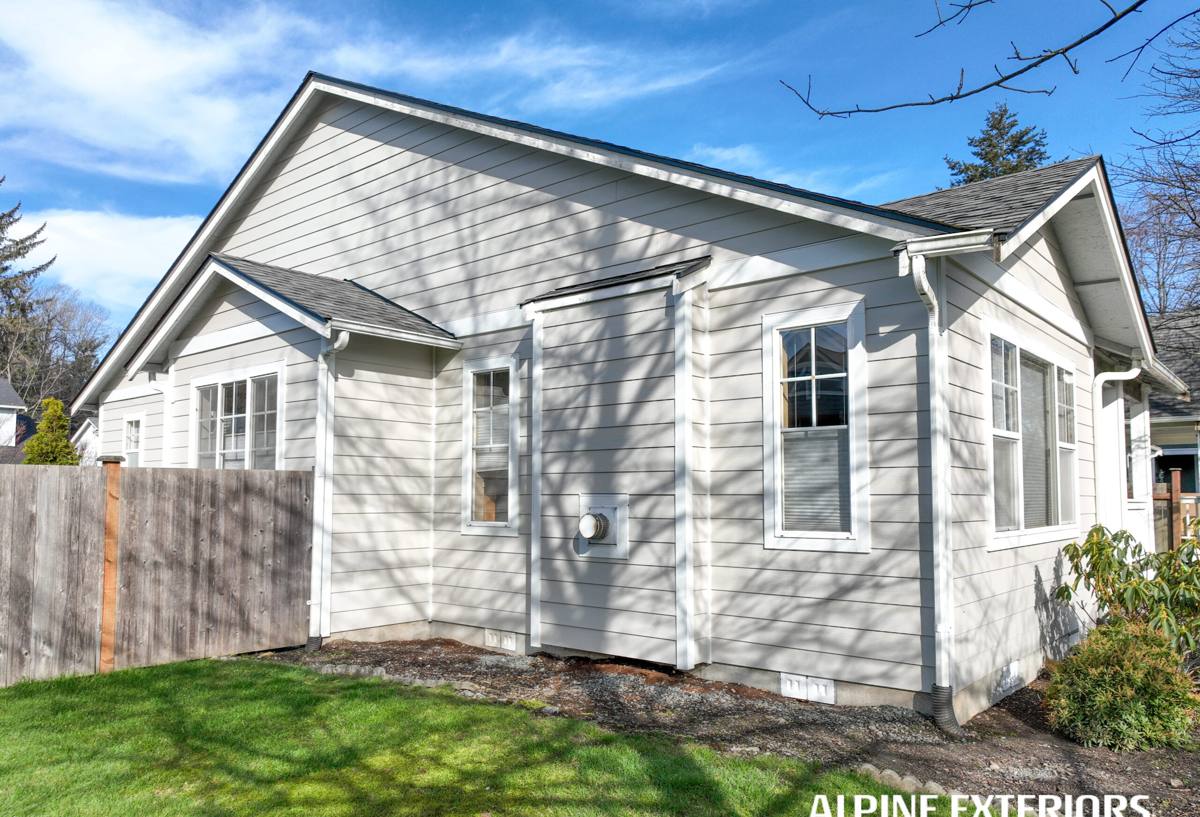
What Seattle's Climate Actually Does to Siding Over Time
Driving Rain and Wind-Driven Moisture
Seattle rain isn't usually a downpour — it's a slow, sideways drizzle that can last for days. That pattern is worse for siding than a hard storm in some ways, because it drives moisture into every seam, lap joint, and fastener hole rather than sheeting off quickly. Any siding material that isn't dimensionally stable when wet, or that relies on paint film alone to keep water out, is going to show it eventually as cupping, swelling, or soft spots.
The Long Moss Season
King County's moss season effectively runs most of the year on shaded exposures. Moss holds moisture directly against the siding surface, keeps that surface cooler and damper than the surrounding air, and — on wood-based or engineered wood products — can accelerate rot at the exact spots it colonizes. On the wrong siding, moss isn't just a cosmetic nuisance; it's a moisture trap sitting right on the wall.
Salt Air and Marine Exposure
Ravenna isn't waterfront, but Seattle's whole airshed carries salt air off Puget Sound, and that marine moisture load affects fasteners, caulk, and painted finishes citywide, not just on homes with a water view. Over years, that salt-laden humidity is part of why fastener corrosion and paint film breakdown show up sooner here than they would in a dry inland climate.
Why James Hardie Fiber Cement Is the Right Match for This Climate
James Hardie siding is fiber cement — sand, cement, and cellulose fiber, engineered and cured to be dimensionally stable and non-combustible. It doesn't absorb bulk water into its core structure the way wood or wood-fiber composite products can, and it isn't a food source for the mold and moss spores that thrive in Seattle's wet months. That's the core reason we standardized on it rather than the wood-based or vinyl alternatives still common around Ravenna.
The HZ5 Engineering Detail That Matters Here
James Hardie engineers its siding in climate-specific "HZ" formulations, and the Pacific Northwest falls into a moisture zone where that engineering is genuinely relevant, not just a marketing label. The product is formulated for a climate where siding spends a large share of the year damp, which is exactly the Seattle reality.
ColorPlus Factory Finish
Most Hardie siding we install uses the ColorPlus factory-applied finish system rather than field-applied paint. That finish is baked on under controlled conditions and backed by its own finish warranty, which matters in a climate where field-applied paint has to cure and adhere properly in between rain events — not always a guarantee in a Seattle fall or winter install window.
What a Correct Hardie Installation Involves
The siding material is only half the equation. A large share of the moisture problems we get called out to inspect on other contractors' work trace back to installation shortcuts, not the product itself. On a Ravenna home, correct installation means:
- Proper water-resistive barrier and flashing detail at every window, door, and penetration — this is where most leaks actually originate, not through the field of the siding
- Correct fastener type, spacing, and depth per James Hardie's published installation instructions, since under- or over-driven fasteners are a common cause of premature failure
- Minimum clearance gaps at grade, roof lines, decks, and other transitions so the siding isn't sitting in standing water or trapped moisture
- Proper joint treatment and caulking at butt joints and trim, sized and sealed to move with the building without opening a water path
- Rainscreen or drainage plane detailing where the wall assembly calls for it, giving any incidental moisture a way out instead of trapping it against the sheathing
Skipping any one of these doesn't usually show up in year one. It shows up in year five or six, as staining, soft trim, or a warranty claim that gets denied because the installation didn't meet manufacturer specification. That's a real risk with any siding product, but it's especially relevant with fiber cement, where James Hardie's product warranty has installation requirements attached to it.
Our Process for a Ravenna Siding Project
1. On-Site Assessment
We walk the exterior, check for existing moisture damage behind current siding (common on older Ravenna homes with multiple past repaint or repair cycles), and evaluate wall orientation, shade, and drainage before recommending a scope of work.
2. Tear-Off and Sheathing Check
Once old siding comes off, we inspect sheathing condition directly. This is often the point where hidden moisture damage from a prior siding failure gets caught — and it's much cheaper to address before new siding goes on than after.
3. Weather Barrier and Flashing
We install or verify the water-resistive barrier and flashing details around every penetration before a single piece of Hardie board goes up. This step is where long-term performance is actually decided.
4. Installation to Manufacturer Spec
Fastening, clearances, and joint treatment follow James Hardie's published requirements, which keeps the product's transferable warranty intact for the homeowner.
5. Final Walkthrough
We review the finished work with the homeowner, including care and maintenance basics specific to a shaded, damp Ravenna lot if that applies to the property.
Comparing Siding Options for a Shaded, Damp Ravenna Lot
| Factor | James Hardie Fiber Cement | Wood-Based / Engineered Wood Siding | Vinyl Siding |
|---|---|---|---|
| Moisture absorption | Minimal — cement-based, not an organic food source for mold or moss | Higher risk — wood fiber can absorb and hold moisture | Doesn't absorb water, but traps moisture behind it if not vented properly |
| Behavior in shaded, moss-prone areas | Resists moss colonization better; surface doesn't feed organic growth | More susceptible to moss-driven surface breakdown over time | Doesn't feed moss, but seams and laps can trap trapped moisture |
| Fire rating | Non-combustible | Combustible | Combustible, can deform under heat |
| Finish durability | ColorPlus factory finish, separate finish warranty | Field-applied paint, needs regular repainting | Color molded in, but can fade and become brittle over time |
| Typical lifespan when correctly installed | Multiple decades | Shorter, especially in wet climates without diligent maintenance | Multiple decades, but seams and fasteners are common failure points |
What Homeowners Often Miss About Cost
Siding pricing gets quoted as a per-square-foot number, but the real cost drivers on a Ravenna project are usually less obvious than the material itself:
| Cost Factor | Why It Matters Here |
|---|---|
| Sheathing condition after tear-off | Hidden rot from a prior siding failure is common on older homes and adds repair scope once discovered |
| Wall complexity and trim detail | Older Ravenna homes often have more architectural detail than newer construction, adding labor time |
| Access and site constraints | Mature trees, narrow side yards, and close-set neighboring homes can slow staging and scaffolding |
| Siding profile chosen | Lap, shingle, and board-and-batten profiles carry different material and labor costs |
| Trim and fascia scope | Full exterior packages that include trim replacement cost more than a straight siding swap but avoid a mismatched finish |
We don't publish a flat per-square-foot number because these factors genuinely swing the total — the honest answer only comes from walking the property.
Why Hiring a Crew That Already Works in Ravenna Matters
Siding installation quality depends heavily on whether the crew understands the specific conditions of the wall they're covering. A crew that regularly works Seattle neighborhoods like Ravenna already knows to check for the moss and moisture patterns typical of mature, tree-shaded lots, to expect the kind of sheathing condition common on homes of a certain age, and to plan installation timing around the reality of a wet-season work window rather than assuming dry, predictable weather. That local pattern recognition is part of what keeps a project on schedule and free of surprises.
It also matters for warranty support. James Hardie's transferable warranty is only as good as the installing contractor's standing and documentation, and a local crew that's still around — and still installing to spec on other homes in your neighborhood — is a meaningfully different position than a contractor who moves through an area once and doesn't come back.
Get a Free, No-Pressure Estimate
If your Ravenna home's siding is showing moss, staining, soft spots, or you're simply due for a replacement, we're happy to walk the property and give you a straightforward assessment — no pressure, no inflated urgency. Fill out the form below to schedule a free estimate.