 Seattle Siding
 Building Decks That Hold Up in Redmond's Climate
Redmond sits inland from Puget Sound but still gets the full Pacific Northwest weather package: long stretches of driving rain from fall through spring, heavy morning dew even in summer, and a moss season that seems to run most of the year. A deck built without that reality in mind will look fine for a season or two and then start showing problems — soft spots, black streaking, slick algae film, and fasteners that bleed rust through the boards. A deck built for this climate handles all of it and keeps handling it for decades.
We work throughout the greater Seattle area and King County, and Redmond decks get a specific set of considerations: tree cover from mature landscaping that keeps decking damp longer after a storm, valley fog that adds to the moisture load, and yards that often slope enough to make proper drainage and footing depth non-negotiable. None of this is exotic — it just has to be planned for instead of ignored.
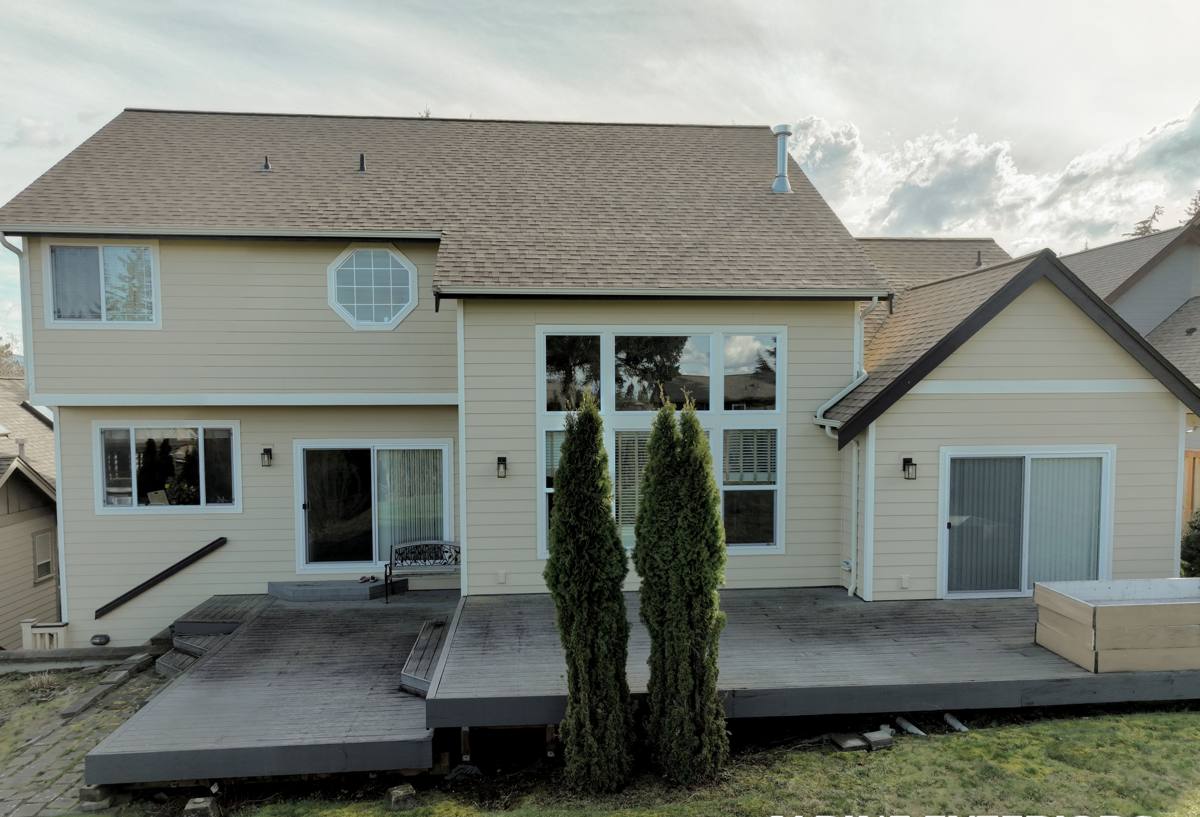
What a Redmond Deck Actually Needs
Every custom deck we build here gets evaluated against the same short list of climate demands before we ever talk about style or layout:
- Moisture management underneath, not just on top. Ledger boards, joists, and posts need airflow and proper flashing so water doesn't sit against wood or fasteners.
- Fastener and hardware corrosion resistance. Standard coated screws and hangers rust and streak decking within a few wet seasons in this climate. We use stainless or heavy-duty coated hardware rated for exterior, high-moisture use.
- Surface footing that stays slip-resistant when wet or mossy. Smooth composite or poorly grooved wood gets dangerous fast under a film of algae.
- Drainage away from the house and any lower structure. A deck attached to the home needs to shed water away from the siding and foundation, not funnel it back toward them.
- UV and moisture-stable finishes. Coatings that aren't rated for both sun exposure and constant damp cycling fail early — peeling, graying, or trapping moisture underneath.
Decking Material Options: Honest Trade-Offs
We install several decking material types, and each one has a different maintenance and moisture profile. There's no universally "best" choice — it depends on budget, how much upkeep you want to do, and how the deck sits relative to shade and drainage.
| Material | Moisture Behavior | Maintenance | Typical Lifespan |
|---|---|---|---|
| Pressure-treated lumber | Absorbs and releases moisture; needs sealing to control swelling and checking | Annual cleaning, re-sealing every 1-2 years | 15-20 years with upkeep |
| Cedar | Naturally moisture and rot resistant; still needs finish maintenance | Cleaning and re-staining every 1-2 years | 20-25 years with upkeep |
| Composite (capped) | Sheds surface moisture well; won't rot, but low-quality or uncapped boards can absorb at cut edges | Periodic cleaning to prevent moss/algae film; no sealing or staining | 25-30+ years |
| PVC | Fully moisture-resistant surface | Low; occasional cleaning | 25-30+ years |
We steer most Redmond clients toward capped composite or cedar depending on the look they want, mainly because both handle the region's moisture cycling well when detailed correctly underneath. Pressure-treated lumber is still a sound, budget-friendly choice for a substructure or a simpler deck — it just needs a homeowner willing to keep up with sealing.
Why We're Selective About Uncapped Composite
Some early-generation composite decking without a fully capped shell can absorb moisture at cut ends and fastener holes over time, leading to swelling or surface staining in a climate this wet. It's not that the product is bad everywhere — it's that our standard for this specific climate calls for fully capped boards with sealed cut edges, because the moisture exposure here is more constant than in drier regions where that same board might perform fine.
Substructure: The Part Nobody Sees But Everyone Relies On
The framing under a deck matters more in a wet climate than almost anywhere else, because it's the part that stays damp longest after every rain event. We build substructures around a few non-negotiables:
- Joists and beams sized and spaced to local building code, not shortcut spacing
- Post footings set to the required frost and bearing depth for King County soil conditions
- Proper ledger flashing where the deck attaches to the house, so water can't work behind the siding
- Joist tape or flashing on top of framing members to shed water off the wood instead of letting it pool
- Adequate ground clearance and airflow beneath the deck to prevent trapped humidity
A deck can look identical from the top and perform completely differently underneath depending on whether these details were done right. This is where corners get cut on cheap builds, and it's exactly where problems start.
Design Considerations Specific to Redmond Properties
Grade and Drainage
Many lots in and around Redmond have some slope, which means deck height, stair placement, and footing depth often need custom planning rather than a stock layout. We assess grade and existing drainage patterns before finalizing a design so the finished deck doesn't create a low spot that collects standing water.
Shade and Tree Cover
Mature landscaping is common in this area and it's a mixed blessing for a deck — great for comfort in summer, but it also means slower drying after rain and more moss and algae growth. We factor board spacing, surface texture, and finish choice around how much sun exposure a specific deck location realistically gets.
Railings and Code
Any elevated deck needs code-compliant railing height and baluster spacing, and in a region with heavy rain, railing material matters too — untreated metal hardware and connections corrode faster here than in drier climates, so we spec corrosion-resistant railing systems as standard.
Our Process for a Redmond Deck Project
- On-site assessment. We look at grade, drainage, sun exposure, and how the deck will attach to your home before recommending materials.
- Design and material selection. We walk through decking, railing, and finish options with honest trade-offs for your budget and how much maintenance you want long-term.
- Permitting. Most custom decks in this area require a permit; we handle the paperwork and inspections so you don't have to chase it down.
- Framing and flashing. This is where the climate-specific detailing happens — ledger flashing, joist protection, footing depth, and drainage planning.
- Decking, railing, and finish installation. Boards, railings, and any sealing or capping details go in last, once the structure underneath is solid.
- Final walkthrough. We go over maintenance expectations specific to the material you chose, so there are no surprises in year two or three.
Maintenance Realities in a Wet Climate
Whatever material you choose, plan on some level of seasonal upkeep if you want the deck to last. Here's what that looks like in practical terms:
- Sweep off leaves and debris regularly, especially in fall — trapped organic matter holds moisture against the surface and feeds moss growth
- Clean the deck surface at least once or twice a year to remove algae film before it becomes slippery or stained
- Check and re-seal wood decking on the schedule appropriate to that material — don't wait until it looks dry and gray
- Keep gutters and downspouts near the deck clear so runoff isn't dumping extra water onto or under the structure
- Inspect railings and fasteners annually for any early signs of corrosion or loosening
Why Hire a Crew That Already Works in This Area
A deck built to a generic national spec sheet isn't necessarily built for Redmond's actual weather pattern. Crews who work King County regularly already know how deep footings need to go for local soil and frost conditions, which hardware actually holds up through a full Puget Sound wet season, and how much drainage slope a deck needs on the sloped lots common in this area. That local experience shows up years later — in whether the deck is still solid, dry underneath, and free of rot at the ten-year mark, not just at the final walkthrough.
We also carry that same climate-first approach into everything else we do on a home's exterior, so a deck we build integrates properly with the siding, flashing, and drainage already in place — not as an afterthought bolted onto the house.
Get a Straightforward Estimate
If you're planning a custom deck in Redmond or anywhere else in the greater Seattle area, we're happy to walk your property, talk through material options honestly, and give you a clear estimate — no pressure, no upsell script. Fill out the form below to get started.