 Seattle Siding
 Redmond's Climate Is Harder on Siding Than It Looks
Redmond doesn't get the dramatic storms that make headlines, and it's far enough inland that it doesn't take the direct hit of marine weather the way waterfront King County neighborhoods do. But the Eastside's climate is still a slow, steady test for exterior siding: months of low-intensity rain, heavy tree canopy that keeps siding shaded and damp longer than it should be, and humidity that settles in around Lake Washington and Lake Sammamish and doesn't fully clear until late spring. Add in the broader Puget Sound region's marine air pattern, which pushes moisture inland across the whole metro area, and you get a wall assembly that's rarely bone-dry for more than a few weeks at a stretch between fall and early summer.
None of that is dramatic on its own. The problem is cumulative. Siding that's marginal on day one — a weak product, a rushed install, missing flashing — doesn't fail in year one. It fails in year eight or ten, quietly, behind a wall you can't see until the damage is already done. That's the standard we install to.
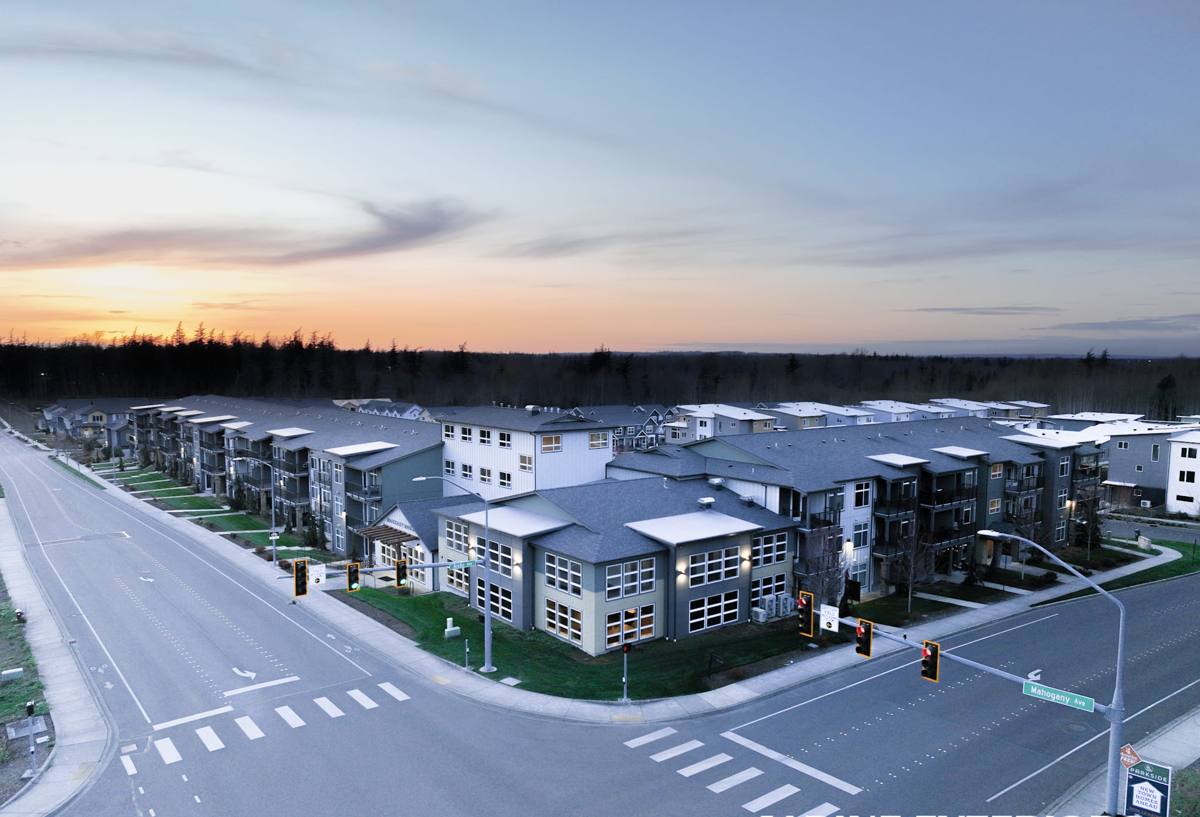
What Redmond Homes Actually Need From Their Siding
Moisture Management, Not Just Weather Resistance
A lot of homeowners think of siding as a shell that keeps rain out. That's part of it, but the bigger job is managing the moisture that gets past the surface — through nail holes, seams, window and door penetrations, and simple wind-driven rain. A correctly installed siding system assumes some water will reach the wall and gives it a way to drain and dry out before it becomes a problem. This is done with a drainage plane (typically a weather-resistive barrier with a rainscreen gap, or a purpose-built drainage wrap), correctly lapped and taped seams, and flashing at every horizontal transition — window heads, deck ledgers, roof-to-wall intersections.
Shade and Moss Tolerance
Redmond's mature tree cover is one of the neighborhood's best features and one of the tougher conditions for exterior materials. North- and east-facing walls under tree canopy stay damp longer, get less UV to dry them out, and are the first places moss and algae take hold. Siding material matters here — porous materials hold moisture and organic growth longer; a dense, factory-finished fiber cement surface sheds it faster and cleans up easier.
Long-Term Dimensional Stability
Wood-based and wood-derived siding products expand and contract with moisture cycles. Over a decade of Puget Sound wet seasons, that movement opens up seams, telegraphs through paint, and stresses caulk joints. A stable substrate matters as much as a water-resistant surface.
Why We Install Only James Hardie Fiber Cement
We don't offer a product menu. We install James Hardie fiber cement siding, full stop, and we turn down jobs where a homeowner wants vinyl, LP SmartSide, Cemplank, Allura, primed spruce, or cedar. That's not brand loyalty — it's a standard we built after weighing what actually holds up on Eastside homes over 20-plus years of Northwest wet seasons.
Fiber cement is dimensionally stable, non-combustible, and doesn't feed moisture into the wall assembly the way wood-based products can if a seam opens. Hardie's ColorPlus factory finish is baked on under controlled conditions, which gives it more consistent coverage and better fade resistance than field-applied paint on other substrates. And Hardie engineers separate product lines for different climate zones — the HZ5 line is built for the Pacific Northwest's moisture profile specifically, not a one-size-fits-all national spec.
We're not going to tell you other products are junk — plenty of them perform fine when installed correctly in the right climate. But we've made a professional call: for Redmond's rain, shade, and moss cycle, fiber cement done right is the product we're willing to put our name behind and warranty.
What a Correct Installation Actually Involves
The siding itself is maybe half the job. The other half is everything underneath it that you'll never see again once the panels go up.
| Stage | What Happens | Why It Matters |
|---|---|---|
| Tear-off & inspection | Remove old siding, inspect sheathing for rot or water damage | Hidden damage found now is a repair; found in five years is a rebuild |
| Sheathing repair | Replace any compromised OSB or plywood | New siding over bad sheathing just hides the problem |
| Weather-resistive barrier | Install and properly lap a code-compliant WRB | This, not the siding, is the primary water barrier |
| Rainscreen / drainage gap | Furring strips or drainage mat behind the siding | Gives incidental moisture a path to drain and air to dry the wall |
| Flashing | Windows, doors, deck ledgers, roof-wall intersections | The majority of siding failures start at unflashed penetrations |
| Panel installation | Hardie siding installed to manufacturer nailing and gapping spec | Wrong nailing pattern or tight joints void the warranty and cause cracking |
| Caulking & trim | Sealant only where Hardie specifies, correct trim details | Over-caulking traps moisture instead of letting it escape |
Our Process for a Redmond Project
1. On-Site Assessment
We start by walking the home with you, looking at siding condition, sheathing access points (around outlets, vents, corners), roofline drainage, and how much shade and moisture exposure each wall actually gets. Redmond lots with heavy tree cover often need different attention on the north side than the south, and we'll point that out rather than quoting a flat number for all four elevations.
2. Detailed, Written Scope
You get a scope that specifies product line, color, trim details, and what happens if we find sheathing damage once tear-off starts — not a vague "siding replacement" line item. Change-order surprises are almost always avoidable with a clear scope up front.
3. Tear-Off and Sheathing Verification
This is the step that gets skipped by crews trying to move fast. We don't re-side over questionable sheathing. If we find soft spots, delaminated OSB, or old water staining, we show you before we cover it back up.
4. Weather Barrier and Drainage Plane
Correctly lapped WRB, taped seams, and a rainscreen gap sized for the wall assembly. This step is invisible in the finished product and is the single biggest factor in whether siding lasts 15 years or 40.
5. Hardie Installation to Spec
Manufacturer-specified nailing pattern, gapping at butt joints and trim, correct fastener type and spacing. This is also what keeps the manufacturer's warranty valid — installed out of spec, a lot of that warranty coverage doesn't apply.
6. Final Walkthrough
We walk the finished job with you, point out where flashing and drainage details are (since you won't see them again), and go over basic maintenance.
What We Look For on Older Redmond Homes
A large share of our Redmond calls come from homeowners with siding that's 15 to 30 years old and starting to show problems that aren't obvious from the street. If you're evaluating your own siding, these are the spots worth checking before you assume a patch job is enough:
- Soft or spongy spots when you press on siding, especially near the bottom courses and around window sills
- Dark streaking, moss, or algae concentrated on shaded north and east walls
- Paint that's bubbling, peeling, or chalking heavily in patches rather than evenly across a wall
- Gaps or separation at seams, corners, and trim boards
- Visible caulk failure or hardened, cracked caulk lines
- Staining or discoloration below window sills and at deck ledger connections — common flashing failure points
- Any interior signs — musty smell, soft drywall, peeling interior paint on exterior walls — that suggest moisture is already past the siding
Any one of these might be cosmetic. Several together, especially on a home over 15 years old, usually means the underlying water management has been compromised for a while.
Cost Factors for a Redmond Siding Project
We don't publish flat per-square-foot pricing because it's genuinely misleading — the real cost drivers on most jobs aren't the siding panels themselves.
| Factor | Impact on Cost |
|---|---|
| Sheathing condition | Hidden rot or water damage found during tear-off is the most common source of added cost |
| Home size and elevation complexity | Steep rooflines, multiple stories, and dormers add labor and staging time |
| Trim and detail work | Corner boards, window trim, and fascia detailing vary widely by home style |
| Product line and profile | Lap siding, shingle-style panels, and board-and-batten carry different material and labor costs |
| Access and staging | Tight Redmond lots, mature landscaping, or limited driveway access can affect equipment and crew logistics |
| Tear-off scope | Full removal of old siding versus a smaller partial replacement changes labor significantly |
We give a firm written quote after the on-site assessment, not a phone estimate — sheathing condition alone can swing a project's cost enough that a drive-by number isn't honest.
Why It Matters That We Already Work in Redmond
A crew that works Redmond regularly already knows the permitting expectations for King County and the City of Redmond, has a feel for which neighborhoods run heavier tree cover and shade exposure, and isn't learning the local weather pattern on your project. That familiarity shows up in small but real ways — scheduling around the wet season instead of getting caught mid-tear-off in a multi-day rain system, knowing which wall orientations need extra flashing attention on a given lot, and having a realistic sense of what a home's siding condition should look like at a given age in this specific climate.
It also means we're not a crew that shows up once and disappears. If a warranty question comes up five years from now, we're still a local business working in the same area.
Maintenance After Installation
Correctly installed Hardie siding is low-maintenance, not no-maintenance. A simple annual check goes a long way in Redmond's climate:
- Rinse siding gently once a year, focusing on shaded, moss-prone walls
- Keep gutters clear so water doesn't overflow down the siding face
- Trim back vegetation and tree limbs that keep a wall section shaded and damp
- Check caulk lines at trim and penetrations every couple of years and re-caulk if it's cracked or pulling away
- Watch for any new staining below windows or at deck connections — early signs of a flashing issue are far cheaper to fix than a wall repair
If you're weighing a siding replacement or just want an honest read on what condition your current siding is in, we're happy to take a look. The estimate is free, there's no pressure, and you'll get a straight answer about what your home actually needs.