 Seattle Siding
 Why Renton Homes Take a Beating From the Local Climate
Renton sits in a part of King County where the weather doesn't do siding any favors. Long stretches of driving rain, high humidity that lingers for months, and a moss season that can run from fall through spring all work against materials that weren't built for it. Add the salt air that moves through the broader Puget Sound region and you've got a climate that quietly tests every seam, joint, and fastener on the outside of a house. Most siding failures we see in this area aren't dramatic — they're slow. Moisture gets behind a panel that wasn't flashed correctly, or a lower-grade material starts absorbing water at the bottom edge, and a few years later there's soft wood, peeling paint, or trim that's swelling at the corners.
This is why the siding material you choose for a Renton home matters as much as the installation. A product that performs fine in a dry climate can struggle here. That's the entire reason we standardized on James Hardie fiber cement and stopped installing anything else.
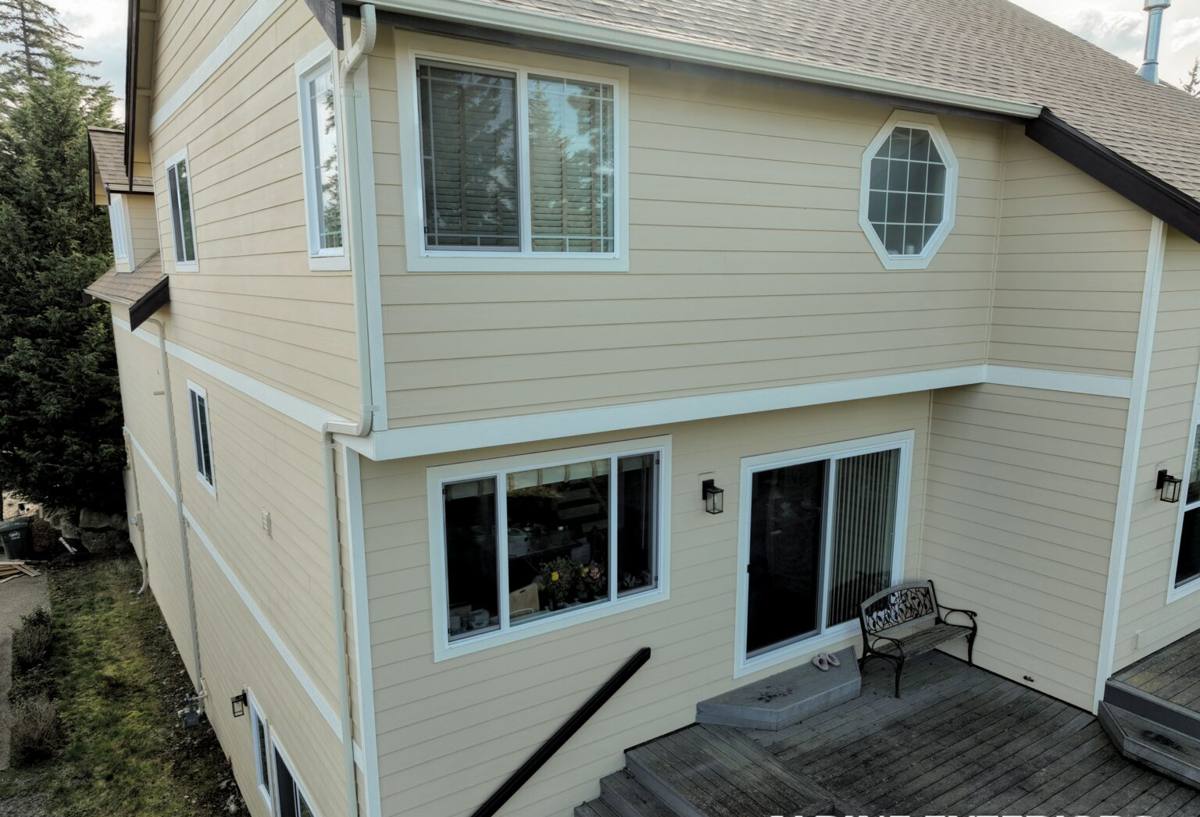
What James Hardie Is Built to Handle
James Hardie siding is fiber cement — a mix of cement, sand, and cellulose fibers engineered to resist moisture absorption, hold paint, and stay dimensionally stable through wet-dry cycles. For a climate like ours, that stability is the whole point. Wood-based products expand and contract with moisture; fiber cement doesn't move the way wood does, which means fewer cracked joints and less paint failure over time.
HZ5 Engineering for This Region
James Hardie makes climate-specific product lines under its HZ (HardieZone) system, engineered for different combinations of moisture, freeze-thaw, and UV exposure across the country. Western Washington falls into a wet, moderate-temperature zone, and the HZ5 formulation is built around exactly that combination — resisting moisture intrusion and moss/mildew growth better than a one-size-fits-all product would.
ColorPlus Factory Finish
A lot of long-term siding failure in this climate starts with the paint, not the substrate. Field-applied paint has to bond and cure in whatever weather shows up that week, and it's the first thing to give out under years of rain and UV. James Hardie's ColorPlus finish is baked on in a controlled factory environment before the boards ever reach the jobsite, which gives a harder, more consistent finish with a much longer color life than a job-site paint job.
What a Correct Installation Actually Involves
Fiber cement is only as good as the installation behind it. Most of the siding problems we get called out to inspect on older homes trace back to installation shortcuts, not the material itself. A correct Hardie install includes:
- Proper weather-resistive barrier (house wrap) installed and lapped correctly before any siding goes up
- Flashing at every window, door, and roofline intersection — not caulk used as a substitute for flashing
- Correct fastener type, spacing, and penetration depth per James Hardie's published installation guide
- Minimum clearance between siding and grade, decks, patios, and roofing to keep the bottom edge out of standing water
- Proper gapping at butt joints and trim, sealed with the right sealant — not everything caulked solid
- Panels primed and painted on cut edges before installation, since factory finish doesn't cover a field cut
Skipping any one of these doesn't usually show up right away. It shows up in year three or four, as trapped moisture works on the sheathing behind the siding — which is a far more expensive repair than doing the flashing right the first time.
Our Process on a Renton Job
1. Assessment and Tear-Off
We start by walking the home and removing the existing siding to inspect the sheathing underneath. This is the step that tells us whether there's hidden moisture damage from years of the old material not keeping water out — something you often can't know until the walls are open.
2. Repair and Weather Barrier
Any compromised sheathing gets repaired before anything else happens. Then we install a new weather-resistive barrier and flash every penetration — windows, doors, hose bibs, light fixtures, roof-to-wall intersections — before a single piece of siding goes up.
3. Installation to James Hardie Spec
Siding, trim, and any accent details go up following James Hardie's installation requirements, not shortcuts. This is also what keeps the manufacturer's warranty intact — installations that skip steps can void the coverage a homeowner is paying for.
4. Final Detail and Walkthrough
Caulking, touch-up paint on cut edges, cleanup, and a final walkthrough so you know exactly what was done and what maintenance (if any) to expect going forward.
Why a Crew That Already Works Renton Matters
Siding work in this part of King County isn't the same as siding work in a dry climate, and it isn't identical from one neighborhood to the next either. A crew that regularly works in and around Renton already knows what moisture patterns to expect based on a home's exposure, roofline, and lot drainage. They know how the local building department wants flashing and clearances documented, what permits apply, and how to sequence a tear-off around our rain patterns so sheathing isn't left exposed longer than it has to be. That local repetition is worth more than it sounds — it's the difference between a crew guessing at best practices and one that's already solved these problems on houses like yours.
James Hardie vs. Other Common Siding Choices
We get asked why we don't offer vinyl, LP SmartSide, or cedar as options. Here's the honest comparison, focused on how each performs in a wet Pacific Northwest climate over the long run:
| Material | Moisture Behavior Here | Long-Term Maintenance | Why We Don't Install It |
|---|---|---|---|
| Vinyl | Doesn't rot, but seams and edges can allow water behind the panel with nowhere to dry out | Low, but can crack, fade, and warp; hard to repair invisibly | Doesn't offer the fire resistance or factory-finish durability of fiber cement |
| LP SmartSide (engineered wood) | Wood-based; more sensitive to prolonged moisture exposure than fiber cement | Depends on caulking and paint staying intact; edge sealing is critical | Moisture sensitivity is a bigger risk in a climate with our rain totals |
| Cedar / primed spruce | Natural wood movement; absorbs moisture at end grain and cut edges | Highest — regular refinishing, caulk checks, moss/mildew treatment | Ongoing upkeep burden is significant for the average homeowner |
| James Hardie fiber cement | Dimensionally stable; engineered HZ5 formulation for wet climates | Low — factory finish holds color, occasional wash-down | This is what we install |
None of these are bad products in every setting — vinyl and engineered wood both have their place. But for a climate that stays wet for months at a time, fiber cement's stability and factory finish are what hold up with the least ongoing maintenance, which is why it's the only siding we put on homes.
What Renton Homeowners Should Expect to Pay
Every home is different, so a real number requires a walk-through, but the factors that move the price are consistent:
| Cost Factor | Why It Matters |
|---|---|
| Home size and wall complexity | More corners, dormers, and trim detail mean more labor and cut waste |
| Condition of existing sheathing | Hidden rot found during tear-off adds repair scope before siding goes on |
| Siding profile chosen | Lap width, shingle-style panels, and board-and-batten all price differently |
| Trim and accent work | Window trim, fascia, and any architectural detailing adds material and labor |
| Site access | Tight lots, second stories, and landscaping obstacles affect scaffolding and staging |
Signs Your Renton Home May Need New Siding Soon
A few things worth watching for, especially heading into another wet season:
- Visible moss or dark streaking that keeps coming back after cleaning
- Paint that's peeling, bubbling, or chalking faster than it used to
- Soft spots when you press on siding near the bottom edge or under windows
- Warping, cupping, or visible gaps opening up at seams and corners
- Rising heating bills that could point to compromised insulation behind failing siding
Catching these early usually means a straightforward siding replacement. Waiting on them usually means sheathing and framing repairs get added to the job.
If you're weighing your options for a Renton home, we're happy to take a look and give you a straight, no-pressure estimate — what condition your current siding is really in, what a correct James Hardie installation would involve for your house specifically, and what it would cost. Fill out the form below to get started.