 Seattle Siding
 Roof Repair Built Around How Renton Roofs Actually Fail
Renton sits in that stretch of King County where roofs don't fail from one dramatic event — they fail slowly, from months of low gray skies, saturated air, and shade thrown by mature evergreens. A roof here rarely just "springs a leak." More often, a small weak point sits unaddressed through a few wet seasons until it finally shows up as a stain on a ceiling. Our job on a repair call is to find that weak point, understand why it happened in this specific spot on this specific roof, and fix it in a way that holds up through the next round of Pacific storms — not just patch what's visible and move on.
We work roofs across the greater Seattle area, and Renton's mix of housing stock — postwar ranches, split-levels from the 1960s and 70s, and newer builds tucked into hillside lots — gives us a wide range of roof problems to compare against. That range matters. A repair crew that only sees a handful of roofs a year is guessing. A crew that sees this climate do its work on dozens of roofs a season is diagnosing.
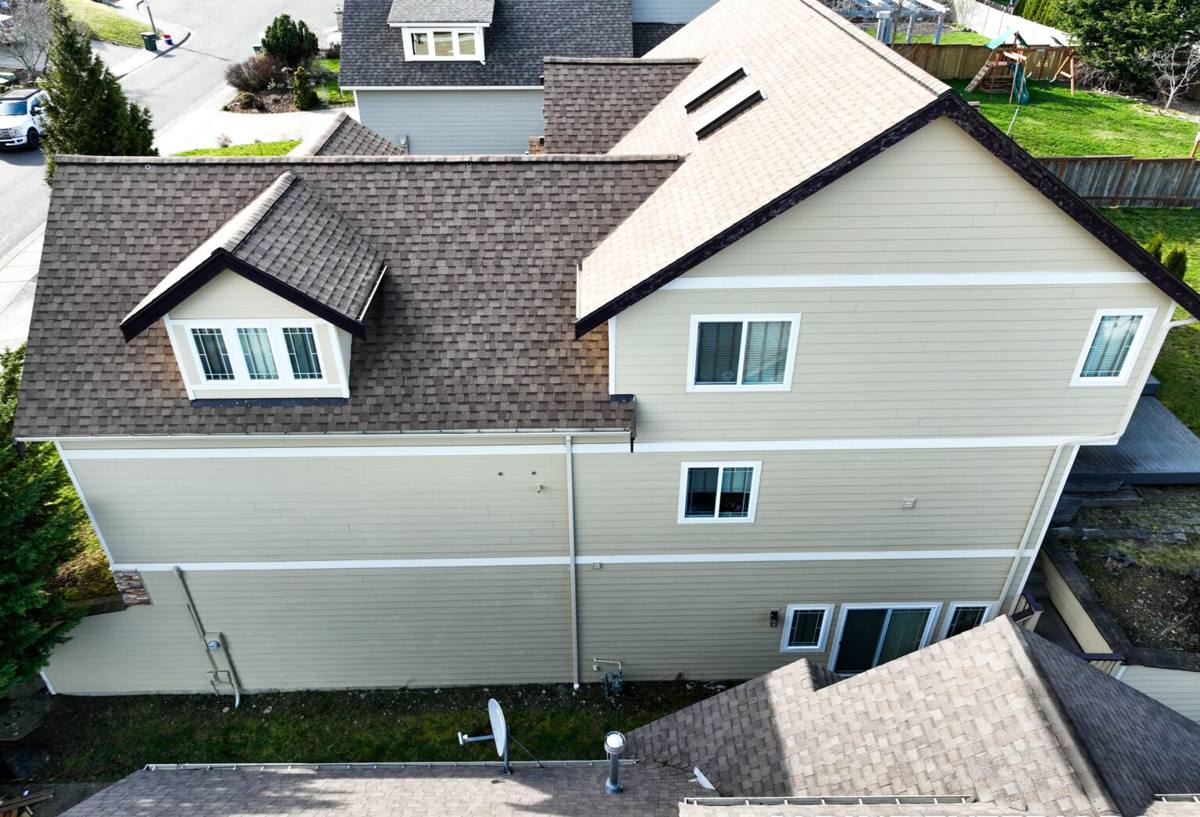
What King County's Climate Does to a Roof Over Time
The driving rain that moves through in fall and winter doesn't just fall straight down — wind pushes it sideways, up under shingle edges and around flashing that was installed a little too casually the first time. Add in the long stretch of overcast, humid months, and you get conditions that favor moss and algae far more than direct sun and heat do. A roof section shaded by trees or facing north can carry moss while the rest of the same roof looks fine.
Moss isn't just cosmetic. As it spreads, it holds moisture against the roofing material, lifts shingle edges as it grows, and channels water in directions the roof wasn't designed to shed it. Over a few seasons, that's enough to turn a healthy roof into one with soft spots, granule loss, and slow leaks at the edges. The broader marine air that moves in off Puget Sound adds to this — it keeps roofing materials damp longer after every rain, which is exactly the environment moss, lichen, and wood rot prefer.
Where We See the Most Repair Calls
- Valleys and low-slope sections where moss and debris collect and slow water down
- Flashing around chimneys, skylights, and roof-to-wall transitions
- Shaded north- and east-facing slopes with heavier moss growth
- Eaves and gutters clogged with needles, holding water against the roof edge
- Older penetrations (vents, old satellite mounts) with dried-out or cracked sealant
What a Correct Roof Repair Actually Involves
A repair done right starts with figuring out the actual source of the problem, not just the point where water is showing up inside the house. Water travels — a stain on a bedroom ceiling can trace back to a flashing gap several feet away. Skipping that step is the single biggest reason repairs fail to hold: the visible symptom gets patched, and the real entry point keeps leaking until it causes damage somewhere else.
Once we know the source, the repair itself needs to match how the rest of the roof is built — same general shingle profile and exposure, flashing tied in correctly with the existing roofing (not just caulked over it), and underlayment restored wherever it was disturbed. A repair that doesn't integrate cleanly with the surrounding roof just creates a second weak point next to the first.
Steps We Take On Every Repair
- Interior and attic inspection to trace the leak path, not just the stain
- Full roof-surface walk to check for related wear nearby (moss, granule loss, lifted edges)
- Removal of damaged material back to sound decking
- Decking repair or replacement if wood has softened or rotted
- New underlayment and flashing tied into the existing roof system
- Matching roofing material installed and sealed to manufacturer spec
- Gutter and debris check nearby, since clogged drainage is often part of the original cause
Repair or Replace: How We Help Renton Homeowners Decide
Not every roof problem needs a full replacement, and not every roof problem should be patched forever either. The right call depends on the age of the roof, how much of it is affected, and whether the damage is isolated or spread across multiple sections. We walk homeowners through this honestly rather than defaulting to whichever answer is more profitable for us.
| Factor | Leans Toward Repair | Leans Toward Replacement |
|---|---|---|
| Roof age | Under 12–15 years, otherwise sound | Nearing or past expected lifespan |
| Extent of damage | Localized to one section or penetration | Spread across multiple slopes |
| Moss/algae condition | Light growth, surface-level | Heavy, long-term growth affecting granules broadly |
| Decking condition | Solid, dry, no soft spots found | Widespread soft spots or rot |
| Recent repair history | First or second repair on this roof | Repeated patch jobs in the same areas |
When a roof falls in the middle of that table, we say so plainly and lay out both options with real trade-offs — including what a repair now might mean for timeline to eventual replacement — rather than pushing toward the bigger job.
Materials and Methods We Use for Repairs
For most Renton homes, that means matching the existing asphalt composition shingle as closely as possible, since that's still the dominant roofing material in this part of King County. We also handle repairs on cedar shake, metal, and low-slope/flat sections common on additions and garages, where the failure points and correct materials differ from a standard pitched shingle roof.
We don't rely on surface sealants or roof cement as a stand-in for proper flashing work. Caulk and tar-based patches can look like a fix on day one, but they degrade under UV and repeated wet-dry cycles faster than a properly integrated flashing repair, and they tend to trap moisture rather than shed it — which works against the roof rather than for it. Our standard is to reconstruct the flashing and shingle layering correctly, even when it takes longer than a surface patch.
Signs a Renton Roof Needs Repair Now
Most homeowners don't get on their roof regularly, which is reasonable — it's not a place people want to be. But a few signs are visible from the ground or from inside the attic, and catching them early is usually the difference between a modest repair and a much larger one.
- Dark streaks or green/black patches on the roof surface (algae or moss)
- Granules collecting in gutters or at downspout outlets
- Any ceiling stain, even a small one that seems to have stopped growing
- Daylight visible through the roof deck from inside the attic
- Shingles that look curled, cracked, or lifted at the edges
- Soft or spongy feel when walking near a roof edge or valley (approach with caution, or let us check it)
- Visible gaps or rust at flashing around chimneys, vents, or skylights
Why It Matters That We Already Work in Renton
A repair crew that's unfamiliar with an area is working from general roofing knowledge. A crew that regularly works Renton and the surrounding Seattle communities knows which roof styles and ages are common on which streets, how tree cover in a given neighborhood tends to load a roof with moss and debris, and which older repair habits (from past owners or past contractors) tend to cause the next round of problems. That local pattern recognition speeds up diagnosis and helps us set realistic expectations from the first visit — including for permitting and code details specific to King County jurisdictions, when a repair is significant enough to require them.
It also means we're not guessing at material availability or matching shingle profiles from scratch — we know what's already on most roofs in this area and what will blend in rather than standing out as an obvious patch.
What to Expect From Our Renton Roof Repair Process
We start with a straightforward inspection and a plain explanation of what we found — where the water is getting in, why, and what it will take to fix it correctly. If a repair is the right call, we'll say so. If the roof is far enough along that repair is just delaying a bigger cost, we'll say that too, and explain the reasoning rather than just stating a conclusion. Either way, you get a clear scope of work and a written estimate before anything happens, with no pressure to decide on the spot.
During the repair itself, we protect the areas around the work zone, clean up debris and old material as we go, and don't consider the job finished until the repaired section performs the same as the surrounding roof in the next rain, not just looks the part.
If you're seeing a stain, missing granules, or moss creeping across a slope of your Renton roof, it's worth getting an honest opinion before the next wet season adds to the problem. We offer free, no-pressure estimates — use the form below to get a time on the calendar.