 Seattle Siding
 Siding Installation in Renton: What Local Homes Actually Need
Renton sits at the south end of Lake Washington, close enough to Puget Sound that the region's marine climate reaches every neighborhood here — even blocks that never see the water. That means siding on a Renton home is doing real work year-round: shedding driving rain off the Sound and the lake, resisting the moisture that feeds a long moss and algae season, and holding up through the freeze-thaw swings that show up most winters. A siding installation here isn't just a cosmetic upgrade. It's the single biggest factor in whether the wall behind it stays dry for the next 30 years or starts rotting from the inside without anyone noticing until the damage is expensive.
We install siding in Renton the way we install it everywhere in the greater Seattle area: one product, done to spec, with the water management details that this climate actually requires. This page walks through what that looks like on a real project.
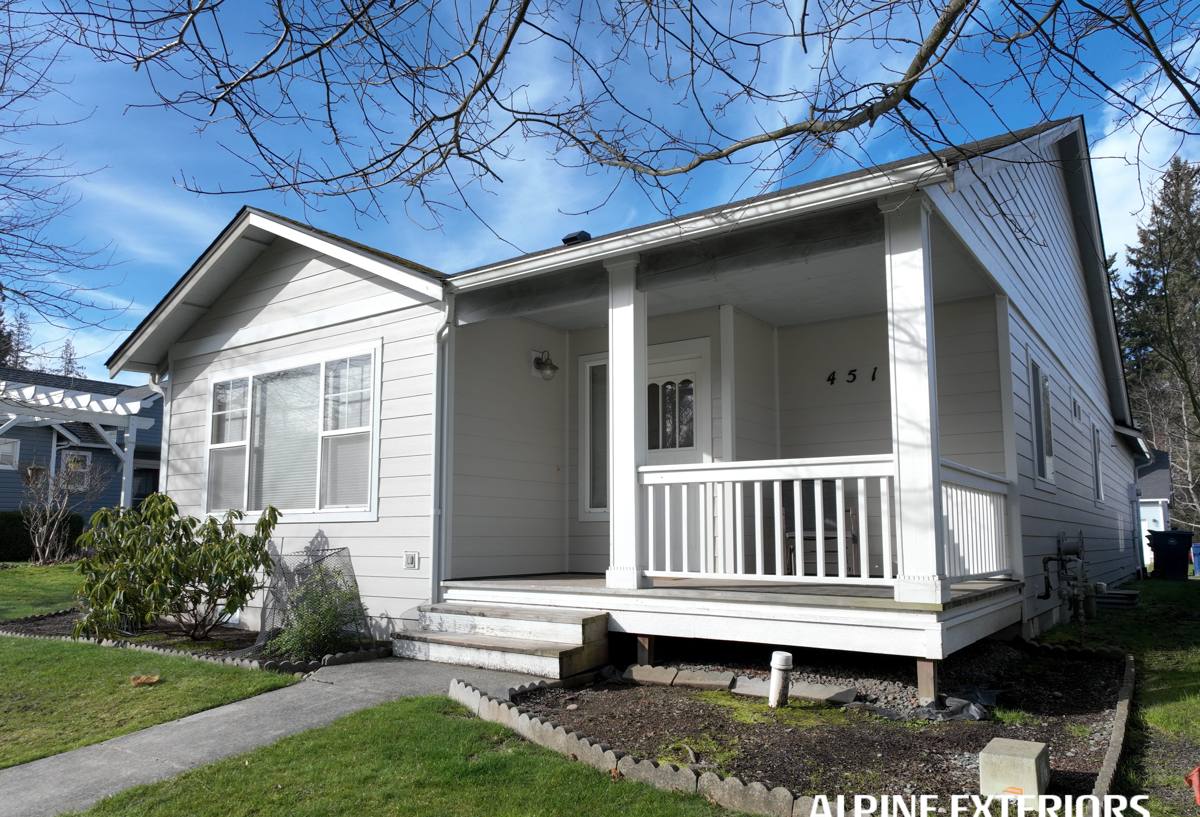
Renton's Climate and What It Does to Siding
King County's marine climate is mild on paper — no extreme heat, no brutal cold — but "mild and wet, constantly" is its own kind of hard on a building envelope. A few specifics that matter directly to siding performance:
- Driving rain: Storms off Puget Sound often come with enough wind to push water sideways into seams, laps, and trim joints, not just straight down a wall face.
- Salt-influenced marine air: Renton is inland from the Sound, but the broader region's air carries enough salt and moisture to accelerate corrosion on fasteners, flashing, and any metal component that isn't rated for it.
- Extended moss and mildew season: Shaded, north-facing, and tree-lined walls — common on Renton's older, more established lots — stay damp for months at a stretch, which is exactly what moss and mildew need to take hold.
- Freeze-thaw cycling: Not extreme here, but frequent enough each winter to widen any crack in a product that isn't dimensionally stable, turning a hairline gap into a water path within a season or two.
None of this makes Renton unusual — it's the same pattern across the Puget Sound lowlands. But it does mean the margin for error in the siding material and the installation is smaller than it looks. A product or a nail pattern that would be fine in a dry climate can fail here in a fraction of the time.
Why We Install Only James Hardie Fiber Cement
We standardized on James Hardie fiber cement siding for every home we work on, including in Renton, and we don't install vinyl, LP SmartSide, or other engineered wood or fiber cement alternatives. That's not a marketing position — it's a decision based on how those products actually perform against a climate like this one:
- Fiber cement doesn't feed moss or fungus. It's cement, sand, and cellulose fiber — there's no organic wood substrate for mildew to break down over time, unlike engineered wood siding.
- It's dimensionally stable. Hardie boards don't swell and shrink with moisture the way wood-based products can, which matters directly for freeze-thaw resilience and long-term caulk-joint integrity.
- It's non-combustible. Not a Puget Sound wildfire concern specifically, but it's a real, permanent advantage of the material itself.
- The factory finish holds up. James Hardie's ColorPlus finish is baked on in a controlled environment, not sprayed or brushed on site, so it resists fading and chipping far better than field-applied paint.
Vinyl siding has its own honest trade-offs worth naming plainly: it can warp in temperature swings, its seams are a known water-entry point, and it's not repairable in the way fiber cement is — a damaged panel usually means a full panel replacement, and matching decades-old vinyl color is rarely possible. LP SmartSide and similar engineered wood products perform well in many climates, but they still rely on a wood-strand substrate with an engineered resin coating, and that substrate is more sensitive to sustained moisture exposure than cement-based fiber. In a climate that gives siding wet weather for a large share of the year, we'd rather put a non-combustible, moisture-stable material on a Renton home than manage those trade-offs after the fact.
What a Correct Siding Installation Actually Involves
The product only performs as well as the installation behind it. A huge share of siding failures we see on older homes weren't caused by bad siding — they were caused by skipped steps underneath it. A correct James Hardie installation includes:
Water Management Behind the Siding
A weather-resistive barrier (house wrap) goes over the sheathing first, lapped correctly from bottom to top so water always drains outward and down, never into a seam. Every window, door, and penetration gets proper flashing integrated into that barrier — not caulked over as an afterthought.
Correct Clearances
James Hardie specifies minimum clearances between the bottom edge of the siding and roof lines, decks, patios, and grade. Skipping these clearances is one of the most common corner-cutting mistakes we see, and it's exactly what lets standing water wick into the bottom of a wall.
Fastening to Spec
Fasteners need to be corrosion-resistant (stainless or hot-dip galvanized, appropriate for our marine air) and driven at the manufacturer's specified pattern and depth — not overdriven, not underdriven, and into framing, not just sheathing.
Joint and Seam Treatment
Butt joints, corners, and trim intersections get treated per Hardie's fastening and sealing specifications, using compatible sealants that stay flexible through our freeze-thaw cycles instead of cracking.
Every one of these is invisible once the job is finished — which is exactly why it matters who's doing the work. A rushed installation can look identical to a correct one on the day it's finished and still fail in five years.
Our Installation Process
- On-site assessment: We look at the existing siding, sheathing condition, and any moisture damage before quoting anything, so the estimate reflects your home's actual wall condition, not a guess.
- Tear-off and sheathing inspection: Removing the old siding is also when we find out if there's hidden rot or water damage — this gets addressed before anything new goes on, not covered up.
- Weather barrier and flashing installation: House wrap, window and door flashing, and penetration sealing go in correctly, matched to how water actually moves down a wall in this climate.
- Hardie board installation: Panels or planks go up to manufacturer spec — clearances, fastener pattern, and joint treatment included, not shortcuts.
- Trim, caulking, and finish detail: Corners, trim boards, and touch-up painting at cut edges are finished so the ColorPlus factory finish reads as a continuous, uniform surface.
- Final walkthrough: We go over the finished work with you before calling the job done.
James Hardie Product Lines: Choosing the Right Fit
James Hardie makes several siding profiles, and the right one for a given Renton home depends on the architecture, the exposure, and personal preference. Here's how the main options compare:
| Product | Look | Best For |
|---|---|---|
| HardiePlank lap siding | Traditional horizontal lap, wood-grain or smooth | Most Renton homes — classic Northwest look, widest color range |
| HardiePanel vertical siding | Vertical panels, often board-and-batten | Modern builds, accent walls, gable ends |
| HardieShingle | Staggered or straight-edge shingle profile | Craftsman-style homes, accent sections |
| HardieTrim | Smooth or textured trim boards | Window and door surrounds, corners, fascia |
All of these are available in James Hardie's HZ5 product engineering, which is formulated for climates that see freeze-thaw cycling and sustained moisture — a good match for King County's weather pattern.
What Drives the Cost of a Siding Job in Renton
Every home is different, so we won't quote a number without seeing the house, but the real cost drivers on most Renton projects are consistent:
| Factor | Why It Matters |
|---|---|
| House size and wall complexity | More square footage and more corners, gables, and dormers mean more cutting, fitting, and labor time |
| Condition of the sheathing underneath | Rot or water damage found during tear-off adds repair work before new siding can go on |
| Product profile chosen | Lap, panel, and shingle profiles differ in material and labor time |
| Trim and detail work | Homes with extensive trim, window surrounds, and architectural detail take more finish labor |
| Access and site conditions | Tight lots, mature landscaping, or multi-story sections affect staging and time on site |
Signs Your Renton Home May Need New Siding
Some warning signs are obvious; others hide until they're serious. Worth checking for:
- Visible moss, algae, or persistent green or black staining that keeps returning after cleaning
- Soft or spongy spots when you press on the siding, especially near the bottom courses
- Paint that's bubbling, peeling, or failing faster than it should
- Warping, buckling, or gaps opening up at seams and corners
- Rising energy bills that suggest air and moisture are getting past the wall assembly
- Visible rot or damage around window and door trim
If any of these look familiar, it's worth having someone look at the wall assembly itself, not just the surface — by the time siding looks bad, the sheathing underneath has often been wet for a while.
Why Hiring a Crew That Already Works in Renton Matters
Siding installation isn't a one-size-fits-all trade, and a crew that already works throughout Renton and the rest of King County brings something a traveling or out-of-area crew doesn't: familiarity with how local homes are actually built and how the local climate has already treated them. That includes knowing which older Renton neighborhoods tend to have moisture issues behind original siding, understanding how shaded, tree-covered lots need extra attention to moss-prone areas, and being available for warranty follow-up without a long drive. It also means we're accountable locally — reputation in a community you keep working in is worth more than a one-time job somewhere far away.
Caring for Your Siding After Installation
James Hardie fiber cement is low-maintenance compared to wood or vinyl, but "low-maintenance" isn't "no-maintenance" in this climate. A simple annual routine keeps it performing:
- Rinse the exterior once a year to clear pollen, dust, and early moss growth before it establishes
- Keep gutters clean so overflow doesn't run down the siding face repeatedly
- Trim back vegetation and tree branches that keep a wall section shaded and damp
- Watch caulked joints and trim intersections for cracking and have them resealed if you see gaps
- Address any impact damage promptly rather than letting a chip sit exposed
If your Renton home needs new siding — or you're not sure whether it does — we're happy to take a look and walk you through what we see, with no pressure to sign anything. Use the form below to request a free estimate.