 Seattle Siding
 Siding Repair in Redmond: What Local Homes Are Actually Fighting
Redmond sits in that stretch of King County where Pacific storm systems dump steady rain for months at a time, humidity stays high even between storms, and tree cover keeps a lot of yards and rooflines shaded well into the afternoon. That combination is exactly what breaks siding down over time. It isn't one big storm that causes most of the damage we see on repair calls — it's years of moisture sitting against a wall that can't dry out fast enough, plus moss and organic growth finding a foothold in every shaded, damp corner.
When we talk about "siding repair" in Redmond specifically, we're talking about diagnosing and fixing damage caused by a very particular climate pattern: driving rain that gets pushed sideways into wall assemblies during windstorms, salt-tinged marine air drifting in from Puget Sound that accelerates corrosion on fasteners and trim, and a moss season that can run eight or nine months out of the year on north-facing and tree-shaded walls. A repair that doesn't account for all three of those factors tends to fail again within a couple of years.
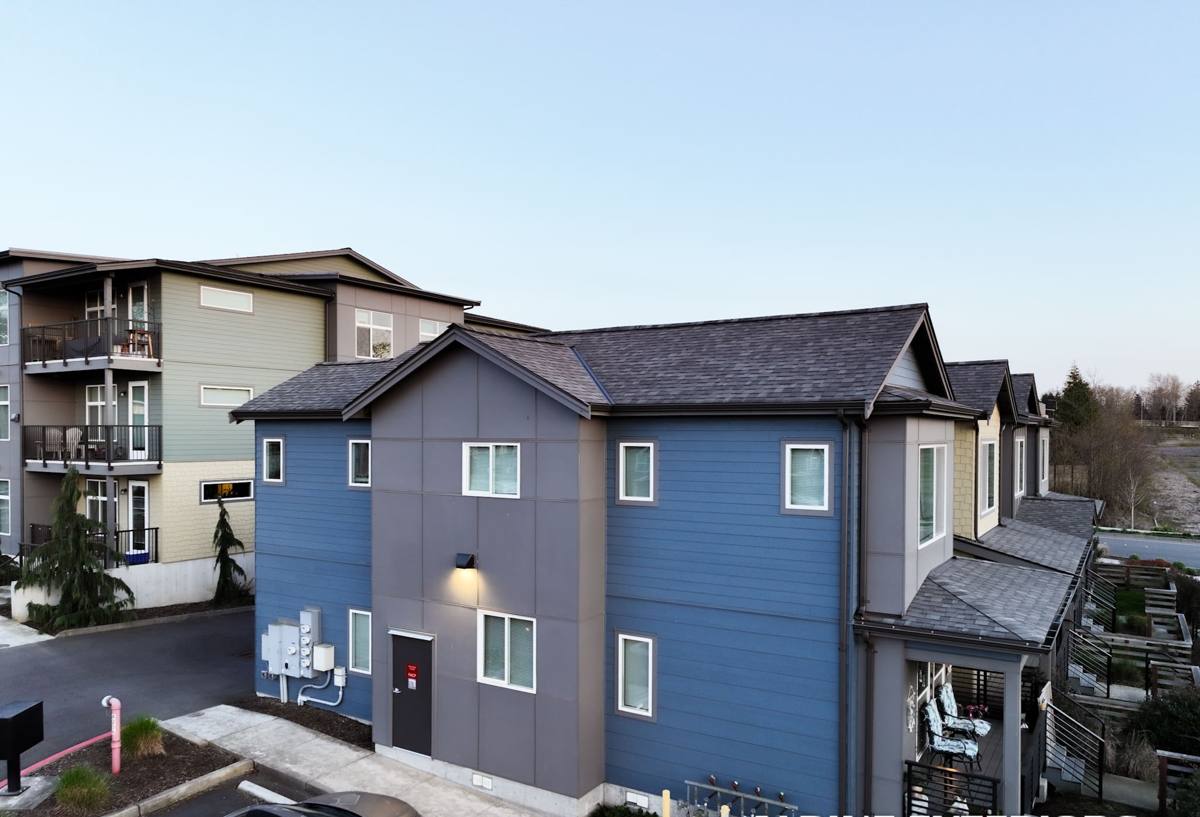
The Damage Patterns We See Most in Redmond
Moisture Intrusion Behind the Cladding
This is the big one. Water finds its way behind siding through failed caulk joints, gaps around windows and doors, or siding that was never properly flashed at the top. Once it's behind the cladding, it doesn't evaporate quickly in our climate — it sits against the sheathing and framing, and that's when you start seeing soft spots, staining, or a slight give when you press on a wall.
Moss and Organic Growth
Moss doesn't just look bad. It holds moisture directly against the siding surface, keeps that surface wet far longer than it would otherwise be, and its root structure can work into seams and butt joints, prying them open over time. Homes with mature trees, north-facing walls, or anything close to a fence line tend to get hit hardest.
Fastener and Trim Corrosion
Redmond isn't right on saltwater, but it's close enough that airborne salt combined with constant humidity speeds up corrosion on lower-grade fasteners and metal trim. Rust streaks running down from a nail head or a corner post are a reliable sign that the original installation used the wrong hardware for this climate.
Impact and Settling Damage
Cracked boards from tree limb strikes, lawn equipment, or ladder contact are common and usually straightforward to repair — as long as the replacement material and finish match what's already on the wall.
What a Correct Repair Actually Involves
A lot of "siding repair" in this region is really just cosmetic patching — caulk over a crack, a quick paint touch-up — and it doesn't last because it never addresses what let the damage happen in the first place. Here's what we consider a repair done right:
- Remove the damaged section, not just the visible crack. Damage often extends further than what's visible from outside, especially with moisture-related soft spots.
- Inspect what's behind it. Check the water-resistive barrier, flashing, and sheathing for hidden rot or mold before anything goes back on the wall.
- Fix the underlying cause. If a failed flashing detail or bad caulk joint let water in, that gets corrected — otherwise the same spot fails again in a year or two.
- Match the material and finish. Replacement boards need to match the existing siding's profile, exposure, and color as closely as possible so the repair doesn't stand out.
- Re-seal and re-flash correctly. Proper lap sequencing and sealant placement matter more here than in drier climates, because any gap becomes a moisture entry point during the wet season.
Repair vs. Replacement: How We Help You Decide
Not every damaged section needs a full re-side, but not every repair is worth doing either. We walk Redmond homeowners through this honestly rather than defaulting to the bigger job.
| Situation | Usually Repair | Usually Replace |
|---|---|---|
| Damage limited to one or two boards, rest of siding sound | Yes | No |
| Moisture damage found in multiple areas around the house | No | Yes |
| Siding is near end of expected service life | No | Yes |
| Cracking from a one-time impact | Yes | No |
| Underlying sheathing shows rot in more than a small area | No | Yes |
| Existing material can no longer be matched (discontinued color/profile) | Sometimes | Often |
We'll tell you flat out if a repair is throwing good money after bad on siding that's failing broadly. That's a harder short-term conversation, but it saves homeowners from paying for patches that don't hold up through another wet season.
Signs You Should Get a Repair Looked At Now
- Soft or spongy spots when you press on the siding, especially near the bottom of walls or under windows
- Visible moss or dark green/black streaking on shaded or north-facing walls
- Rust stains bleeding down from fasteners or trim
- Cracked, warped, or bowed boards
- Peeling or bubbling paint concentrated in one area rather than spread evenly
- Gaps opening up at butt joints, corners, or around window and door trim
- A musty smell near an exterior wall from inside the house
Why We Only Use James Hardie Fiber Cement for Repairs
When a repair calls for replacement boards, the material we bring matters as much as the workmanship. We standardized on James Hardie fiber cement across every job we do, including repairs, for reasons that are specific to this climate:
- Non-combustible core — fiber cement doesn't feed a fire the way wood-based products can, which matters as wildfire smoke and dry-season risk have become more of a regional concern even here in the wetter part of the state.
- Engineered for moisture, not just painted over it. Hardie's HZ5 product line is formulated specifically for the Pacific Northwest's wet climate, which is exactly the pressure Redmond siding is under most of the year.
- Factory-applied ColorPlus finish resists the fading, peeling, and moss-friendly surface texture that field-applied paint develops faster under constant damp conditions.
- Dimensionally stable — it doesn't swell, warp, or cup the way wood-based sidings can when it takes on moisture, which is a major reason for repeat repair calls on other materials.
We don't install LP SmartSide, vinyl, cemplank, Allura, primed spruce, or cedar, and when a repair job means patching into one of those materials, we'll say so honestly — sometimes that means matching what's there, and sometimes it means recommending a broader look at replacing the affected section with Hardie instead. We won't pretend a mismatched patch is a permanent fix when it isn't.
Our Repair Process for Redmond Homes
- On-site inspection. We look at the visible damage and check surrounding areas, trim, flashing, and any signs of moisture that might not be obvious from the ground.
- Honest diagnosis. We tell you what's actually causing the damage, not just what's visible, and give you a straight repair-vs-replace recommendation.
- Clear scope and pricing. You know what's being done and why before work starts.
- Careful removal. We open up the affected area enough to confirm the sheathing and barrier underneath are sound — or address them if they're not.
- Correct reinstallation. Proper flashing, fastener placement, and sealant detailing suited to a high-moisture climate, not just a quick patch.
- Match and finish. We do our best to match existing Hardie coloring and profile; where an exact match isn't possible, we'll tell you upfront.
Why Hiring a Crew That Already Works Redmond Matters
Siding repair looks like a simple trade until you're the homeowner whose "fixed" wall is soft again eighteen months later. A crew that regularly works in Redmond and the surrounding King County area already knows which wall orientations take the worst weathering, how aggressive moss growth gets under the tree cover common in this area, and what installation shortcuts don't hold up once the rainy season sets in. That local pattern recognition is the difference between a repair that lasts and one that's a temporary cover-up.
It also means faster, more accurate estimates — we're not guessing at how this climate behaves, we're accounting for it from the first inspection.
Get an Honest Look at Your Siding
If you're seeing soft spots, moss buildup, cracked boards, or rust streaking on your Redmond home, it's worth getting it looked at before another wet season adds to the damage. We'll give you a straight assessment of what's actually going on and what it will take to fix it right — no pressure, no upsell. Fill out the form below for a free estimate.