 Seattle Siding
 Why Kirkland Roofs Wear Out Differently Than Roofs Inland
Kirkland sits inside the Puget Sound marine climate, and that climate is hard on roofs in ways that don't show up in drier parts of the country. The air here carries a near-constant load of moisture, there's a long stretch of low-angle winter sun that never quite dries out shaded north- and west-facing slopes, and the salt-tinged air that moves inland off Puget Sound accelerates corrosion on fasteners, flashing, and metal roofing components. Add driving rain that comes in sideways during winter storms, and you have a roof system that's being tested from multiple directions at once — not just from above.
The result is a roofing season that's less about heat damage and more about slow, cumulative water and organic-growth damage. Shingles here fail less often from UV breakdown and more often from moss undermining the granule layer, trapped moisture rotting decking from underneath, and flashing that corrodes or works loose faster than manufacturers' national averages assume. A roof replacement done for King County has to account for all of that, not just meet a generic building-code minimum.
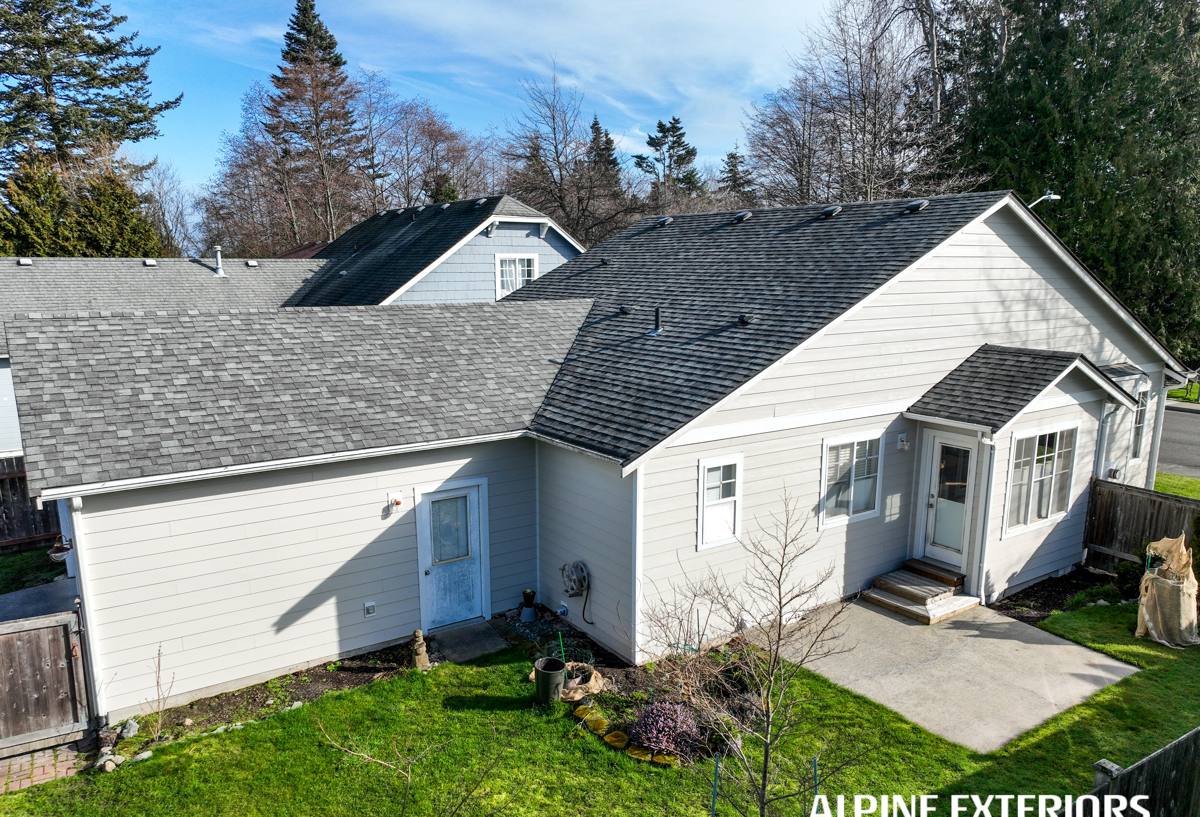
Signs a Kirkland Roof Has Reached the End of Its Service Life
Roofs rarely fail all at once — they give warning signs first. If you're seeing more than one or two of the following, it's worth having the roof looked at before it becomes a repair emergency:
- Shingles that are cupping, curling at the edges, or missing granules in the gutters
- Dark streaking or thick moss growth, especially on north-facing slopes that stay shaded and damp
- Soft spots or noticeable sag when walking the roof or viewing it from a ladder
- Daylight visible through the attic decking, or damp insulation after a storm
- Flashing around chimneys, skylights, and vent pipes that's rusted, lifted, or caulked over repeatedly as a patch
- Interior ceiling stains, especially near exterior walls or below valleys
- A roof that's 20+ years old and has never had a full tear-off, only layer-over repairs
Any one of these on its own might just mean a repair. Several together usually mean the underlying materials — decking, underlayment, or the shingles themselves — have absorbed more moisture cycling than they can handle, and patching will keep costing more than it saves.
What a Correct Roof Replacement Actually Involves
A roof replacement is more than swapping old shingles for new ones. In a climate like ours, the parts you don't see matter as much as the parts you do.
Tear-Off and Decking Inspection
We remove the existing roofing down to the deck rather than layering over it. That's the only way to actually see what's underneath — soft or delaminated plywood, rot around old fastener holes, or hidden damage from a prior leak. Any compromised decking gets replaced before anything new goes down; installing a new roof over bad decking just hides the problem for a few more years.
Moisture Barrier and Underlayment
Given how much of our weather arrives as sustained, wind-driven rain rather than short downpours, underlayment choice matters more here than in drier climates. Self-adhered ice-and-water membrane at eaves, valleys, and penetrations — combined with a synthetic underlayment across the rest of the field — gives a second line of defense if wind-driven rain gets under a shingle tab, which does happen during winter storms off the Sound.
Ventilation
A roof that can't breathe traps moisture in the attic, which shows up later as rot, mold, or premature shingle failure from the underside. Balanced intake (at the eaves) and exhaust (at the ridge) ventilation is part of a correct install, not an optional add-on — it's often the difference between a roof that lasts its full rated life and one that fails from the inside out a decade early.
Flashing and Transitions
Chimneys, skylights, dormers, and roof-to-wall transitions are where most leaks actually start — not in the open field of shingles. Flashing needs to be replaced, not reused, and installed so water is directed out and away at every layer, not just caulked at the seams.
Roofing Material Comparison for the Pacific Northwest
Material choice affects how well a roof handles our specific combination of moss, moisture, and salt-influenced air. Here's how the common options compare for a home in the Kirkland area:
| Material | Moss/Moisture Resistance | Typical Lifespan Here | Maintenance Needs |
|---|---|---|---|
| Architectural asphalt shingle | Good, especially with algae-resistant granules | 20–30 years | Periodic moss removal, gutter checks |
| 3-tab asphalt shingle | Fair — wears faster in shaded, damp areas | 15–20 years | More frequent moss and granule-loss monitoring |
| Standing seam metal | Excellent — moss struggles to gain a foothold | 40–50+ years | Low, but fasteners and coatings need periodic checks near salt air |
| Composite/synthetic shake | Good, resists moisture absorption well | 30–40 years | Low to moderate |
There's no single "best" material for every home — it depends on roof pitch, budget, how much shade the roof gets, and how the rest of the exterior is finished. What matters is choosing a material and installation method matched honestly to how it will actually perform in a shaded, wet King County lot, not just what looks good on a spec sheet.
Our Roof Replacement Process
- On-site inspection. We walk the roof and attic, check decking condition, ventilation, and flashing points, and take photos of anything you should know about before we quote anything.
- Written estimate. A clear breakdown of materials, scope, and price — no vague allowances that turn into surprise change orders later.
- Material selection. We walk through the tradeoffs between shingle grades, metal, or composite options based on your roof's exposure and your budget.
- Tear-off and deck repair. Full removal of old roofing, replacement of any damaged decking, and disposal — we don't layer over existing roofing.
- Underlayment, flashing, and ventilation install. The moisture-management layer goes in correctly before a single shingle is nailed down.
- Final install and cleanup. New roofing installed to manufacturer specification, site cleaned, and a final walkthrough so you know exactly what was done and where.
What Roof Replacement Costs Depend On
We don't publish flat prices because roof cost is genuinely driven by a handful of specific factors — but we can tell you honestly what moves the number up or down:
| Factor | Why It Matters |
|---|---|
| Roof size and pitch | Steeper roofs take longer to work safely and use more material per square foot of coverage |
| Decking condition | Rot or soft spots found during tear-off mean added repair before new roofing goes on |
| Number of penetrations | Every chimney, skylight, and vent pipe needs its own flashing detail — more penetrations, more labor |
| Material choice | Asphalt, metal, and composite carry different material and install costs and different lifespans |
| Access and layout | Multi-story homes, tight lots, or steep driveways affect staging and disposal logistics |
The only way to get an honest number is a real inspection — anyone quoting a firm price over the phone without seeing the roof is guessing, and that guess usually turns into a change order later.
Why Hire a Crew That Already Works in Kirkland
Roofing crews that only occasionally work in the greater Seattle area tend to under-spec for our conditions — using underlayment or ventilation strategies built for a drier climate because that's what they're used to installing elsewhere. A crew that regularly works King County roofs already knows which slopes hold moss longest, how much ice-and-water membrane a valley actually needs given our rain patterns, and which flashing details fail first when salt-influenced air and driving rain hit a roof year after year. That local pattern recognition shows up in fewer callbacks and a roof that's actually built for where it sits, not for a national average.
Roof and Siding Work Together as a System
As a siding contractor, we see roof problems show up on siding all the time — and vice versa. A roof with failing flashing at a wall transition doesn't just leak into the attic; it sends water down behind siding, where it can sit and rot sheathing for years before anyone notices. When we replace a roof, we check how it meets the siding at every transition point, because those junctions are common places for a "roof problem" and a "siding problem" to actually be the same water intrusion issue. Homeowners who replace a roof and siding as a coordinated project, rather than two disconnected jobs years apart, generally get better-sealed transitions and fewer hidden leak paths.
If your Kirkland roof is showing its age or you just want an honest opinion on how much life it has left, we're happy to take a look. Use the form below to request a free, no-pressure estimate — we'll walk the roof, tell you what we actually find, and give you a clear, written quote with no obligation.